
GRENOBLE, DIOCESE of. – City, capital of the Isère department, which is entirely included in the diocese itself, together with the canton of Villeurbaine in the Rhône department. It has an area of 8,200 sq. km., with a population of approximately 700,000 inhabitants, of whom approximately 400,000 are Catholics.
The diocese is divided into two archdeaconries; the first, of G., comprises the arrondissements of G. itself and of St-Marcellin, while the second, of Vienne, comprises the arrondissements of Vienne, La Tour-du-Pin, and the canton of Villeurbaine. There are also 47 deaneries with 598 parishes and 150 vicariates, served by 575 secular priests and 80 religious priests, with two seminaries, 13 male and 60 female religious communities (1949).
The city’s primitive name was “Cularo”; it was changed to “Gratianopolis” in the time of the Emperor Gratian (367–83), whence G. thereafter.
The first bishop of G. was St Donninus, present at the Council of Aquileia in 381; the list of the first thirty-seven bishops is attributed to Bishop St Hugo; the best known are “Ceretius,” commemorated on 6 June in the Hieronymian Martyrology and mentioned in the synodal letter of Eusebius of Milan to Leo I (PL 54, 887, 946); “Victurius,” present at the Council of Lyon in 518–23; Claro, who in-
The diocese is suffragan to Lyon; its patroness is the Blessed Virgin Mary assumed into heaven.
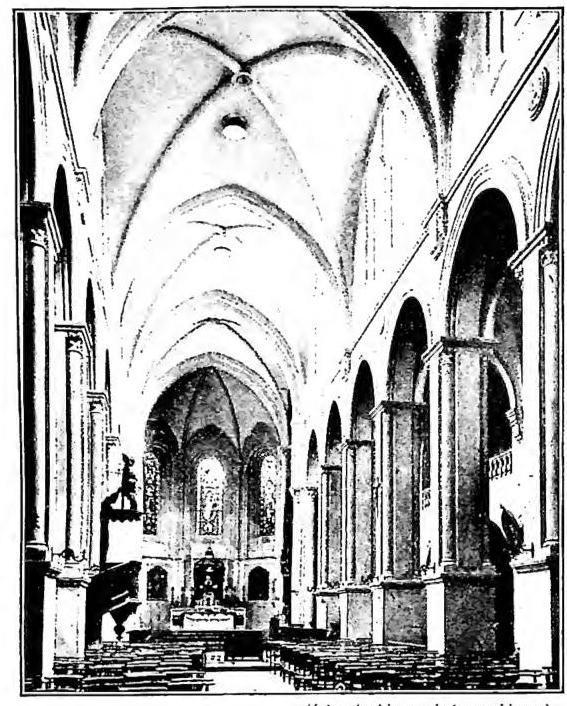
The Cathedral of Notre-Dame, built in the 11th century, was renovated several times; its marble high altar (16th century) comes from the Grande-Chartreuse.
Noteworthy is the church of St Lawrence, built in the 12th century over a Merovingian chapel that forms its crypt beneath the eastern part. The vault is supported by twenty columns of Roman provenance. The capitals, with their decorations of confronted animals and vine tendrils, recall, in their roughness, those of S. Vitale in Ravenna; the apse is framed by superimposed small columns (J. J. A. Pilot, Notice sur l'église de St-Laurent de G., Grenoble 1864; L. Maitre, L'oratoire mérovingien de St-Laurent de G., in Revue de l'art chrétien, 5th series, 3 (1907), pp. 217–25). During restoration work carried out in the crypt, Christian inscriptions came to light, one of them dated 520 (M. Raymond and Ch. Giraud, La chapelle St-Laurent à G., in Bulletin archéologique du Comité, 1893, p. 12). Other Christian inscriptions from G. are in CIL, 12, pp. 273–91, nos. 2309–14. St John Vianney was ordained a priest in G. Pietro Terrail, lord of Bayard, “the knight without stain and without fear,” was born near G. The last constable was Lesdiguières (1543–1627), known as “the fox of the Dauphiné.” The Library of G. possesses 14,000 manuscripts and 700 incunabula. Also noteworthy is the Museum of G., with Coptic fabrics from the 5th to the 7th century. G. is the seat of a flourishing university. – Vedi tav. LXXXIV.