
VAISON. – An ancient diocese and town on the banks of the Ouvèze, today in the archdiocese of Avignon in France.
It was the ancient capital of the country of the Vocontii; it became a flourishing Roman residence, where they built a theatre, baths, aqueducts, and a bridge still in use today. Christianity is attested by its bishops and monuments. It was sacked by the Barbarians and flourished again in the 11th century thanks to its bishops, who, however, were opposed in the
The pontifical administration of the County of Venaissin ensured prosperity for the town until the French Revolution, which also suppressed the diocese. The first bishop seems to have been the Daphnus who took part in the Council of Arles in 314 (G. Morin, Un écrit de st Césaire d'Arles renfermant un témoignage sur les fondateurs des églises de Gaule, in Revue bénédictine, 46 [1934], pp. 190-205). The bishop Auspicius appears at the Councils of Riez in 439, Orange in 440, and V. in 442; he was succeeded by Fonteius in 450, who is mentioned in documents of 451 and 463 (Jaffé-Wurtenbach, 479, 557) and by Sidonius Apollinaris in 475 (Ep., VI, 7; VII, 4); then came Gemellus, who was present at the Council of Epaona in 517; Aletius, who took part in the provincial Councils of 527, 529, and 533 and in that of Orléans in 541; then Theodosius; Quirinus, who was present at the Council of Paris in 579; Artemius, present at the Councils of Mâcon in 581 and Valence in 584; Vincent at that of Paris in 614; Petruinus at that of Chalon-sur-Saône in 650; he founded the monastery of Grasellum (Groseau); the bishop Elias appears in 879 among those present at the assembly of Mantaille. Among the more recent bishops, the learned F. M. Suárez (1665-66) should be recalled; he died in Rome on 7 December 1677 and was a notable collector of Christian inscriptions of Rome (codd. Vat. lat. 9136, 9140; Barb. lat. 1804, 2109, 3017, 3084; Chis. I, VI, 205 ff.; cf. A. Silvagni, Inscr. Chr. Urbis Romae, nova series, I, Roma 1922, pp. XLIX-L).
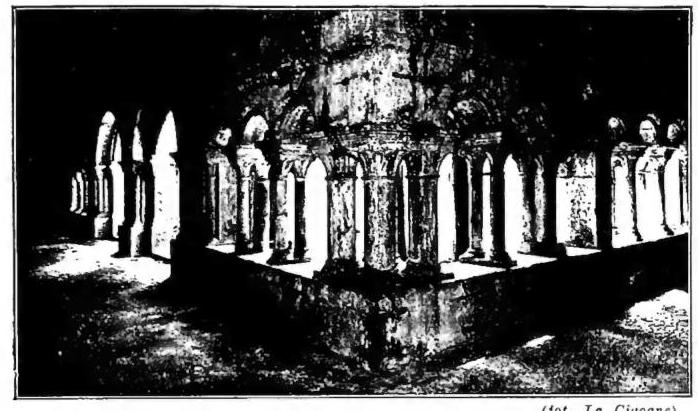
The ancient cathedral of Notre-Dame stands on an earlier construction of the 6th or 7th century, consisting of a building with three naves ending in three apses. Excavations carried out by Msgr. J. Sautel from 1949 to 1951 have made it possible to establish that the Christian basilica was erected on the site of a large Roman public building; the main apse and the two lateral apses rest on the remains of a Roman building of the 1st century, of which 23 drums of fluted columns, remains of Corinthian capitals, and large blocks of stone survive. The triumphal arch is supported by Roman marble columns with square bases and large ancient capitals, like the marble blocks of the presbyteral seat and the episcopal cathedra. Beneath the altar, a tomb cut into a decorated architrave block was found; farther on, other substantial column shafts were discovered, making a total of 30, together with remains of painted plaster, tiles, etc. The basilica, ruined in the 9th–10th century, was restored at the beginning of the 11th century and rebuilt in the middle of the 12th; the work was interrupted, however, and completed in the 13th century, when it was decorated. On the exterior of the northern small nave an inscription was engraved commemorating the work; from this small nave one enters the cloister with paired columns, restored in the 19th century. In the cloister, besides notable Christian inscriptions, there is a carved Christian sarcophagus (Wilpert, Sarcofagi, p. 325). The church, dedicated to Bishop St. Quirinus, was rebuilt by Msgr. G. M. Suárez (1665-66); it has a distinctive apse divided by six columns, pentagonal in form, with two semicircular small apses at the beginning, while externally it is triangular in shape.
The municipal Museum is of great value, with imperial statues, including a silver bust; many statues, however, have emigrated as far as the British Museum, St-Germain, Avignon, Marseille, Lyon, Nîmes, Grenoble, Valenza, etc.