
VALENCE, DIOCESE OF. - Diocese and prefecture capital city in the Drôme department in France, on the left bank of the Rhône, near the confluence of the Isère.
It is ancient Ventia, later Iulia Valentia, capital of the Segalauni; Prosper Tiro in his Chronicle calls it a "most noble city". In the Middle Ages, the city was under the government of the bishops who defended it against the counts of Valentinois; from 1276 to 1687, the bishops also held the title of counts of V. In 1450 the Dauphin, later Louis XI, obtained a portion of their rights, in exchange granting royal protection and the foundation of a university which lasted until 1790 and numbered among its teachers Cujas, Scaliger, etc. In 1562 the Huguenots, aided by Baron des Adrets, seized the city, damaging the Cathedral and other religious buildings, especially the abbey of St-Ruf. It was the capital of the Duchy of Valentinois and passed from the Dauphin Louis to Cesare Borgia, Diane de Poitiers, and Henri Grimaldi, Prince of Monaco. Pope Pius VI was for a month a prisoner of the Directory in the citadel and died there on August 29, 1799. A tradition attributes the foundation of Christianity in V. to the work of the presbyter Felix and the deacons Achilles and Fortunatus sent from Lyon, commemorated on April 23 in the Martyrologium Hieronymianum.
In the third cartulary of Grenoble (Library of Grenoble, ca. mid-12th century) there is a list of bishops beginning in the mid-9th century. The earliest known bishop is Emiliano, whose name appears in the Council held in V. in 374. Before 417 there was Maximus, whom Pope Boniface by a letter of June 13, 419 wished to be judged (Jaffé-Wattenbach, 319). There is then Cariatus, who sent a representative to the Council of Vaison in 442; St. Apollinaris, brother of St. Avitus of Vienne, who in 517 was at the Council of Epaone, is commemorated in the Hieronymianum on October 5; Gallus was at the Council of Orléans in 549; Maximus II had himself represented at the Council of Lyon in 570; Ragnolò was at the Council of Lyon and the two of Mâcon in 581 and 585; Ingild was at that of Chalon-sur-Saône in 650. A precise place cannot be assigned to the bishops Salvio, Antonius, Antoninus, and Elephas. Bishop [Valdalo] received a donation from Charlemagne (808-14); Lambert was under Louis the Pious. On January 8 and 9, 855, a Council was held in V. Then there was Reperto (859-79); Isaac was at the Council of Chalon-sur-Saône.
Later, mention is made of Gothard (1082-95); John I (1141-46), formerly abbot of Bonnevaux; Bl. Humbert of Moribel (1200-20); Gerald, formerly abbot of Cluny, then patriarch of Jerusalem; St. Boniface of Savoy (1240-42), later archbishop of Canterbury; Amadeus II, cardinal of Saluzzo (1383-89); John VI, cardinal of Lorraine (1521); Fr. G. de Casteluan, cardinal of Clermont-Lodève (1524-31); Ch. F. Fr. Cotton (1895-1905). On May 4, 1847, Pope Pius IX, in memory of Pius VI, appointed the bishops of V. ex officio assistants at the pontifical throne and Roman counts; they also hold the title of bishops of Die and of St-Paul-Trois-Châteaux (v.). The diocese is suffragan of Avignon. The patron saint of the diocese is St. Apollinaris.
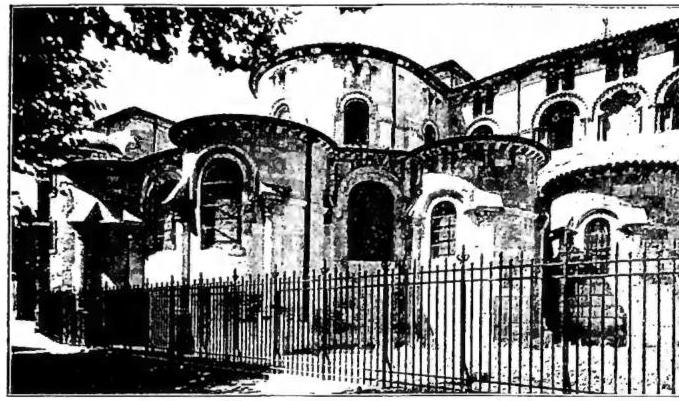
The Cathedral, St. Apollinaris, is in the Romanesque style, with influences of the Auvergne school; it was begun by Bishop Gothard at the end of the 11th century, but was certainly not completed when Urban II consecrated it on August 5, 1095 (inscription in the right aisle). The whole belongs to the first half of the 12th century. It was ruined by the Huguenots and restored between 1604-1609; but the choir was disfigured in 1730 and then entirely restored in the 19th century. The portico is supported by 32 columns. In the south transept is a fine portal in whose tympanum is sculpted the Savior between angels and the symbols of the four Evangelists with traces of ancient polychromy. The interior has a Latin cross plan measuring 75 × 18 m; at the transept it measures 35.88 m; it is divided into three naves by square piers with 4 attached columns. The choir is surrounded by 8 columns, one of which is an ancient milestone; a marble monument containing the heart of Pius VI is preserved there; in the ambulatory open 4 apsidal chapels. In the transept are the tombs of Msgr. de la Tourrette (d. 1840), Chartrousse (1857), and de Gibrigues (1919). The sacristy is Gothic (1488). The adjoining cloister has been destroyed; in the middle of it stood the surviving characteristic monument created by Canon Nicola Mistral in 1548, called the Pendentif. The church of St. John the Baptist was rebuilt after 1840 in the Romanesque style, of which the ancient bell tower from the end of the 12th century remains. The former Palace of the abbot of St-Ruf is now occupied by the Prefecture.
Pope Pius XI, by a letter of May 24, 1937, conferred the title and privileges of a minor basilica on the church of Notre-Dame de Aiguebelle, in the monastery of the Reformed Cistercians, on the occasion of the eighth centenary of the foundation of the monastery itself, a splendid monument of Romanesque art; from this abbey seven others were formed (AAS, 29 [1937], pp. 395-96). For the Christian sarcophagi preserved in V., V. Wilpert, Sarcofagi, pl. 215, 3, p. 306; pl. 214, 6, p. 296.