
BORGIA, CESARE. - Condottiere, b. in Rome in the summer of 1475, d. in Viana, near Pamplona, on March 12, 1507. The son of Card. Roderico Borgia and Vannozza Cattanei, destined by his father for an ecclesiastical career, he was appointed apostolic protonotary on March 27, 1482. He studied at the Collegio della Sapienza in Perugia and then perfected himself in
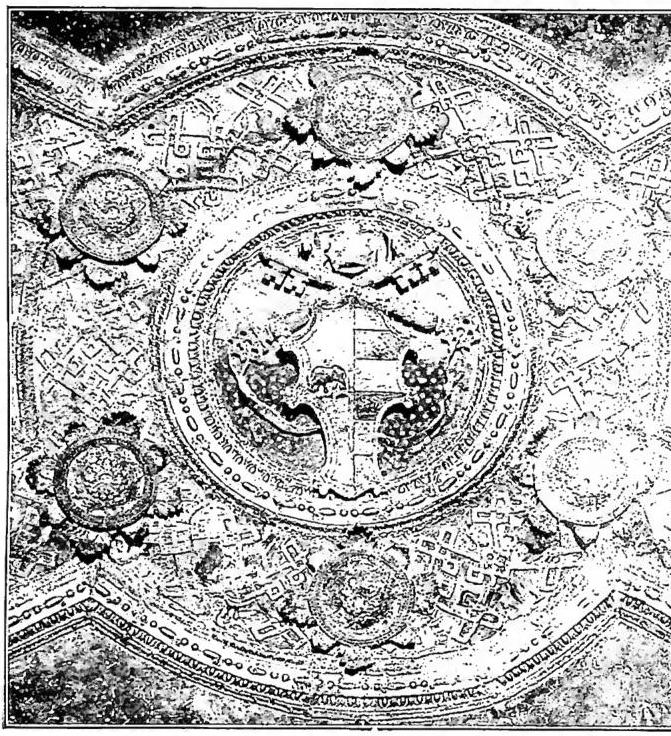
BORGIA - Coat of arms of the family, in the vault of the hall known as the Life of the Madonna and in the Borgia Apartment in the Vatican, from a design by Pinturicchio (late 15th cent.).
canon law at the University of Pisa, where he still was on September 12, 1491, when he was elected bishop of Pamplona by Innocent VIII. On August 31, 1492, he received the archbishopric of Valencia from his father, who had become Pope under the name of Alexander VI, and on September 21, 1493, he was created cardinal. But Cesare aspired to much more: and when his brother Giovanni, second Duke of Gandia and captain-general of the papal troops, was assassinated on the night of June 14, 1497—a crime of which he himself was later considered guilty—he obtained permission in consistory on August 17, 1498, to renounce the cardinalate, and was released by his father from the duties of the diaconate he had received, thus completely secularizing himself.
Already deeply versed in all the political affairs of the time, he succeeded in turning Alexander VI away from the alliance with Naples toward a rapprochement with France, from which he hoped for greater advantages, and had the Pope entrust him with a legation to Louis XII. He offered the king of France the support of the Holy See against Milan and in exchange was invested with the duchy of Valentinois; he was able to marry Charlotte d'Albret, sister of the king of Navarre (1499), and obtain consent for the conquest of the Romagna. Upon returning to Italy, he immediately occupied Imola and Forlì, which were defended in vain by Caterina Sforza, and was appointed gonfalonier of the Church by the Pope (1500). After putting together an army of about 10,000 men led by excellent captains from noble Italian houses, such as the Orsini and Savelli of Rome, Vitellozzo Vitelli of Città di Castello, and Gian Paolo Baglioni of Perugia, he successively took possession of Cesena, Pesaro (where his brother-in-law Giovanni Sforza was lord), Rimini, and, in April 1501, Faenza, which resisted him for a long time and whose lord, Astorre Manfredi, he later had barbarously murdered in Castel Sant'Angelo. Having also occupied Piombino and having been elected duke of Romagna by the Pope, he offered his help to Louis XII and participated in the expedition against Naples. In June 1502 he occupied Urbino, driving out Guidobaldo da Montefeltro, whose title he assumed, and Camerino, and planned the occupation of Tuscany, for which purpose he entrusted the fortification of Piombino to Leonardo da Vinci. But his ambitious aims and the discontent of several of his captains provoked against him the League of Magione, headed by Paolo and Francesco Orsini, Vitelli, Oliverotto da Fermo, Ermete Bentivoglio of Bologna, and Baglioni of Perugia. It was at this moment that Niccolò Machiavelli, sent by Florence to Cesare to probe his intentions, was able to appreciate Cesare's shrewd, unquestionably unscrupulous resolution, and to view him as a possible great Italian prince. Having succeeded in foiling the plot and avenging himself upon all his enemies with refined cruelty, he politically prepared his future conquests by consolidating the alliance with France, rendering the Romagna secure and tranquil, and securing the help of Ferrara through the marriage of his sister Lucrezia to Alfonso d'Este, following the murder—perpetrated by himself—of her second husband, Alfonso, Duke of Bisceglie. But the sudden death of Alexander VI on August 18, 1503, shattered his plans. Finding himself ill at that time and thus unable to react promptly, he had to adapt to the agreement imposed upon him on September 1 of that same year, promising to leave Rome so as not to influence, with his presence and that of his army, the College of Cardinals, while in exchange he was guaranteed safe passage to the Papal States. However, since Piombino, Rimini, and Pesaro had risen in revolt in the meantime, he was forced to return to Rome and submit to the will of the Orsini, Colonna, and Savelli. Finally, he was imprisoned in Castel Sant'Angelo by Julius II, who was elected on November 1 of that same year following the death of Pius III Piccolomini (who had succeeded Alexander VI for just over a month), and was released only on January 29, 1504, after declaring his renunciation of all the cities still under his rule. Since, after the unfortunate French campaign against Naples, he had attempted to draw close to Spain once again, he went to Naples, but there he was imprisoned by Gonzalo Fernández de Córdoba and sent to Spain. He managed to escape from the prison of Medina del Campo on October 25, 1506, and take refuge with his brother-in-law Giovanni d'Albret, king of Navarre. He died in combat during the siege of Viana on March 12, 1507, at about 32 years of age.
Exalted by politicians and deplored by moralists, he is among the most typically grim and dissolute figures of the Renaissance; he was viewed by the most extreme theorists of ragion di Stato as a model of power politics implemented with ruthless and cruel rationality; in reality, beyond the polemics, C. B.'s attempt also fits into the painful genesis of absolute states.