
IMOLA, DIOCESI di. — City and diocese in the province of Bologna.
It has a population of 144,450 inhabitants, of whom 144,226 are Catholics; it has 132 parishes with 193 diocesan priests and 45 religious priests, one seminary, 8 male and 25 female religious communities (1949).
I. lies on the left bank of the Santerno, at the intersection of the Via Emilia and the Appia (Via Mazzini). The Romans called it « Forum Cornelii », after Cornelius Sulla (82 B.C.) or Cornelius Scipio. It was a Roman municipium; « Imolas », although a pre-Roman designation, came into use only in the Middle Ages.
It was devastated several times: in 552 by the Goths; it was subject to the Exarchate of Ravenna, then sacked by the Lombards; Astulf ceded it to the Pope; in the 11th and 12th centuries it was at war with Bologna, Faenza and Ravenna; it was subsequently torn apart by civil wars; it was subjected to the domination of the Alidosi (1341-1424); then conquered by Galeazzo Sforza in 1434 and given as a dowry to Caterina Sforza, wife of Girolamo Riario (1473); in 1499 Cesare Borgia seized it, then the Sassatelli ruled, until in 1504 it passed to the Church, remaining under it until 1860. Christianity is attested by the martyrdom of s. Cassiano (v.). Forum Cornelii was an episcopal see as early as 373, as attested by the famous letter of s. Ambrogio in which Bishop Costanzo of Vibenzia is invited to visit the diocese, which at that time was vacant.
(phot. Alinari)
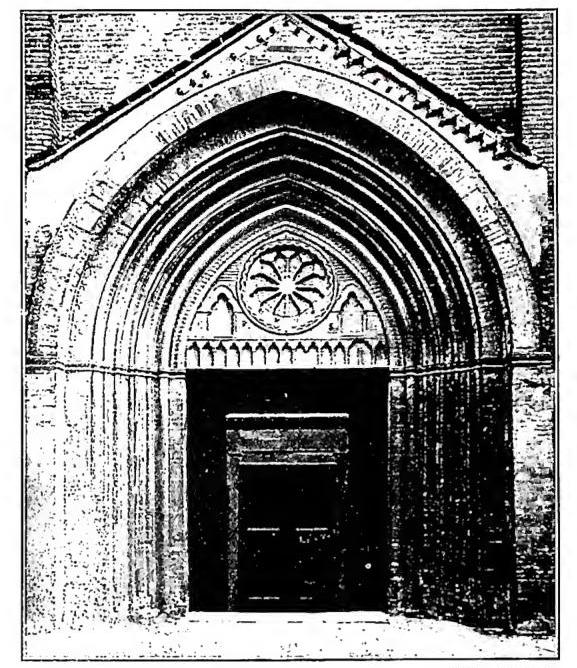
IMOLA, DIOCESI di — Gothic portal (14th century) of the church of S. Domenico.
proposes identifying, like his namesake of Ferrara, with s. Maurelio of Angers; then Basilio, whose name is read on the altar of S. Maria in Pergolà (F. Lanzoni, Un antico vescovo di I., Faenza 1909).
The episcopal see was originally located near the basilica of the martyr s. Cassiano (v.), where a « castrum » soon arose, so that the bishop was sometimes called « episcopus S. Cassiani ». Only after the destruction of the « castrum » did Bishop Enrico transfer the see to I. in 1187.
The diocese was initially dependent on Milan, but already around the middle of the 5th century, that is, in the time of s. Pier Crisologo, it was under Ravenna; it was then under Bologna from 1582 to 1604 and thereafter once again a suffragan of Ravenna; since 1872 it has been a suffragan of Bologna.
The Cathedral (S. Cassiano), erected in 1187-1251, was rebuilt by Bishop Sinibaldo (1270-91); reconstructed by C. Morelli and consecrated by Pio VI in 1782; the bell tower dates from the end of the 15th century, the façade from the 19th century. The interior is in the form of a Latin cross, with three naves divided by piers. Beneath the raised presbytery is the crypt, with Ionic columns and the relics of s. Cassiano. s. Pier Crisologo is buried in the church. In the treasury, the paten known as that of s. Pier Crisologo dates from the 11th century; the Chapter Archive contains documents from the 10th century. The collegiate church of S. Lorenzo is very ancient; it was restored by R. Alidosi in 997 and endowed by the noblewoman Guilla in 1033. Also dating from ancient times is the Benedictine abbey of S. Maria in Regula, « in Arenula », mentioned in 1151 in a bull of Eugenio III; it later passed to the Olivetans in 1564, and subsequently into commendam; the bell tower of 1181 still remains today, but the church has been entirely restored; King Sigismondo of Burgundy (1372) is buried there. Another Benedictine abbey mentioned in the aforementioned bull is that of S. Matteo. The monastery of S. Maria and S. Stefano « in diaconia » first housed Benedictine nuns and then the nuns of the B. Maria della Misericordia. Also noteworthy is S. Maria delle Grazie, or the church of the Osservanza, with remains of the tribune of Giulio II; in the portico is a fresco of the Madonna attributed to B. Vivarini (1430-99). The sanctuary of the Madonna del Piratello, erected in 1491 through citizens’ offerings, is notable (G. F. Cortini, La Madonna del Piratello, Imola 1889). S. Domenico, with an ancient portal by Giacomo di Bernardo di Cereto di I. (1340), preserves votive frescoes from the 14th and 15th centuries and a painting of the martyrdom of s. Orsola by L. Carracci (1600). The convent adjoining the church of S. Francesco houses the Library, the Picture Gallery, the Museum and the Municipal Archive, with documents from the 13th century onward.
Among the bishops of I. are G. Dandino (1546-1552); F. Ghigi (1652-55), later Alessandro VII; Barnaba Gregorio Chiaramonti (1785-1800), later Pio VII; Giovanni M. Mastai Ferretti (1832-46), later Pio IX. From Fagnano in the diocese of I. came Lamberto, later Onorio II (1124-1130); natives of I. were the Dante scholar Benvenuto Rambaldi, known as Benvenuto da I. (1306-90); the painter Innocenzo Francucci, known as Innocenzo da I. (1490-1547); and the architect Cosimo Morelli (1732-1812).