
ALEXANDER VII, POPE. - Fabio Chigi, born at Siena on 13 Feb. 1599. He was in Rome from Dec. 1626 to Oct. 1629; vice-legate at Ferrara until June 1634, he also held the offices of commissioner of arms and commissioner regulating the borders with the Venetians. Recalled to Rome and destined to be inquisitor and apostolic delegate to Malta, he was examined for the bishopric of Nicastro and received the three major orders. Having exchanged Nicastro for Nardò, he arrived in Malta in Oct. 1634 and was consecrated bishop in July 1635. Returning to Rome, he soon left again for Cologne, where he arrived on 9 Aug. 1639 to take up the post of nuncio to the Rhine. In Dec. 1643 he was also entrusted with the duties of extraordinary nuncio to the peace congress. In March 1644 he moved from Cologne to Münster in Westphalia, immediately beginning intense mediation work between the imperials and the Spaniards on one side and the French on the other, always supported by the Venetian ambassador Alvise Contarini. He defended with all his might the rights of Catholicism, which he believed were daily more betrayed by the Catholic princes of Germany and by the King of Spain. He refused to allow the name of the Pope and his own to appear in the peace treaties and lodged a solemn written protest against the violations of the rights of the Catholic Church. In 1649 he left Münster for Aix-la-Chapelle to continue his mediating work in the negotiations between Spain and France. Recalled to Rome to assume the office of Secretary of State, he arrived there on 30 Nov. 1651; created cardinal on 19 Feb. 1652, he received the title of S. Maria del Popolo and resigned the church of Nardò in favor of that of Imola. On 7 Jan. 1655 Innocent X died in his arms. Entering the conclave on 17 Jan., he was elected Pope on 7 Apr. and crowned on 18. In Dec. he welcomed Queen Christina of Sweden to Rome and administered the sacrament of Confirmation to her. When the plague broke out in Rome, the wise measures adopted by the Pope succeeded in keeping mortality within fairly limited bounds (May 1656–Aug. 1657). Having obtained the return of the Jesuits, who had been banished from Venetian territory, he provided repeated assistance to the Republic in its war against the Turks. Mazarin (d. 1661), from the beginning of the pontificate, and later Hugues de Lionne, because of an unfortunate incident (20 Aug. 1662) involving the Pope’s Corsican guard and the Duke of Créqui, French ambassador, made relations between Louis XIV and Alexander extremely difficult. But the legation to France of his nephew Cardinal Flavio Chigi, which was intended to mark the Pope’s ultimate humiliation after the Peace of Pisa (12 Feb. 1664), instead turned into a triumphal journey. Great efforts were required of the Pope in the struggle against Jansenism, both in France and in the Low Countries. In 1658 Alexander canonized St. Thomas of Villanova, and in 1665 St. Francis de Sales, whom he had always admired and revered in a very special way. In five promotions he created 38 cardinals, among them Giulio Rospigliosi, his successor in the papacy as Clement IX, Sforza Pallavicino, and the blessed Gregorio Barbarigo. Alexander died on 22 May 1667. His body rests in St. Peter’s Basilica, in the monument designed by G. L. Bernini (1672–78).
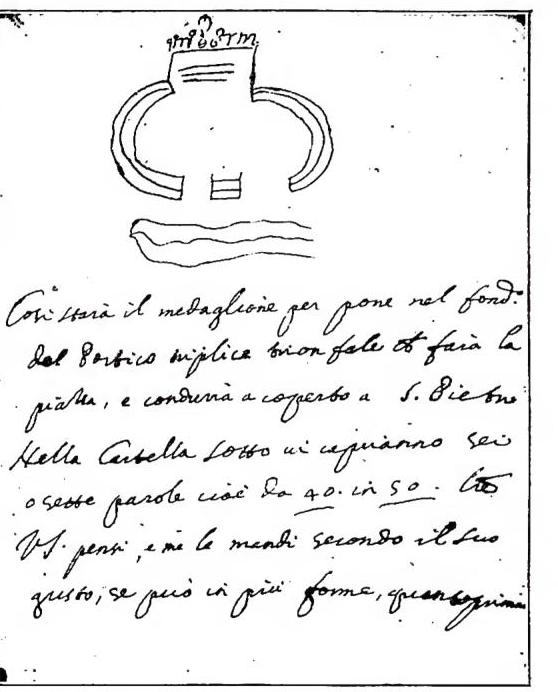
ALESSANDRO VII - Autograph note for the founding medal of the Berninian colonnade - Vatican, ms. Chigiano R. VIII, c. 1, f. 10 (Miscellanea) no. 1.
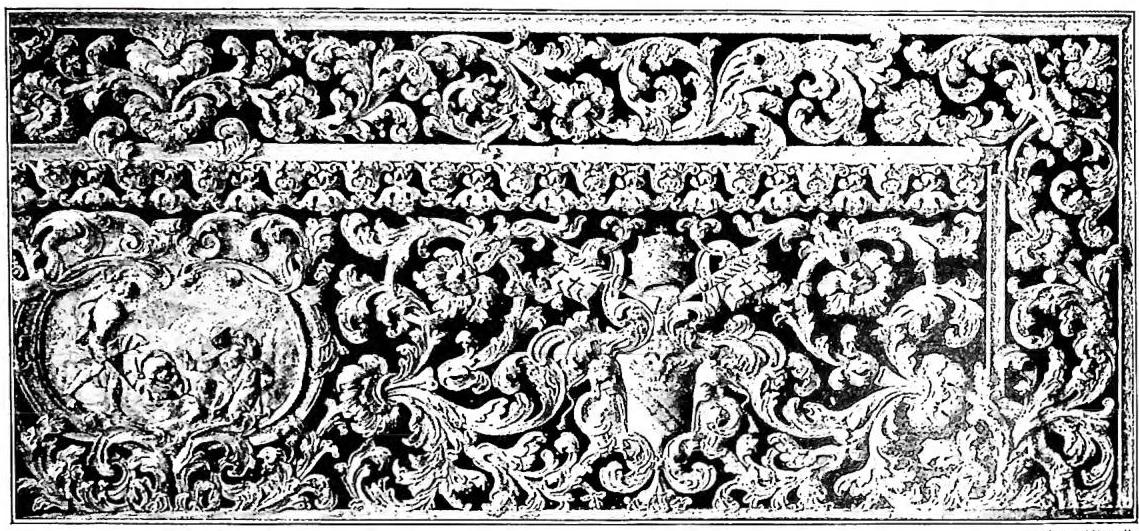
He also greatly enriched the Vatican Apostolic Archive. After completing the construction of the Palazzo della Sapienza, he founded the Biblioteca Alessandrina there (1667). Fabio Chigi largely contributed to the formation of the Biblioteca Chigiana. In his youth he had compiled a list of paintings, sculptures and buildings in Siena (ms. Chigiano I, I, 11), which remains an important source for the history of Sienese art. During his pontificate, the construction of the Propaganda Fide building was completed (1649–66); work on S. Maria del Popolo continued, begun by the young Fabio Chigi (1626–27, 1652, 1655–60); the façade and piazza of S. Maria della Pace were created (1656–67); Bernini’s colonnade in St Peter’s Square arose (1656–57), as did the Chair of St Peter’s baldachin (1656–65). Between 1658 and 1662 the façade of S. Maria in Via Lata and the church of S. Tommaso da Villanova in Castelgandolfo were built; between 1660 and 1675 that of S. Maria in Portico in Campitelli; and between 1662 and 1664 the church of the Assumption and adjacent structures in Ariccia. Between 1662 and 1679 the symmetrical churches of S. Maria in Monte Santo and S. Maria dei Miracoli in Piazza del Popolo were constructed. To the same Pontiff’s munificence are owed, moreover: the transformation of the Scala Regia (1663–66) and the Sala Ducale (1665) in the Vatican; the façade of S. Andrea della Valle (1665); and finally the erection of the obelisk mounted on the elephant in Piazza della Minerva (1666–67). - See Pl. LXI.
Giovanni Incisa della Rocchetta