NICASTRO, DIOCESI DI

**NICASTRO, Diocese of.** - A city and diocese in the province of Catanzaro; it is situated on the foothills of the Sila, at the edge of the plain of S. Eufemia, the ancient Clampetia, through which flows the Sabatum, now called the Savuto.

It has a population of 117,500, all Catholic. It comprises 56 parishes, served by 62 diocesan priests and 11 regular clergy; it has a seminary, 3 male religious communities, and 20 female communities (Ann. Pont., 1951, p. 287).

It does not appear in classical antiquity, as there are insufficient grounds for identifying it with the ancient localities mentioned by regional historians. The name itself betrays a medieval and Byzantine origin. Its strategic and fortified position attracted the attention of the Normans and the Swabians, especially Frederick II, who declared it a royal domain, exchanging half of the city, which was subject to the Benedictines of S. Eufemia, for Nocera Terinese. Local historians trace the episcopal see back to the earliest apostolic times, even assigning names to bishops, such as a Julius, who was born in 44, a Landulf of N. in 65, and a Giannantonio in the 50th year of Nero, which constitute an obvious anachronism. Nor does St. Gregory the Great, in his letters to the prelates of Bruttium, nor the conciliar subscriptions prior to

Article illustration
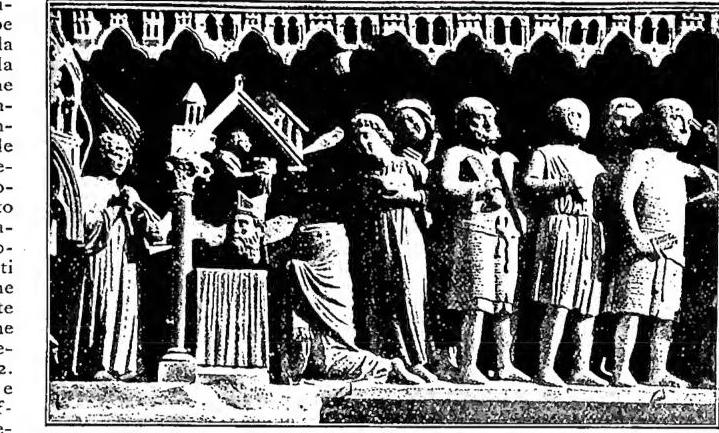
(from Reims. La France Illustrée, Paris 2nd ed., pp. 7)-87) Nicasius, Saint - The martyrdom of St. Nicasius. Sculpture (3rd century) on the northern façade of the transept of the Cathedral - Reims.

the necessity of its reconstitution by the Normans, through the work of Amburga, daughter of Count Drogano, who endowed Nicastro with pious munificence and rebuilt the Cathedral there, dedicated to Sts. Peter and Paul. However, the territory long retained a Greek preponderance, which was first contained and then overwhelmed by the Benedictine abbey of S. Eufemia, founded by Robert Guiscard around 1070. Among the Greek monasteries, those of S. Nicola di Flaiano, S. Maria de Carra, and S. Isidoro, also called S. Sidero, were of great importance and remained flourishing until the time of Cardinal Bessarion.

Ughelli records the first bishop of Nicastro as Enrico in 1094, while in the Greek documents edited by Trinchera, a Giovanni appears as early as 1084. Among the most distinguished bishops are Enrico, who in 1094 participated in the consecration of the church of S. Maria di Torre, erected by St. Bruno, founder of the Carthusians; the Franciscan Pietro di Scalea, who received privileges from Robert of Anjou in 1323; the Cistercian Antonio De Paula, who after three years was transferred to Catanzaro, his homeland; the Roman nobleman Paolo Capizucchi, who held many offices from the Apostolic See; Cardinals Marcello Cervini and G. Antonio Facchinetti, who became Pope Marcellus II and Pope Innocent IX, respectively; the Rossanese G. Tommaso Perrone, who governed from 1639 to 1677 and rebuilt the Cathedral, which had been destroyed by an earthquake and inaugurated in 1650; and Carlo Pellegrini da Longobardi, who died in the year the Concordat of 1818 was promulgated, which, among other things, assigned to Nicastro the territory of the suppressed diocese of Martorano.

**

BIBL.:** Ughelli, IX, pp. 553-57; G. Fiore, *Calabria illustrata*, II, Naples 1743, pp. 308-11; F. Adilardi, s. V. in *Enciclopedia dell'ecclesiastico*, IV, Naples 1845, pp. 816-31; P. Ardito, *Spigolature storiche sulla città di N.*, Nicastro 1889; G. Giuliani, *Memorie storiche della città di N. dai tempi remoti al 1880*, 2nd ed., ibid. 1893; G. Minasi, *Le chiese di Calabria*, Naples 1866, pp. 268-71; E. Borrello, *Sannibale*, Rome 1950.