
CALABRIA. -
I. GEOGRAPHY
In antiquity this name designated the Salentine Peninsula, and only after the 7th century the other, larger peninsula which, south of the Pollino group, breaks away from the Italian mainland between the Gulf of Policastro and the mouth of the Sinni and terminates it to the west. It is an almost entirely mountainous country (22.4% of the territory) or hilly, with peaks rising above 1500 m. (M. Cocuzzo, 1541 m.) and broad upland massifs (Sila, Aspromonte), themselves rising to nearly 2000 m. (M. Botte Donato, 1929 m.; M. Montalto, 1956 m.). The watercourses, more torrents than rivers (fiumare), have created, with their abundant detritus, small alluvial plains (below 100 m.; the Crati, the plain of Sibari; the Amato, that of S. Eufemia), which together cover barely 14% of the area of C. The climate, typically Mediterranean subtropical along the coasts, takes on a continental character inland, with cold, rainy winters in the higher areas, and a tendency toward a certain thermal imbalance between the two shores, the Ionian shore being warmer and drier.Once luxuriant with forests, C. still stands out among the regions of our south for the extent of the area covered by woodland and specialized tree crops (48%). Above all, the coastal strip is clothed in splendid olive groves, citrus groves, and orchards. In Italy, C. ranks first in the production of bergamot (Reggino), citrons, and chestnuts, and second in that of other citrus fruits, olive oil, and dried figs (Catanzarese); likewise, considerable quantities of silkworm cocoons, fruit, legumes, etc., are placed on the national market from here. Agriculture absorbs more than three-fifths of the active population;
by contrast, the figures for industry are very modest (18%, with a further 6% in handicrafts).
The fertility of the soil and the traditional frugality of its inhabitants explain the relatively high population-density index (although lower than the national average) (133 inhabitants per sq. km.). The absolute maxima correspond to southern C., the Cosentine valley, and the Catanzaro isthmus. Large population centres are rare: only the municipality of Reggio exceeds 100,000 inhabitants (the city 60,000); next come Catanzaro with 35,000 and Cosenza with 32,000 inhabitants. More than two-thirds of Calabrians live in municipalities with fewer than 10,000 inhabitants.
The present administrative division perpetuates, under different names, the traditional partition into C. citeriore (Cosenza), ulteriore prima (Reggio), and seconda (Catanzaro), hence the still fairly frequent use of Calabrie instead of C. The relevant statistical data are as follows:
| Provinces (and population of the provincial capital) 1948 | No. of municipalities | Area in sq. km. | Comparable population 1936 | Density per sq. km. | Population 1-1-48 in thousands |
|---|---|---|---|---|---|
| Catanzaro (57613) | 155 | 5232 | 606364 | 116 | 704 |
| Cosenza (60216) | 153 | 6673 | 587025 | 88 | 680 |
| Reggio (139598) | 93 | 3189 | 578262 | 182 | 650 |
| Calabria | 401 | 15094 | 1771651 | 117 | 2034 |
On 1 January 1948, the population of C. was estimated at more than 2 million inhabitants.
II. HISTORY
In antiquity it was called Brutium, after its first inhabitants, who were related to the Lucani and settled there, and it formed an integral part of Magna Graecia. When, in the 7th century, the Byzantines lost control of the old C., that is, the Salentine peninsula, they transferred its name to Brutium, which from then on has always retained its present designation. In the Augustan division of Italy, Brutium, together with Lucania, constituted the third region.The Christian origins of Bruttium are traced back to s. Paul, who, on his journey to Rome, stopped for a day at Reggio (Act. 28, 13). According to later legends, one of his disciples, Stefano of Nicea, together with a certain Suera, is said to have continued his work there. The presence of s. Peter in the region, the preaching of s. Mark in Val di Crati, and that of s. Dionigi l'Areopagita as bishop of Crotone are likewise legendary. It is certain that Christianity entered C. at an early date through the highly active ports of Reggio, Locri, Crotone, Turio, and Vibona, which maintained continuous contact with the East; the Christian inscriptions found at Reggio, Tauriano, Tropea, and elsewhere demonstrate that the Gospel first took root in the coastal cities and proceeded from south to north. According to a testimony of s. Atanasio, the hierarchy was already established there by the first half of the 4th century. At the beginning of the 5th century, Pope Innocenzo I (401–17) addressed the bishops of Bruttium, Massimo and Severo. In Tauriano and Blanda Iulia, inscriptions have been found bearing the names of the bishops Leucosio and Giuliano, both of them married (4th–5th centuries). In the letters of s. Gregorio Magno, eleven dioceses of Bruttium are mentioned: Reggio, Locri, Squillace, Miria, Crotone, Turio, Cosenza, Nicotera, Tauriano, Vibona, and Tempsa.
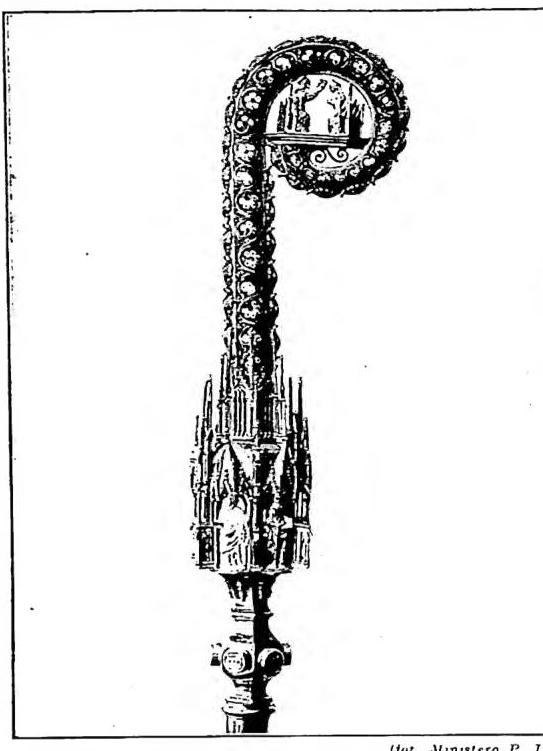
(phot. Ministry of Public Instruction)
CALABRIA — Pastoral with the Coronation of the Virgin
(beginning of the 15th century) — Reggio Calabria, Cathedral.
Greek. In the 9th century the ecclesiastical circumscription was reorganized; the two metropolitan sees of Reggio and S. Severina were established, and other dioceses, such as Rossano, Cassano, Bisignano, Oppido, and Nicastro, took the place of those destroyed, Turio, Tempas, Miria, etc.
Monasticism, which existed in the region before s. Gregorio Magno, gained prominence with Cassiodorus, who founded the two celebrated monasteries of Vivarium and Castellese near Squillace. But the Latin monks were soon supplanted by the Greeks, who also penetrated the region’s most remote and inaccessible recesses, forming eremitical zones (the best known being that of Mercurion in the north-western C.) and celebrated monasteries, which transformed C. into a new Thebaid. Among these monasteries, particular attention should be paid to those of Patirion, near Rossano; S. Adriano, near S. Demetrio Corone; S. Giovanni di Stilo; S. Filarete, near Seminara; and S. Bartolomeo di Trigonio, near Sinopoli. The precious Greek manuscripts produced in these monasteries are now dispersed among various libraries of Europe. Holiness flourished remarkably, with about forty Calabro-Greek saints, among them s. Elia di Reggio, s. Giovanni Teristi, s. Gregorio di Cassano, s. Fantino, s. Nilo, s. Bartolomeo di Simèri, etc.
The Normans began the conquest of C. in 1054 and virtually completed it in 1064. They restored to Rome the jurisdiction usurped by Byzantium, while leaving the existing ecclesiastical circumscription unchanged; indeed, they added other dioceses, such as Mileto and S. Marco, in place of Tauriano and Vibona, which had been destroyed, and of Malvito. To them are owed the Latinization of C. and the great favor accorded to the Benedictine, Carthusian, and Cistercian monastic Orders: thus arose the rich and powerful Benedictine abbeys of S. Eufemia and of the S.ma Trinità of Mileto; the Charterhouse of S. Stefano del Bosco at Serra S. Bruno, where the founder of the Carthusians himself died; and the Cistercian monasteries of Sambucina, Corazzo, and Mattina, whose art achieved triumphant expression in the cathedral of Cosenza, consecrated in 1222. From the Cistercians there FIORE, IL (v.), who in 1189 laid the foundations of the Florensian Congregation, centered at S. Giovanni in Fiore.
The Swabians succeeded the Normans (1195–1264). During the long rule of Frederick II, C. attained considerable economic progress; but the Swabians adopted a disastrous religious policy, which led to their downfall. Under the Angevins religious conditions improved greatly; but the long War of the Sicilian Vespers devastated C. (1282–1304). The Spanish viceroyal government, which lasted for more than two centuries, was ruinous for C. (16th–17th centuries). In the 13th century the Calabrian Franciscans had their martyrs in Morocco (1227); the Dominicans were entrusted with the church of S. Matteo in Cosenza (1240).
The 15th century was dominated by the figure of s. Francesco di Paola, founder of the Order of Minims. At the same time, the reformed Dominican Congregation was gaining strength in the region through the work of b. Paolo da Mileto. Still more important reforms were carried out in the 16th century: thus there arose two Augustinian Congregations, the so-called Congregation of the Zumpani, through the work of b. Francesco da Zumpano, and that of Collorito, through the work of b. Bernardino da Rogliano. The Capuchin reform had its promoters in bb. Ludovico and Bernardino da Reggio. In this same century prominent Calabrian ecclesiastics distinguished themselves by their gifts: the three Calabrian cardinals, Paolo Parisio da Cosenza, Guglielmo Sirleto da Guardiavalle, and Vincenzo Lauro da Tropea; Colantonio Ruffo da Scilla was the first superior general of the Basilians; Filippo Gesualdi da Castrovillari was superior general of the Conventuals, and Silvestro Papalo da Monteleone of the Capuchins; Teofilo da Tropea, a Dominican, was the first commissioner of the S. Uffizio; his confrere Tommaso Campanella da Stilo was also a Calabrian.
The Church has decreed the honors of the altars for five Calabrian religious of the 17th century: Umile da Bisignano, Franciscan; Nicola Saggio da Longobardi, Minim; Angelo Falcone da Acri, Capuchin; Paolo Navarro da Laino and Camillo Costanzo da Bovalino, martyrs of the Society of Jesus in Japan.
The 18th century was a century of decline, aggravated by the disastrous earthquake of 1783 and by the jurisdictionalist policy of Minister Tanucci. The 19th century was distinguished by the heroic virtues of ven. Bernardo Maria Clausi da S. Sisto, a Minim, and Gesualdo Melacrinò da Reggio, a Capuchin.
The 20th century saw the establishment of the two regional seminaries of Reggio and Catanzaro, which made a substantial contribution to the intellectual and spiritual formation of the clergy. V. also BASILIANI D'ITALIA; ITALO-ALBANESI; ITALO-GRECI.
The following should also be consulted: D. Taccone-Gallucci, Le epigrafi cristiane del Bruzio, Reggio Calabria 1904; P. Orsi, Iscrizioni cristiane di Taurania nei Bruzi, in Arch. stor. della C., 2 (1914), pp. 225–36; A. Crispo, Le antichità cristiane della C. prebizantina, in Arch. stor. Cal. e Lucania, 14 (1945), pp. 3 ff., 119 ff., 209 ff.; F. Russo, La metropoli di S. Severina, in Arch. stor. Cal. e luc., 16 (1947), pp. 1–20.
III. ART OF C
Christian art, after almost every trace of the flourishing Greek and Roman civilization of the preceding period had been lost as a result of the barbarian invasions, began to manifest itself in C. when the Eastern monks arrived there.Even before the clear reflections of Byzantine architectural civilization appeared in the baptistery of S. Severina (9th cent.), the catholica of Stilo, and S. Marco of Rossano (10th–12th cents.), small churches arose resembling the shrines of the Hellenic regions of Armenia and Anatolia. Later, elements derived from Sicilian-Muslim architecture introduced decorative elegance into the Byzantine buildings. The new spirit and orientation also prevailed in painting, sculpture, and the minor arts, of which only very scant remains survive. The celebrated Evangelario of Rossano, from the 6th cent., is a precious document of the painting of manuscripts, while the Cross of the cathedral of Cosenza is a typical example of Byzantine goldsmithery. Norman rule stimulated intense activity, especially in the field of construction; this was manifested above all in the churches erected by the monks of s. Nilo, which developed distinctive features and thus came to be called «Nilian churches». The churches and monasteries built by the Normans were followed by very numerous sacred buildings constructed by the Benedictines and later by the Florensians. The type of temple with a Greek cross and with a cross bearing a central dome, characteristic of the Nilian churches, was replaced by the basilical type with a Latin cross; but even after the advent of the Normans, the influence of Sicilian-Muslim art continued to appear in decoration. Marble workers and craftsmen, perhaps Sicilian, introduced the art of decorating floors and architectural members with mosaics of geometric designs, Cosmati (v.).
This fruitful architectural activity was encouraged and assisted by the Hohenstaufen. In 1222 the cathedral of Cosenza was inaugurated; there, for the first time, Cistercian Gothic elements appear in the apse and façade. During the subsequent Angevin-Durazzese period, C. too joined the architectural renewal fostered by the Angevins; at this time, painters, sculptors, and decorators from other regions worked in C. The frescoes of the crypt of S. Francesco at Irsinia, the tomb of the Sangineto family in the church of S. Maria della Consolazione at Altomonte, and the mausoleums of Ademaro Romano at Scalea and of the Carafa family at Caulonia showed that in C. too painting was dominated by the distant reflections of Cavallinian and Sienese art, and sculpture by those of Tuscan Gothic, which had reached the farthest limit of the peninsula through Neapolitan works. As throughout southern Italy, the Renaissance did not establish itself in C. with distinctive features, but works of art imported from other regions are fairly numerous. A true artistic revival took place in C. only in the seventeenth century. Stucco work, marble, woodcarving, decorated ceilings, choir stalls, lecterns, carved seats, damasks, and velvets manufactured by the famous silk mills of Catanzaro enriched churches and patrician houses, while the textiles of Longobucco and other towns of the Sila—valuable examples of a popular textile art—demonstrated the vitality of a tradition dating back to the Durazzese period. Neapolitan painters such as Antonio Sarnelli and Niccolò Rossi, Flemish painters such as Guglielmo Borremans, and architects and stone sculptors traveled throughout the region to construct palaces and decorate façades and interiors. But towering above them all is the great figure of Mattia Preti, called the Calabrian cavalier, whose work triumphantly brought the cycle of seventeenth-century Neapolitan painting to a close. In architecture and decoration, the Baroque continued to reign in the eighteenth century. During the nineteenth century, Calabrian artists turned decisively toward the forms flourishing in Naples.
IV. FOLKLORE
C. is one of the regions where popular traditions have been best preserved, and they lend a picturesque character to the life of its towns and villages. The customs of the various colonies contribute liveliness and variety: neo-Greek communities in the southern Aspromonte, Albanian communities in the provinces of Cosenza and Catanzaro, and Waldensians at Guardia Piemontese (Cosenza). Although the practice of wearing traditional dress is rapidly disappearing, it nevertheless survives in various places, preserved in the beauty, richness, and originality of the different styles of dress and their related ornaments. It appears especially during religious and family celebrations. At S. Giovanni in Fiore, women’s dress is completely black, except for the white of the blouse and the cloth worn over the head; in general, however, Calabrian women wear broad, pleated skirts of brightly colored silk, red or blue, a bodice with a velvet corset, and sleeves fastened with ribbons over broad embroidered blouses. The finest examples may be observed at Castrovillari, Luzzi, Tiriolo, Nicastro, Gioiosa Ionica, Lungro, and Cardeto. Men’s dress is now less common, with its characteristic conical hat adorned with ribbons, short jacket of fustian with metal buttons, velvet waistcoat, short trousers of cloth or velvet, woolen stockings, and on the feet the “calandrelle” or “porcine,” similar to ciocie. The dress of shepherds and fishermen is simpler and more ancient. As a vow to the Addolorata, women dress in black with a large white cord around the waist; as a vow to S. Antonio, they wear a friar’s habit, and so forth: such garments are also frequently worn by children.In some places the funeral lament performed by professional mourners survives: some of these songs, similar in meter and style to the Corsican “voceri,” vibrate with intense maternal love. But the most interesting manifestations are connected
There are numerous patronal festivals, preceded by novenas: sumptuous meals are offered to guests, the streets are decorated with garlands and balloons and traversed by bands and by «tumbari» (drummers). Well-to-do people place before the door of their house a table adorned with the finest carpets; the statue of the Saint stops to bless the family, which casts flowers and grain and invokes grace. Monetary offerings are made to the Saint and hung from a red ribbon tied around the statue’s waist. Especially for the Assumption, the game of the ships is practiced, formed by ten young men who carry another ten on their shoulders and thus go around the town singing (Delianova, Cetraro, Cittadella del Capo, etc.). For S. Giuseppe, almost all families lay a meal for three poor people: an old man, a woman, and a child. In many places, the remains of the sacred drama recalling the Passion and death of Christ during Holy Week are still performed: they are called «mortoro» or «affacciata» (from the meeting of Jesus with His Mother) or «pigghiata» (from the capture of Jesus); of the latter there exists a script by an unknown seventeenth-century author, in unrhymed verse, with about thirty characters, besides the numerous extras.
Expressions of enthusiastic religious fervor are found among the companies of the «battenti», who, in the Holy Week procession, continue the ancient custom of the flagellants (e.g., the «uffizianti» of Bova). Other popular dramatic forms are provided by carnival farces. The repertory of lyric songs (stambotti), narrative songs («rumanze»), and sacred songs («orazioni» and «storie») is also rich, as is that of fairy tales and legends. Popular art can boast the beautiful production of the carpets of Longobucco and of ceramics from Seminara and other centers.
V. CALABRIAN CONCILIAR REGION
It is one of the regions into which Italy was divided, by measures of the S. Congregazione Concistoriale of 15 February and 22 March 1919 and 29 September 1933 (AAS, 11 [1919], pp. 72–74, 176; 25 [1933], p. 466), so that regional councils might be celebrated in place of provincial councils.It comprises the territories of the ecclesiastical provinces of Reggio Calabria and S. Severina, as well as the archdioceses of Catanzaro, Cosenza and Rossano, and the dioceses of Lungro, Mileto, S. Marco e Bisignano, and Squillace.
The regional ecclesiastical tribunal for cases of matrimonial nullity is located in the regional capital (Reggio Calabria); appeals against the judgments it issues must be brought either before the Campanian regional tribunal (Naples) or before the S. Rota (cf. Pio XI, motu proprio «Qua cura», 8 December 1938, in AAS, 30 [1938], pp. 410–13). – Vedi Tav. XXI. Pio Ciprotti