
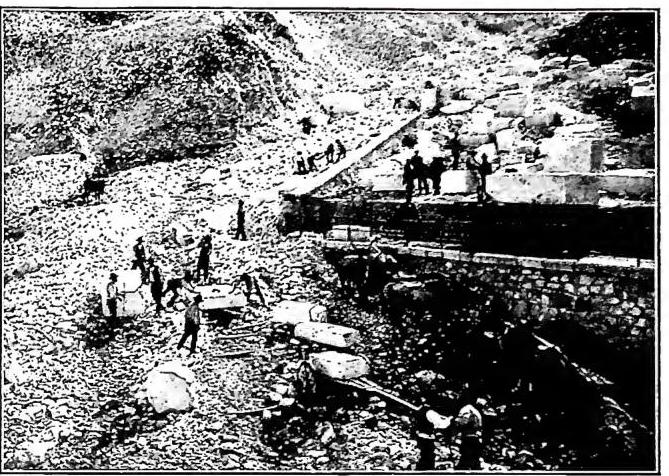
MARBLE. - For sculpture, the marbles most commonly used are the white ones, hence called statuary marbles; among these, the most highly prized are those of fine grain, which permit cleaner and more delicate workmanship. Famous in antiquity were the Greek marbles, especially Parian; today the exceedingly rich quarries of Carrara, already known in the 2nd century B.C. and worked since the 12th century, supply material to the whole world.
(int. Alinari)
MARMO — Loading and transport by animal traction of m. — Quarry of Carrara (Ravaccione).
…vessels, etc.). Its use continued in the early Christian period: monumental porphyry sculptures of the 4th century are the two sarcophagi of s. Elena and s. Costanza, now in the Vatican Museums. For the same purpose of rarity and technical preciousness, polychrome m. were again used by sculptors of the late sixteenth century, and Vasari cites, as works of extreme virtuosity, three oval works in porphyry by Tadda, a sculptor from Fiesole, one with the head of Christ, the others with portraits of Duke Cosimo and Duchess Leonora. Likewise, in an exhibition of technical skill, about a century later Algardi sculpted in pietra di paragone (that is, in the extremely hard nero antico) the soft sleeping putto of the Galleria Borghese, which is a tour de force even among the virtuoso works of the sumptuous seventeenth century; at that time polychrome m. were fashionable not only in decorative sculptures but also in accessories of funerary monuments (Rome, the monument to Gregory XV by Legros, in S. Ignazio; that of Alexander VII by Bernini, in S. Pietro, etc.), and they continued to be used with conspicuous excesses until the Neoclassical period returned to the exclusive use of white m.
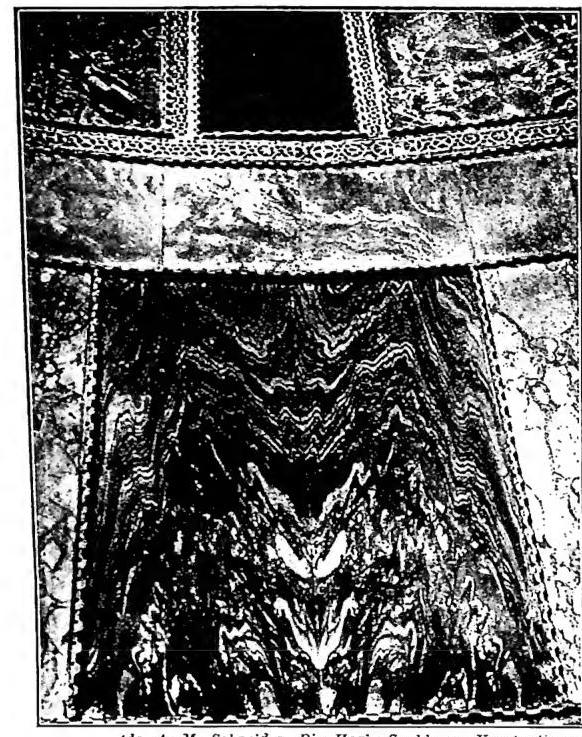
In architecture, m. served in ancient Greece as a building material, that is, for the very framework of the building; among the Romans it was used for cladding, with an ever-greater splendor of polychromy and technique. Polychrome m. were also used for structural elements—columns, capitals, entablatures: granite (from which colossal columns were made, such as those of the Pantheon and the Baths of Diocletian, later S. Maria degli Angeli), cipollino, serpentine, porphyry, etc. In early Christian churches these elements are often spolia (that is, originating from pagan buildings), and consequently columns of different materials and dimensions are frequently found aligned together; but in the churches of the Exarchate—in Ravenna, Grado, and Parenzo—the greater wealth and building possibilities made it possible to use m. from Greek quarries specially worked. For decorative parts, Christian art continued and perfected the techniques already in use in the classical period: litostrati for floors, and, with a few additions of glass tesserae, also for vaults (S. Costanza in Rome); opus sectile for wall cladding. It also brought the delicate openwork technique to stylistic clarity, with flat ornaments on deeply recessed backgrounds, producing a vivid chiaroscuro effect, for capitals and transennas.
(from A. M. Schneider, Die Hagia Sophia zu Konstantinopel, Berlin 1919, pl. 61)
MARMO — South apse of Hagia Sophia, marble facing. Constantinople.
white and dark green (the churches of Pistoia) or white and black (the cathedral of Genoa; S. Pietro di Portovenere, etc.). In Rome, the use of colored marble on the exteriors of churches was abandoned in the late Renaissance, which introduced considerably greater variety in the interior polychromy, after Raffaello had first employed precious colored marbles in the Chigi Chapel in S. Maria del Popolo in Rome. In that same city, subsequent examples are innumerable, with ever-increasing splendor in Baroque architecture. There, precious marbles were used for columns (Sicilian jasper facings in S. Marco and S. Maria in Via Lata; fior di persico in S. Antonio dei Portoghesi; Verona yellow in the Cybo Chapel in S. Maria del Popolo, etc.), while rare marbles were combined with bronze and hard stones in altars (examples of exceptional richness are the altars of S. Ignazio at the Gesù and of the Pauline Chapel in S. Maria Maggiore), ciboria, and pulpits. With no less sumptuousness, but with greater softness in the chromatic harmonies, marble was used in the interiors of churches and chapels, especially in southern Italy and Sicily, during the eighteenth century; but in the Rococo period the use of stucco increasingly took its place. The nineteenth century also returned, in architecture, to the almost exclusive use of white marble, and when it occasionally resorted to colored marbles, it maintained a pronounced coldness of polychromy. Today polychrome marble in architecture is used in more or less successful imitation of Baroque models (v. ALTARE; CIBORIO; RIVESTIMENTI).