
CHIGI, FAMIGLIA. — It appears in Sienese history in the 13th century, and from the outset its members were prominent in banking; some were entrusted by their city with missions, especially to the papal court.
It acquired nobility in 1377 and was distinguished by the bl. Giovanni (1300–63), a hermit friar in the convent of S. Leonardo di Lecceto, and by the bl. Angela (fl. in the second half of the 14th century), a hermit woman (after four marriages) in the monastery of S. Agostino in Siena. The branches of the C. still in existence derive from the brothers Mariano (1439–1504) and Benedetto (b. 1449).
MARIANO was a banker of great renown. He took part in extraordinary Sienese embassies, in 1492 and 1502, to Alessandro VI and Cesare Borgia; in 1473–74 he rebuilt the palace on via del Casato di sotto, in Siena; in 1502 he commissioned Pietro Perugino to paint the panel of the Crucifix with various Saints, in the church of S. Agostino in Siena.
Of Mariano’s sons, AGOSTINO (ca. 1465–1520), who moved to Rome after his father had established in 1487 a banking company between himself and Stefano Ghinucci, himself established another trading company in 1502 with Francesco Tomasi, and soon opened new banking enterprises with the Spannocchi. He was Treasurer of the Church and obtained concessions and privileges for supplying grain to the Papal States, for the lease of the customs duties, and for that of the saltworks of the Apostolic Camera and of the Kingdom, together with the lease of the alum mines of Tolfa, Agnano, and Ischia. The cession of Port’Ercole, made to him in 1506 by the commune of Siena, was of great assistance to Agostino in the trade in alum from Tolfa. Although generally so sparing in conferring honorary titles on its citizens, the commune bestowed on Agostino the title of magnifico.
From his bank in Rome, Agostino maintained commercial relations with all Europe; he had twenty thousand employees and, it is said, a fortune amounting to eight hundred thousand ducats. He financed Cesare Borgia in the wars, the Medici in exile, and Leone X in his extravagance. Giulio II adopted Agostino and his brother Sigismondo, together with their descendants, into the Della Rovere family. But the honors bestowed on him by this Pope, as previously by Alessandro VI, were nothing compared with those he received from Leone X, who attended three times the banquets offered by Agostino at his suburban villa on the Lungara, known as the Farnesina (30 April 1518, summer 1518, 28 August 1519). After the third of these banquets, Leone X blessed the wedding
The wealth accumulated by the magnificent Agostino did not last long after his death: his direct line became extinct in 1573. His brother Sigismondo (1479–1525), married (1507) to Sulpizia del magnifico
Pandolfo Petrucci, had built (1505) the Villa delle Völte (Sovicille) and enlarged and embellished the family palace in Siena. Mario (1511–64), his son, spent much of the inheritance: from him was born Flavio (1548–1611), father of Fabio, Alessandro VII (v.). In May 1656, Alessandro VII, until then opposed to nepotism, decided to summon to Rome his brother Mario (1594–1669), his son Flavio, and the sons of his other brother Augusto (1605–51), namely Agostino and Sigismondo. Mario became general of the Holy Roman Church; FLAVIO (1631–93) was created cardinal on 9 April 1657,
superintendent of the general affairs of the Holy See, legate of Avignon, and then (1659) librarian of the Holy Roman Church. He was prefect of several Congregations, was sent as legate a latere to France to implement the Peace of Pisa (12 February 1664), became bishop of Albano in 1686 and bishop of Porto in 1689. He commissioned Bernini to build the palace (now Odescalchi, enlarged and disfigured in its façade)
in piazza dei SS. Apostoli, where he assembled classical statues, sold in 1728 to the king of Poland and still forming the most important core of the Albertinum in Dresden, as well as ancient and modern paintings. He commissioned Bernini to create the funerary monument of Alessandro VII in S. Pietro in Vaticano. He contributed greatly to the decoration of the chapel of the Madonna del Voto, begun by Alessandro VII in Siena Cathedral under Bernini’s direction, and built the villa of Cetinale (Sovicille), designed by Carlo Fontana. Together with his father Mario and his cousin Agostino (1634–1705, from 1658 prince of Farnese and from 1659 prince of the S.R.I.), he purchased (1661) from the Savelli the estate of Ariccia, later raised to a duchy; from the Orsini, the estates of Campagnano di Formello, Cesano, and Scrofano, later raised respectively to a principality, a duchy, and lordships. On his own, he purchased (1663) from the Cesi the estate of Magliano Pecorareccio, raised to a marquisate. In the palace (formerly Aldobrandini) at the corner of the Corso and piazza Colonna, completed by Agostino on the four sides of the courtyard, the Chigiana Library was housed. It consisted, in its largest and finest part, of manuscripts collected by Fabio (later Alessandro VII), and was subsequently augmented with printed books. Sold by the C. family, together with the palace, to the Italian State in 1918, it was incorporated in 1922 into the Vatican Apostolic Library.
SIGISMONDO (1649–78), Agostino’s brother and grand prior of Rome of the Order of Malta, was created cardinal on 12 December 1667 and governed the legation of Ferrara from 1673 to 1676. AUGUSTO, Agostino’s son (1662–1744), received from Clement XI, in 1712, the office of marshal of the Holy Roman Church, custodian of the Conclave, vacant owing to the extinction of the Savelli and subsequently made hereditary in the C. family. AGOSTINO (1710–69), Augusto’s son and a knight of the Austrian Order of the Golden Fleece, through his marriage to Giulia Augusta Albani of the princes of Soriano, secured for the family the possible rights to the hereditary property of the house of Clement XI. His brother FLAVIO (1711–71), created cardinal on 26 November 1753, considerably enriched the Chigiana Library with printed books. SIGISMONDO (1736–93), Agostino’s son, a gifted friend of archaeological studies, the arts, and literature—particularly notable were his relations with Vincenzo Monti—incurred the displeasure of the papal government because of the advanced opinions he professed. The government seized upon the pretext of an untenable accusation that he had attempted to poison Cardinal Filippo Carandini in order to condemn him in absentia to perpetual exile. AGOSTINO (1771–1855), Sigismondo’s son, likewise a man of letters and a friend of the arts, is known especially for the diary he kept from 1801 to 9 June 1809 and from 11 June 1814 to 9 December 1855, the eve of his death, with the deliberate gap covering the five years of the French occupation of Rome: he was the first to join the name C. to that of Albani. FLAVIO (1810–85), his son, represented Pius IX in Moscow at the celebrations for the coronation of Alexander II (1855), was nuncio in Munich and Paris, and was created cardinal on 22 December 1873. Of the cardinal’s great-grandchildren, Agostino (1858–96) fell heroically at Adua, while the present head of the C. della Rovere Albani branch, LUDOVICO (born in 1866), has been grand master of the Order of Malta since 30 May 1931.
From Benedetto (born in 1449), Mariano’s brother, descended CAMILLO (born in 1503), who was one of the ambassadors sent to Charles V in 1550 to dissuade him from erecting the citadel in Siena, and SCIPIONE (born in 1507), his brother, who, together with other fellow citizens, was called upon after the expulsion of the Spaniards (July 1552) to reform the government of Siena, and in April 1555, with seven others, went as envoy to the duke of Florence for the surrender of Siena and its State. From his nephew SCIPIONE (1584–1633), a musician of considerable renown, patron, captain of the people, and gonfalonier, descended the C. known as those of Città, who became extinct in the 18th century. From IACOMO, this Scipione’s brother, descended the C. known as those of Camollia, among whom CARLO CORRADINO C. (1802–81) deserves mention. He first entered the Sardinian navy and distinguished himself in the expedition to Tripoli (1825), but left it in 1839. A distinguished governor of Elba from 1840 to 1846 and gonfalonier of Fivizzano at the difficult moment of its annexation to the duchy of Modena in 1847, he organized the Tuscan militias in 1848, had to concern himself with relations between them and the Sardinian army, and fought bravely at Curtatone, where he lost his left hand. He commanded the Florentine civic guard and resigned in order not to violate his oath to the grand duke, but did not support the reaction. Gonfalonier of Siena in 1859, he was the first among the Tuscan magistrates to have the annexation to the Kingdom put to a vote. In the Senate, to which he had belonged since 1860, pro-
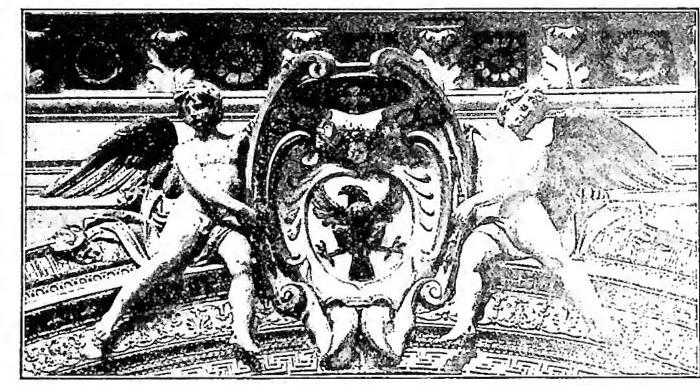
From Agnese C. (born in 1629), married in 1645 to Ansano Zondadari, derives the C. Zondadari branch, established by her brother, Cardinal Flavio (1631–93), who left to her and to her eldest son, Bonaventura (1652–1719), the marquisate of S. Quirico, conferred upon him by Cosimo III in 1677, and his other properties in Tuscany, with the obligation, for himself and his descendants in order of primogeniture, to assume the name and coat of arms of C. Of Agnese’s other children, MARCANTONIO (1658–1722) was elected grand master of the Order of Malta on 13 January 1720; ANTON FELICE (1665–1737), archbishop of Damascus from 1699, was sent by Clement XI, first as extraordinary nuncio to Philip V, then warring in Italy and Spain, and subsequently as ordinary nuncio to Spain from 1706; he was recalled from there in 1709 and had to remain for three years in the State of Avignon; he was created cardinal on 18 May 1712; Alessandro (1669–1744) was archbishop of Siena from