VISCONTI, ENNIO QUIRINO. — Archaeologist, born in Rome on 10 Nov. 1751, died in Paris on 8 Feb. 1818.
Having been granted a stipend by Prince Sigismondo Chigi, from 1775 he began to publish a whole series of important monographs illustrating monuments and inscriptions of ancient Rome. Fundamental among these is *Il Museo Pio-Clementino* (7 vols., Rome 1782–1807), in which all the sculptures of the collection amassed in the Vatican by Clement XIV and Pius VI are described and critically illustrated.
Despite the environment in which he was born and raised, he was drawn to the innovative theories of the French Revolution and sent to Paris a list of Roman citizens particularly hostile to the papal government. This explains his immediate adherence to the republican regime established in Rome by the French army in 1798 and his participation in public affairs (from G. B. and E. Q. Vincenzi, *Il Museo Pio Clementino*, Milan 1818).

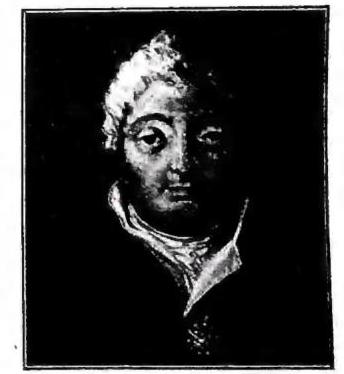
VISCONTI, ENNIO QUIRINO — Portrait. Engraving by Locatelli.
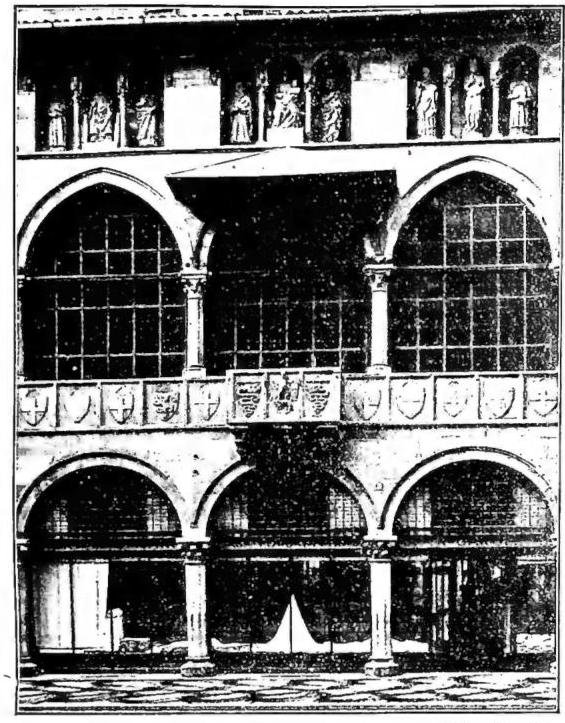
VISCONTI, FAMIGLIA — The Visconti coat of arms on the balcony of the Loggia degli Osti, built in 1316 by Matteo V. — Milan.
First as Minister of the Interior and then as Consul of the Republic, at the same time directing the antiquities section of the National Institute created in Rome on the model of the Institut de France, he soon came into conflict with the new rulers because he opposed their malfeasance, so much so that he was removed from all his offices. The restoration of 1799 prompted him to take refuge in Paris, where he was entrusted with the direction of the Museum of Ancient Sculpture at the Louvre, along with teaching archaeology and ancient history. He spent the last twenty years of his life in Paris, publishing there his major work, *L'Économie grecque*, while leaving *L'Économie romaine* in the course of publication; both works became the foundation of all subsequent studies in the field, despite the advances in archaeological science.
His son Luigi (1791–1853) was one of the greatest architects of early 19th-century France: he designed the expansion of the Louvre commissioned by Napoleon III and the tomb of Napoleon I in the crypt of the Hôtel des Invalides.
VISCONTI, FAMIGLIA — A feudal family from Milan that, from 1277 until its extinction in 1447, held almost uninterruptedly the lordship of Milan, even obtaining the ducal title. Setting aside the courtly legends of the 14th century, historically it is one of those families of captains of the archbishop who, from Archbishop Landolfo (978–98), obtained in fief the tithes of the parishes: in 1157 it indeed possessed a third of the tithes of Marliano; it must already have obtained the office of viscount, whose fiscal advantages it reclaimed in the 13th century, and certainly its coat of arms derived from the bronze serpent in Sant’Ambrogio. The family divided and weakened, with branches found in Cremona and Novara: an Ottone V. died in Rome in 1111 to save Emperor Henry V from rebels.
The known progenitor of the future lords is Uberto V. (in 1248), who had several sons: from one of these was born Tebaldo, father of Matteo I, killed by the Torriani in 1276. His uncle was Ottone V., the future archbishop. The fortune of the house came from this election and from the political skill of his great-nephew Matteo, not from the family’s modest standing. Ottone, a canon of Desio, was sent by the exiled archbishop Leone da Perego to Pope Innocent IV, and by Urban IV in 1262 was chosen archbishop of Milan over two other candidates; but only in 1277, after allying with the expelled nobles and defeating the Milanese at Desio and capturing Napo della Torre, de facto lord of the city, was he able to enter Milan and be elected its lord, though he waged a long and stubborn war against the exiles and other Lombard cities. In 1287 he reduced his rule almost entirely to ecclesiastical authority by having Matteo elected Captain of the People: he died on 8 Aug. 1295 at Chiaravalle; his tomb is in the Duomo. This marks the first phase of Matteo’s lordship (1287–1302), which in 1294 was legitimized by the imperial vicariate of Lombardy granted by Emperor Rudolph, and assumed Ghibelline colouring, or rather relations; though in fact the two Italian parties had local character. Reconfirmed as Captain every five years from 1289, and in 1298 by Emperor Albert, he could not withstand the hostility of the Lombard cities and in 1302 went into exile at Nogarole in the Veronese. The descent of Henry VII in 1310 brought him back as a citizen to Milan, but soon the rebellion of the Guelph Torriani led the Emperor to grant him the vicariate of Milan, and despite Henry’s death, through his skill and that of his sons, by 1315 Piacenza, Bergamo, Lodi, Como, Cremona, Alessandria, Tortona, Pavia, Vercelli, and Novara were subject to him. From 1316 Pope John XXII opposed him, and from 1320 the legate Bertrand du Pouget organized a true coalition against him. Excommunicated and then condemned as a heretic, in 1322 he left government to his son Galeazzo: he died on 24 June at Crescenzago, and only in 1342 was he buried in consecrated ground. By his wife Bonacossa Borri he had five sons (Galeazzo, Marco, Giovanni, Luchino, Stefano) and several daughters. Galeazzo I, born in 1277, was Captain of the People in Milan in 1298, in exile in Ferrara where in 1300 he married Beatrice d’Este, imperial vicar in 1313 for Henry VII at Piacenza of which he later became lord. He fought alongside his brother Marco, a valiant captain, against the Guelph coalition, but upon succeeding his father he had to abandon Milan in 1322, returning the following month and with Ghibelline and imperial aid driving off the Crusaders who had arrived under the city walls. When Emperor Louis arrived in Milan in 1327, by whom he had been created imperial vicar, he was imprisoned in Monza and freed only the following year in Rome: he died on 6 Aug. 1328 at Pescia, taking refuge with Castruccio, lord of Lucca. From Beatrice he had only a son, Azzone, who from the Emperor, in need of money, obtained the vicariate of Milan; upon his return he negotiated with the Pope so that the interdict on the city was lifted. Besieged by Louis for this, he bought him off. Formally submitting in 1331 to King John of Bohemia, he then joined the league against him, thereby obtaining Bergamo, Vercelli, Cremona, Como, Lodi, Crema, Borgo San Donnino, and Piacenza. Finally adhering to the anti-Scala coalition in 1337, he conquered Brescia, but at the war’s end the Company of St George, formed by dismissed mercenaries, marched on Milan and was barely defeated at Parabiago (19 Feb. 1339). On 16 Aug. following Azzone died without heirs. To him are owed the city walls and the Palace next to the Duomo, later the royal palace. He was succeeded first by his brother Luchino, who until then had devoted himself to arms, extended dominion into the Ticino valley,
And in Piedmont with Asti, Tortona, Alessandria, Alba, Cherasco, as well as Parma, Pavia and Pontremoli; his work, less brilliant than that of his brother GIOVANNI, was the necessary preparation for expansion outward and consolidation within, including the establishment of a substantial patrimony. He left only one legitimate child from his third wife Isabella Fieschi, who was excluded from succession. When he died on 24 January 1349, his troops were under Genoa. Government passed to his brother GIOVANNI, who was associated with him in the Signoria. He, a canon of Milan, had been created cardinal of S. Eustachio by the antipope Nicholas V (19–20 January 1329), but had later resigned into the hands of John XXII on 15 September of the same year. Appointed bishop of Novara on 19 August 1331, he became archbishop of Milan on 17 July 1342. He recalled the sons and nephews of his brother Stefano (d. 1327) and of Valentina Doria, who had been exiled by Luchino, designating them as his successors. A magnificent lord and friend of Petrarch, he made peace with his neighbours—Genoa, Savoy, Montferrat, Gonzaga, della Scala—in order to expand toward two vital centres of Italian politics: Bologna, which he obtained from the Pepoli (1350) and for which, after being excommunicated, he secured the papal vicariate; from there he attempted an invasion of Tuscany, ending with the Peace of Sarzana in 1353; and Genoa, which surrendered to him in 1353 after being defeated by Venice and threatened by exiles. With these two acquisitions the Visconti state became predominant in Italy, provoking the formation of a league against it by Venice; during this conflict, on 5 October 1354, Giovanni died at the age of 64 and was buried in the Duomo in the tomb of his predecessor and predecessor Otto.
He was succeeded by the three nephews MATTEO II, GALEAZZO II and BERNABÒ, who divided the duchy into three parts, soon reduced to two after Matteo’s death. Milan remained in common; Galeazzo received the western portion, Bernabò the eastern. The former resided in Pavia, built its castle where Petrarch was a guest, and founded the university; he was less scheming than Bernabò, though beset by successive anti-Visconti leagues, and sought to create a unified state in place of a series of still-autonomous cities. Despite the memory of his “Lent of Galeazzo” (a mounting sequence of tortures and mutilations), he was judged, perhaps by comparison with his brother, a mild man; his wife Bianca of Savoy, sister of the Green Count, exerted influence, belonging as she did to a more refined family and court. He secured for his only son, the young Gian Galeazzo, the hand of Isabella, daughter of John II of France, and recognition of the new standing of the family. He died on 4 August 1378. Far different was his brother Bernabò, born in 1323, also exiled during the rule of his uncle Luchino, and married in 1350 to Regina della Scala, daughter of Martino II; she is remembered in Milan by the theatre named after her, built on the site of a church she founded. A capable woman appreciated by her husband, who was himself very unfaithful (twenty natural children), Bernabò’s eccentric character provided ample material for contemporary novellas. Under him the Visconti state, weakened by division, remained aggressively expansionist and thus the occasion of many hostile leagues (1362, ’67, ’69, ’72), nearly always promoted by the popes. In vain he sought to recover rebellious Bologna, which remained with the Church; in compensation he occupied Reggio in 1372. He married his many daughters with lavish dowries, several to nobles in Germany and Austria, and one, Caterina, even to his nephew Gian Galeazzo, who, perhaps anticipating a move by his uncle, captured him on 6 May 1385 and seized his state. Bernabò died on 19 December 1385 at Trezzo, reportedly poisoned. His tomb, a work by Bonino da Campione, is now in the Castello Sforzesco.
Gian Galeazzo (b. at Pavia on 16 October 1351, d. at Melegnano on 3 September 1406) had fought against his uncle Amadeus of Savoy in 1372 and at Montechiari with Hawkwood in 1373; after his father’s death he showed apparent inertia, suspicious of the greed of his uncle Bernabò.
Having reunited the state, he revealed an ambitious drive, exploiting every weakness of neighbouring and distant states and securing the best Italian condottieri. With unscrupulous skill he used Padua to occupy Verona and Vicenza in 1387, and Venice to obtain Padua in 1388. He resisted the league promoted by Florence and Bologna in 1390–92, losing only Padua in the Peace of Genoa after defeating (1391) at Alessandria the French mercenaries of d’Armagnac called in by Florence. The peace was a truce during which Florence and its allies worked to turn the king of France—husband of a niece of Bernabò—against Gian Galeazzo; to placate him, Gian Galeazzo had given his daughter Valentina in 1387 to the king’s brother Louis, later duke of Orléans. This prevented him from obtaining Genoa, which passed into French hands (1396), while Gian Galeazzo sought compensation from the emperor Wenceslas, who created him duke of Milan on 11 May 1395 and in 1397 granted him the new title of duke of Lombardy. From 1397 to 1399 he vainly attempted to take Mantua, defended by the league and eventually by Venice. In 1399–1400 he became lord of Pisa, Siena and Perugia.
In 1401 the league brought into Italy the new emperor Robert, defeated at Brescia in October; the following year, on 23 June 1402, the league was defeated at Casalecchio near Bologna and Bologna became Visconti territory; Florence was threatened directly, but Gian Galeazzo died only two months later, leaving a state larger than it was strong, after the terrible sacrifices imposed upon it and after he himself had almost single-handedly organized its finances. In his will he divided the state between the sons of Caterina, daughter of Bernabò: GIOVANNI MARIA (b. 1388), duke of Milan, and FILIPPO MARIA (b. 1392), count of Pavia. He is remembered for the reconstruction of Milan’s cathedral and the Certosa of Pavia, where he is buried. The new duke, first under the guardianship of his mother and later of various condottieri, the last being the cruel Facino Cane, was killed on 16 May 1412 and left no heirs. He was succeeded by his brother FILIPPO MARIA, who in a first phase reconstituted his father’s state in Lombardy, Piedmont and Emilia and acquired Genoa in 1421. In a second phase he intervened in Romagna; Florence opposed him, often defeated but inducing Venice in 1426 to intervene out of fear that Filippo intended to retake Verona and Vicenza. This led to constant warfare, though interrupted by truces (1433 and 1441), in which Filippo lost Brescia and Bergamo to Venice. Of suspicious nature, he alienated his best condottiero of early fortune, the count of Carmagnola, who went over to Venice, and alternated between peace and rancour with his son-in-law Francesco Sforza, husband of his only natural daughter, Bianca Maria. He died on 13 August 1447 without naming a true successor, until Sforza was recognized as duke of Milan in 1450. Thus ended the direct line, leaving the rights of the heirs of Valentina, namely the Orléans of France. Bianca Maria died on 23 October 1468 at Melegnano: a cultured and intelligent woman, she had helped her husband consolidate his authority in the duchy.
Of other ancient branches, that of Oleggio (Novara) died out in 1366 with GIOVANNI da OLEGGIO, lord of Bologna (1355–60), which rebelled against Matteo II, and then of Fermo. The line of the dukes of Uberto, brother of Matteo I, continues in Milan; this branch in 1700 received the marquisate of Modrone, raised to a duchy by Napoleon I.