NAPOLEON III, EMPEROR OF THE FRENCH. — Louis N., born in Paris on 20 April 1808, was the third son of Louis Bonaparte, King of Holland, and Hortense Beauharnais, the daughter of the Empress Joséphine by her first marriage. After the Napoleonic collapse, he followed his mother to Arenenberg on Lake Constance, where he was educated by Le Bas in the cult of revolutionary ideas. As a young man he visited Italy repeatedly; he returned there with his mother in 1830. Together with his elder brother, he took part in the Carbonari movement that was to break out in Rome. Expelled from Rome for this reason, he went to Florence and then to Romagna, but the Carbonari did not receive him willingly. After the death of his elder brother in 1831 and of the Duke of Reichstadt (Napoleon II) in 1832, he became the representative of Bonapartism.
In 1836 he attempted to incite a regiment at Strasbourg to revolt, but was arrested and expelled. In 1840 he landed at Boulogne, was arrested, tried for high treason, and sentenced to life imprisonment. Only in 1846 did he manage to escape from the Castle of Ham, disguised as a mason. General discontent with the Orléanist government drew public attention to the Napoleonic prince. He reappeared in Paris from London in 1848, after the fall of Louis Philippe; elected a deputy, in December 1848 a plebiscitary vote brought him to the presidency of the Republic.
The expedition to Rome against the Mazzinian Republic won him the sympathies of the entire Church of France. The coup d’état of 2 December 1851 gave him the legal powers to reorganize the government: the plebiscite of 14 December (seven and a half million votes against 600,000) approved his actions. The new Constitution of 15 January 1852 established that the President would be responsible before the people and remain in office for ten years. A senatus consultum of 4 November decided on the restoration of the Empire, and the plebiscite of 21 November sanctioned it (7,839,000 votes against 253,000). On 2 December 1852 N. III, as he chose to call himself in recognition of the legitimacy of the rights of the Duke of Reichstadt, took up residence at the Tuileries. And in order to create a dynasty, on 30 January 1853 N. married the Spanish noblewoman Eugenia de Montijo, Countess of Teba, who on 16 March 1856 gave birth to the imperial prince Eugène Napoléon.
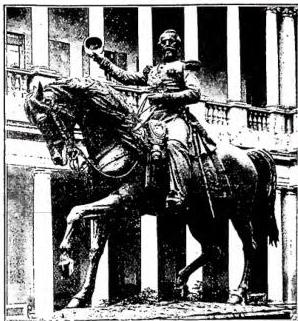
(photograph Alinari)
NAPOLEONE III, IMPERATORE DEI FRANCESI - Monument to N. III. Bronze by F. Barzaghi - Milan.
and state initiative in major public works. Paris was embellished by Prefect Haussmann, who was also following certain plans of political strategy. The elections to the Legislative Corps, skillfully managed by the prefects, caused the opposition almost to disappear: from the elections of 1857, it was reduced to five members. Felice Orsini’s attempt on the Emperor’s life in 1858 provided the police with a good pretext for arresting thousands of suspects. N. III had proclaimed that «l'Empire c'est la paix», yet he felt the moral obligation to free France from the Treaties of 1815, destroy the Holy Alliance that had arisen upon the ruins of the Napoleonic Empire, and restore to France the hegemony that Napoleone I had won for II. The Crimean War soon gave N. III the means to reach an understanding with England against Russia, thereby preventing the formation of European coalitions and subsequently detaching Austria from Russia. Thus the Holy Alliance vanished. The Congress of Paris of 1856 saw all the European diplomats gather around N. III. But it was an ephemeral success: England soon withdrew from the French alliance, and N. III left the Congress in a breach with Russia and Austria. A new phase of his policy now began, as he offered the protection of France to the small European states that were most advanced and adventurous from the liberal point of view. Thus he concluded the Plombières Agreements with Piedmont, which led to the war against Austria in 1859; but after the Battle of Solferino he had, through the Villafranca agreements, to allow Austria to retain Venetia, while the Italian liberal revolution escaped his control and led to the formation of the unified Kingdom of Italy. Through his intervention in Italy, N. III acquired Savoy and Nice, but he was harshly reproached for his Italian policy by opposing parties; he sought to placate the Catholics by becoming inflexible in the defense of the surviving temporal power of the popes, against the demands of Italian unified liberalism, which on the other hand he sought not to alienate: a policy accused of insidious duplicity. He intervened briefly in Poland, provoking the anger of Russia, which he would have liked to make his friend and ally against Austria. Traditional French distrust of the Austrian Empire led him to view with a certain sympathy the anti-Austrian tendencies of the Prussian government. N. III did not understand in time that Austria, troubled by internal struggles and weakened by the defeats in Lombardy, would be forced to yield before Prussia, supported by formidable armaments and by the sympathies of the entire German nation. The conflict that broke out between Austria and Prussia in 1866 led N. III to hope that the two enemies would give him time to intervene as arbiter; but the war was decided at Sadowa before N. III could mobilize and act. Prussia’s triumph was a humiliation for France. The intervention in Mexico also failed, since the Emperor had to withdraw the expeditionary corps in the face of the demands of the United States; Massimiliano d'Austria, who had accepted the throne of Mexico counting on French support, soon became its victim.
N. III sought to restore his prestige by negotiating with the Prussian government for territorial compensation (Luxembourg); when the project failed, he turned to another project, that of a European coalition against Prussia, which had by then become threatening. But Russia had become an enemy because of N. III’s imprudent demonstration in favor of the Poles; the King of Italy, Vittorio Emanuele, made his adherence conditional upon France’s consent to the occupation of papal Rome; Austria waited for the outcome of the Franco-Italian negotiations. Thus N. III’s policy continued to suffer the sad consequences of the equivocal and nebulous positions in which he had placed himself since 1849. His relations with the papacy on the one hand and with the Kingdom of Italy on the other embarrassed him: he had sought to escape from this situation through the Convention of September 1864 (v.) with the Italian government, which, however, had soon been maliciously violated; very soon the Garibaldian attempt against Rome in 1867 (v. MANA, BATTAGLIA di) had forced him to resume his position as official defender of the temporal power, alienating the Italian liberals. Thus, when negotiations for an Austro-Franco-Italian alliance against Prussia failed in 1869, N. III contented himself with a moral understanding with Francesco Giuseppe and Vittorio Emanuele II, hoping for a possible military alliance.
The setbacks in foreign policy had gradually strengthened the opposition. After 1869 N. III began making concessions to the liberals in domestic affairs: he sought to diminish the influence of the clergy in the life of the country; he granted a broad amnesty to political prisoners, though several of them rejected the concession. Having embarked upon the path of constitutional reforms, he granted the Senate and the Legislative Corps the right to discuss government policy. The opposition grew in number: the opposition parliamentarians increased from 5 to thirty-five. The elections of 1869 gave the opposition 3 million votes, against the 4 million given to the government. The party of conciliation, led by the Marseillais Ollivier, demanded the establishment of a genuine parliamentary regime with a responsible ministry. N. III accepted, and charged Ollivier with forming the new government (2 Jan. 1870); the plebiscite of 8 May approved the constitutional reform by 7 million votes against one and a half million. The Emperor had returned to the principles of the Orleanist parliamentary monarchy.
Suddenly the collapse occurred, and responsibility fell upon the parliamentary government for which Ollivier was responsible. The Spanish question was its cause: fear that Prussian influence might succeed in displacing French influence in Madrid led the French government to ask the Prussian government that Prince Hohenzollern, to whom the Spanish throne had been offered, renounce II. Not content with Prussia’s acceptance of the request, Ollivier’s government sought to impose a commitment for the future that would represent a public diplomatic victory for the Napoleonic Empire. The refusal by the government in Berlin determined the breach between the two countries. N. III was unable to oppose the errors of the government for which he was no longer responsible, nor was he able to conclude an agreement with Italy and Austria. The Franco-Prussian War was rapidly decided at Sedan, where N. III, surrounded, had to capitulate with 80,000 men (2 Sept. 1870). Two days later, the revolution (v. COMUNE [LA] DI PARIGI) broke out in Paris, and N. III was declared deposed by the Chamber, together with his family. Released after the Peace of Frankfurt, N. III withdrew to England: he died at Chislehurst on 9 Jan. 1873 and was buried there.