
HOHENZOLLERN, DYNASTY of. — The cradle of the dynasty that rose to become a great power in Prussia is located in the Swabian Jura: on a ridge at 800 m. stand the ruins of Zollern Castle. They were originally minor vassals of the Staufers: at the end of the twelfth century FREDERICK of Zollern became burgrave of Nuremberg; the Swabian domains were expanding, while others were added in Franconia, so that at the death of Frederick III the family divided into two branches (1201): CONRAD III established the line of the burgraves of Nuremberg with the Franconian possessions, while FREDERICK IV retained the title of count of Zollern with the Swabian possessions. The line of Zollern branched extensively; marriages and inheritances created a rich patrimonial basis
for each of the branches; the H.-Hechingen line died out only in 1869, and in 1891 the H.-Sigmaringen line also died out, of which one branch survived, represented by the dynasty reigning in Romania since 1866.
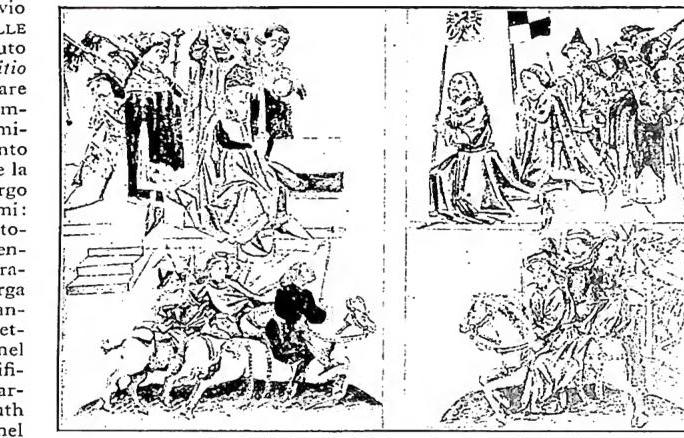
The burgravial dynasty of Nuremberg shifted the center of its activity at the beginning of the fifteenth century, when Emperor Sigismund, in recompense for the support given him by FREDERICK VI of H., granted him the margraviate of Brandenburg (1415). Frederick VI thereby acquired such prestige that, at Sigismund’s death, the electors remained uncertain between Albert of Habsburg and the Brandenburg elector. The H. were to attain the imperial crown four centuries later. In
1486 the margrave ALBERT ACHILLES established a family statute (Dispositio Achillea) to prevent the dangerous partition of the domains. Nevertheless, it was precisely under Albert Achilles that the House of Brandenburg divided into two branches: one retained the Brandenburg electorate, the other the burgraviate of Nuremberg and the Franconian possessions. In the sixteenth century the electoral house displayed various branches, such as the margraves of Bayreuth, who died out in 1769, and the margraves of Ansbach, who died out in 1807. The Ansbach branch
included at the beginning of the sixteenth century ALBERT of H., who in 1511 was elected grand master of the Teutonic Order; in 1525 he adhered to the Lutheran Reformation, dissolved the Order, and proclaimed himself duke of Prussia, rendering feudal homage to the king of Poland. The H., dukes of Prussia, died out as early as 1618 with ALBERT FREDERICK, whose succession was assumed by the Brandenburg elector JOHN SIGISMUND, who consented to render homage to the king of Poland, undertaking to guarantee Catholics the free exercise of their religion. The electors of Brandenburg had in fact adopted the Lutheran Reformation in 1539 under JOACHIM II (1535-71). As a consequence of the acquisition of Prussia, the H. of Brandenburg had two principal centers of dominion: those of Brandenburg, by virtue of which they were dependent upon the emperor in Vienna, and those of Prussia, by virtue of which they were vassals of the king of Poland. In 1657 FREDERICK WILLIAM I succeeded in freeing himself from the bonds of vassalage to Poland, and from that moment he was a completely independent prince in Prussia.
The family agreement of Gera of 1603 established that the domains of the dynasty should be indivisible and should pass only through the line of primogeniture. Consequently, when the families holding them died out, the Franconian margraviates passed to the principal Brandenburg branch. During the seventeenth century, expansion had been pursued through a skilful policy of marriages and inheritances. In the seventeenth century the great European wars opened to the electors of Brandenburg the possibility of achieving the unification of their various domains through conquests on several fronts. The Thirty Years’ War placed the existence of Brandenburg in jeopardy, caught between the Swedes and the Imperial forces, but it revealed to the electors the necessity of a skilful policy of oscillation between the contending parties. GEORGE WILLIAM did not yet adopt a definite position; greater energy was displayed by his son FREDERICK WILLIAM, known as the Great Elector (1640-88). At the Peace of Westphalia he obtained Eastern Pomerania. This was the first revelation to the H. of the possibility of expansion: a political program was then begun, aimed at asserting themselves among the second-rank powers within the Empire. The Great Elector organized a standing army, creating from the feudal elements a corps of trained officers; he reorganized the finances into a regular system of taxation; he gave the government an organic administration with permanent, salaried, and disciplined officials; he repopulated the lands devastated by the wars by welcoming the French Huguenots expelled from France by Louis XIV with the revocation of the Edict of Nantes; he gave the house and the country an example of pietistic and fanatical religious policy through absolute devotion to Lutheran traditions and legislation hostile to Catholicism. Thus, applying what could be called
the fundamental characteristics of the race—tenacity, discipline, and frugality—the Great Elector laid the foundations of the Prussian state: a disciplined and loyal army based on the devotion of the feudal nobility, happy to provide the officers, and of the agricultural class, blindly obedient; a state administration organized militarily, with officials convinced that they were carrying out a mystical mission in the service of God and their prince; devoted populations willing to let themselves be manipulated by the
prince who did and arranged everything. The Battle of Fehrbellin in 1675 revealed to Europe an unsuspected political reality: a new country organized by a dynasty; an army and a bureaucracy directed by the will of a prince; a single program of dynasty and people: loyalty, honor, discipline.
FREDERICK III, with a different intelligence but equal tenacity, continued his father’s work (1688-1713). He knew how to take advantage of the wars at the end of the seventeenth century and the beginning of the eighteenth to compel the imperial House of Habsburg, which needed his military contribution, to recognize his desire to become king. The Emperor recognized him as king of Prussia, the former Polish fief in which the H. were absolute masters. On 18 January 1701 Frederick crowned himself in the cathedral of Koenigsberg and, in memory of the event, founded the chivalric Order of the Black Eagle.
The H. state now acquired a new importance in Germany; in the face of the Empire, the Kingdom of Prussia, of which electoral Brandenburg and the other feudal domains were merely appendages, appeared as an independent and dangerous power. The H. were to become the gathering center of all the German Lutheran forces against the Catholic Habsburg Empire. Frederick III (now King Frederick I) encountered no small opposition from the European princes to his recognition, but he placed his troops at the Emperor’s service and remained loyal to him. At the Peace of Utrecht he obtained a considerable territorial enlargement: the H. now had three principal groups of domains—those of Prussia, Brandenburg, and the Rhine—not counting their ancestral fiefs in Sveria and Franconia. Relations among the various groups were difficult. FREDERICK WILLIAM I (1713-40), with great patience, set about consolidating the organization of the state: he felt that the day of trial would not be long in coming. Miserly and dominated by a passion for gold, throughout his reign he was preoccupied with the need to create a strong and numerous army. His measures ensured that the
career in arms became the absolute occupation of the nobility, and the educated class came to regard the bureaucracy as the most prestigious career after that of the military. It was Frederick William I who created the Prussian tradition of precision in state services. The last of the great H. was FREDERICK II the Great (1740–86). Like his father, he faithfully observed the principle that the king ought to be the first servant of the State and ought to set the example of continuous, methodical work in government. He nevertheless wanted his State to be not merely militaristic and bureaucratic, but also civil and cultivated, and he strove to create in Prussia a tradition of culture—not by initiating it, but by imposing II. The idea that Prussia would ultimately be Austria’s rival led him to undertake war without hesitation in order to wrest Silesia from his enemy, while the partitions of Poland gave him the opportunity to unite Brandenburg and Prussia firmly. The Seven Years’ War brought the H. to the brink of ruin: they emerged from it, in spite of everything, as the masters of one of the principal powers of Europe. The French Revolution brought the new democratic political conceptions into conflict with the old world dominated by monarchical traditions. The H., defeated by Napoleon, lost a large part of their domains, but remained faithful to their dynastic traditions. Thus, after the fall of the Napoleonic Empire, FREDERICK WILLIAM III (1790–1840) sought to preserve his autocratic power by relying on the bureaucracy and the army, in which the aristocracy predominated, jealous of preserving its privileges. Around him, however, the parties were in agitation: the absolutists and the liberals. He heard talk of national unity, but distrusted unitarism and the unitarists; he wished to preserve Prussia intact, as his ancestors had entrusted it to him. Thus, during the liberal crisis of 1848, FREDERICK WILLIAM IV (1840–61) was deeply distrustful of the liberals who dreamed of German unity and wished to offer the imperial crown to the King of Prussia. A traditionalist, he was a convinced follower of the divine right of kings and hated constitutions. But the renewal of the conflict with Austria over the Danish duchies and the war of 1866 confronted Prussia with the definitive problem of the political arrangement to be given to Germany. The minister of WILLIAM I (1861–88), Count Bismarck, while veiling the dispute with Austria at the appropriate moment so that it would not reach its ultimate consequence—the destruction of the Viennese Empire—knew how to bind the fortunes of the H. dynasty closely to the urgency of the conflict with France for German independence. Thus, at Versailles, on 18 January 1871, William I assumed the crown of emperor of the Deutsches Reich, in which there was to be a reconciliation between the absolute, militaristic traditions of the H. and German liberal unitarism. The experiment failed under WILLIAM II (1888–1918); in this prince some of the traditional qualities of his lineage appeared, but not the best ones. The H. dynasty fell through the abdication of William II after the armistice of Rétondes, on 11 November 1918; it had nevertheless given Germany the political unity that was to survive.