
SIGISMONDO of LUSSEMBURGO, emperor. — Second son of Carlo IV of Lussemburgo, king of Bohemia and emperor, and of Maria of Valois, daughter of Filippo VI, king of France, b. in Prague on 15 February 1361. His father secured the crown of Hungary for him, but S. encountered strong opposition from Carlo di Durazzo and could be crowned only in 1387, after Carlo’s assassination. Under S., the Kingdom of Hungary was repeatedly troubled by the Turkish threat: in 1396 S. was defeated by Sultan Murad at Nicopolis. He also fought repeatedly and unsuccessfully with Venice for possession of Dalmatia and the patriarchate of Aquileia.
Elected king of the Romans on 20 September 1410, he was recognized by all on 21 July 1411. His only financial base, however, was the Kingdom of Hungary, and in order to rely upon it he was forced to turn to the great Magyar aristocracy and to favor the scant bourgeoisie of the Hungarian cities in order to obtain money; thus he did not hesitate to assert rights over the bishoprics. The heavy taxation, weighing particularly upon the rural classes, produced discontent and rebellions. As for the affairs of the Empire, as early as 1411 he ceded the march of Brandenburg to a faithful partisan of his, Federico di Hohenzollern, burgrave of Nuremberg, laying the foundations of the power of that dynasty. Concerned by the fortunes of the Teutonic Order, in crisis after the defeat at Tannenberg, he induced the victor, Ladislao of Poland, to agree to a lenient peace at Thorn. Believing that, as king of the Romans, he had the right to act on behalf of the Church to end the schism, he reached an agreement with Giovanni XXIII at the meeting in Como (1413) for an ecumenical council to be convened at Constance on 1 November 1414; and indeed it was opened by Giovanni XXIII on 5 November 1414. After the conciliar decision that the three rival Popes should resign in order to restore unity, he acted energetically against Giovanni XXIII, who refused to do so, and against Federico of Austria, his protector. To persuade the Avignonese pope Benedetto XIII to yield, the Emperor went as far as Perpignan (July–November 1415). He did not achieve his aim, but succeeded in inducing the Spanish monarchs to submit to the Council. Concerned by the spread of the Hussite heresy in Bohemia,
(fot. Boissonnas)
SIGISMONDO, king of the BURGUNDIANS, saint, martyr — Reliquary chest of St. S. Romanesque art (12th century) — St-Maurice, Treasury of the abbey church.
he wanted Giovanni Hus to appear before the Council and granted him a safe-conduct. He nevertheless encouraged the Council to combat the heresy, attended Hus’s trial, and approved his condemnation to the stake.
When the king of Bohemia Venceslao died (18 August 1419), succession belonged to his brother, S.; but in Bohemia the nobles and burghers now demanded that S. recognize the four articles proclaimed by the University of Prague, the foundations of their faith. The religious conflict was compounded by an antagonism of the Bohemian nation toward Germany, which looked to S. as its leader. He ordered the rebels to return to the Catholic Church; the consequence was open rebellion, directed against the town of Hradista, which the Hussites called Tabor. The military leader of the rebels was Jan Žižka. S. had Martino V preach a crusade against the heretics and, with the German princes who recognized him as king of Bohemia, organized a military expedition. He succeeded in entering Prague Castle and having himself crowned (28 July 1420), but immediately afterward had to withdraw. Subsequent expeditions by the German crusaders failed. In Bohemia the Diet declared that it no longer recognized S. as king and sought another: Vitoldo of Lithuania, when invited, sent his nephew Korybut, who was made regent and was then recognized as king by part of the Czechs; but a rebellion soon broke out against him as well, and in 1427 he was expelled. Throughout these years the country remained without a true government: various tendencies arose among the rebels; opposed to the Taborites were the Utraquists, who in turn persecuted other, more advanced religious currents. Žižka was succeeded in military command by the priest Procopio, who in 1427 repelled a new German expedition led by Alberto of Austria, S.’s son-in-law. Procopio then went on the offensive, and his fanatical bands invaded Germany at various points. Negotiations for an agreement took place only after 1432, through the efforts of the Council of Basel and S., with the more moderate rebel groups. After Procopio disappeared in an internal conflict in 1434, the moderates prevailed, and S. acted as mediator between the Council and his subjects. On 5 July 1436 at Iglau, the compactata were established, restoring religious peace in Bohemia in an equivocal manner. In August S. was finally able to return to his Kingdom. In Germany too S. made only very brief stays after the close of the Council of Constance, arousing great discontent among the princes, who in 1421 threatened him with deposition. Crowned king of Italy at Milan and then emperor at Rome (31 May 1433), S. thought he would be able to assert his authority in Germany with renewed energy. After his death there was talk of a reformatio Sigismundi that would have curtailed feudalism, secularized the ecclesiastical princes, abolished serfdom, and imposed strict ecclesiastical discipline. During his reign S. succeeded in considerably asserting imperial prestige. He died at Znaim on 9 December 1437, while the breach between Eugenio IV and the Council of Basel—which he had sought to prevent—was taking place. — Vedi tav. XXXVII.
SIGISMONDO I Jagellone, called the Elder, king of POLAND and grand duke of LITHUANIA. — Son of Casimiro and Elisabetta of Habsburg, b. at Kraków on 1 January 1467, d. there on 1 April 1548, he was elected to the throne of Lithuania on 20 October and to that of Poland on 9 December 1506, thanks to the reputation of a capable administrator that he had earned in the Silesian Duchy.
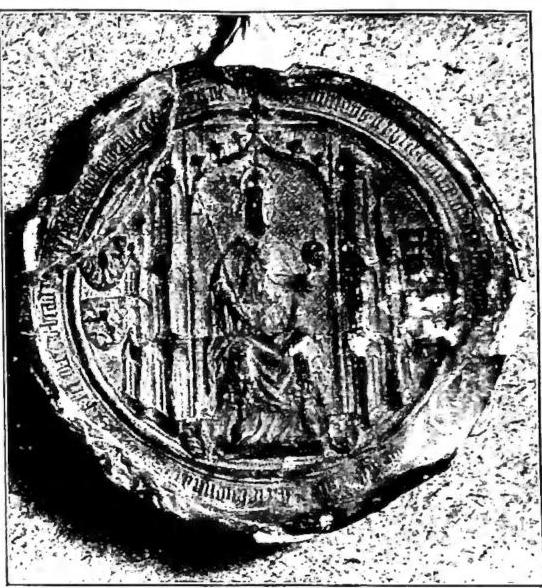
(from J. Boson, Pätiographie valdôtaine, II. Aosta Dél., p. 10) SIGISMONDO DI LUSSEMBURGO, emperor — Great seal of S. attached to a privilege granted by the Emperor to the Canons of St. Orso (16 July 1418) — Aosta, archive of the collegiate church of SS. Pietro and Orso.
find satisfaction for their mutual conflicts at the expense of the Polish Respublica nobiliaris—while internally the nobility had grown increasingly rebellious and intended to dominate the state, subjecting royal power to itself.
Under these conditions S. sought to confront all his enemies prudently and separately: first of all he attacked Muscovy, and, between 1507 and 1537, three successive wars, although they did not lead to a decision, paved the way for future solutions and for a five-year truce; meanwhile, in 1515, he had succeeded in resolving every disagreement with Austria and thus, having isolated the Teutonic Order, in 1520 he defeated its grand master, Alberto di Hohenzollern, approved its secularization, and in 1525 Duke Alberto received East Prussia as a vassal of Poland. Finally, keeping watch against Tatar incursions, he defeated Moldavia, a vassal of the Turks. On the other hand, in domestic policy, S. failed to impose himself upon the nobility, which, in 1537, during the campaign against Moldavia, compelled him to guarantee the free election of kings and not to permit any modification of the electoral law. Beyond these problems and difficulties, his reign is characterized above all by the rapid establishment of Renaissance civilization in Poland, thanks to the King’s splendid patronage and the activity of his second wife, Bona Sforza, who exercised great influence over S. and considerable interference in political life. The Protestant revolution penetrated Poland around the middle of S.’s reign through the mercantile bourgeoisie, especially the German bourgeoisie, of Danzig and East Prussia, and S., profoundly Catholic, opposed its spread by every means, even though it reached his own court. Nevertheless, on the whole, when he closed his eyes at Cracow, S. had not permanently resolved any of the problems of foreign or domestic policy of the Polish-Lithuanian state, and they would reappear, aggravated, after his death.