COMO, DIOCESE OF. — In Lombardy it forms part of the province of C.; it comprises the whole of Sondrio (province: 3,123 sq km), as well as the Marchirolo and Cuvio valleys with Saltrio in the province of Varese. Originally it also included Poschiavo in the canton of Grisons and the entire canton of Ticino, the latter being detached in 1886.
In 1858 the diocese consisted of 507 parishes (178 in C. and its province, 140 in Sondrio and its province, 186 in the canton of Ticino, and 2 in the canton of Grisons), 2,102 priests, and 360,089 faithful. At present (1948) it has 360 parishes, 605 diocesan priests and 200 religious priests, serving 379,600 faithful out of a population of 380,000. There are 15 male orders and congregations, 35 female congregations, 2 seminaries, and 2 pro-seminaries. The bishop held the title of count; the patron saint of the diocese is s. Abbondio, whose feast is celebrated on 2 April; the titular of the Cathedral is S. Maria Assunta.
I. HISTORY
C. first appears in history ca. 196 B.C.; in 87 it enjoyed Latin rights, and under Julius Caesar it took the name Novum Comum and became a Roman colony.Narses (d. 568) made it a defensive stronghold; subsequently it became a county, with the bishop at the head of the new political entity; around 1100 the commune arose.
C., destroyed in the struggle against Milan (1118–27), was soon rebuilt and recognized as independent in the Peace of Constance (1183). The Guelph and Ghibelline struggles followed, intensified by the Rusconi and Vitani factions and by the repercussions of the Visconti and Torriani conflicts; Franchino Rusca ceded it (1335) to Azzone Visconti; in 1447 it was proclaimed the Republic of S. Abbondio; during the Franco-Spanish-ducal conflicts it was sacked (1521) by Pescara. For two centuries C. remained under Spanish rule, then being assigned (1714), with the Peace of Rastatt, to Austria; united with Cisalpine in 1789, it returned to Austria in 1814 and in 1859
was incorporated into Piedmont; in 1927, after the district of Varese had been taken from it, it remained with 224 communes and 456,988 inhabitants over an area of ca. 2,668 sq km. (Grande illustrac., III, Milan 1859, p. 746).
Among the many distinguished people of Como, the outstanding figures are: Gaius Pliny the naturalist (23–79), Caecilius Pliny the man of letters (64–118), Paolo Giovio the historian (1483–1552), Benedetto Giovio the historian and poet (d. 1544), and Alessandro Volta (1745–1826).
II. ECCLESIASTICAL HISTORY
The origins of Christianity in C. are obscure; the first bishop, St. Felice, was consecrated in 379 by St. Ambrose, converted several citizens to the faith, and inaugurated the first church on Baradelle Hill, where he established his see. Until 1945 the diocese had had 110 bishops, 4 of whom had been honored with the purple, and 8 of whom belonged to religious Orders.Noteworthy among them were St. Provino and St. Amanzio (450–89); St. ABBONDIO, SANTO (v.), who organized the diocese, destroyed the pagan cults on the shores of Lake Lario and on Comacina Island, and extended his activity into Valtellina, for which reason he was declared its patron. Under Agrippino, because of the diocese’s adherence to the schism of the Three Chapters, it passed from the ecclesiastical province of Milan to that of Aquileia, from which it adopted the patriarchal rite. When the schism ended, C. nevertheless remained subject to Aquileia. Titles and privileges were granted and increased by Charlemagne, Louis the Pious, Lothair, and others. Pietro III attended the Roman Council of 998; Guido Grimoldi (1096–1126) had as his opponent the pseudo-bishop Landolfo Carcano, an adherent of the Errician party; under Blessed Guglielmo della Torre and Umberto Sala, the Dominicans and Friars Minor were introduced into the diocese, and under Benedetto da Asniago, the Augustinians. During the Western Schism (1378–1415), the diocese remained with the Roman pope until the election of the Pisan pontiff Alessandro V (1409–1410); Bishop Turconi resigned his see to Martino V; Giannantonio Volpi (1559–88), together with the Friars Minor of Milan, mounted strong resistance to the heretics in Valtellina; and there the archpriest of Sondrio, Niccolò Rusca, won the crown of martyrdom (4 September 1618). Paolo Cernuschi (1739–46) founded the seminary of S. Orsola, and Carlo Romano the seminary of S. Abbondio.
During the Middle Ages, until 1223, the bishop was appointed by the canons of the Cathedral together with the abbots of the three abbeys of Como, S. Abbondio, S. Carpoforo, and S. Giuliano.
The patriarchal rite gave way to the Roman rite during the episcopate of Filippo Archinti (1595–1621); in 1751 Benedict XIV restored the diocese to the status of a suffragan see of Milan.
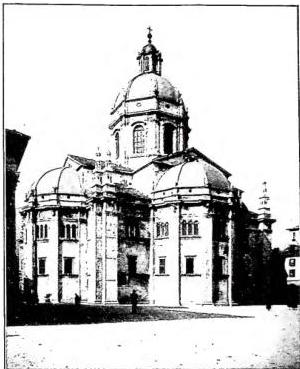
The episcopal see remained at S. Carpoforo until about 480; St. Abbondio transferred it to the Holy Apostles (S. Abbondio from 818), and from 1093, in the city, to S. Maria, where the present Cathedral stands.
The diocese has celebrated sanctuaries that are destinations for frequent pilgrimages: the Basilica of the Most Holy Crucifix in C., the Madonna of Tirano, S. Maria del Soccorso at Lenno, Gallivaggio above Chiavenna, and S. Maria delle Lagrime of Dongo.
III. ILLUSTRIOUS PERSONAGES
A native of Como was the ven. Innocenzo XI (Benedetto Odescalchi, d. 1689); 13 cardinals, among them Tolomeo Gallio (d. 1607); Antonio Rusconi, superior general of the Friars Minor (d. 1449); the martyr Nicolò Rusca; Daniele Cassomo O. F. M., Minister of State in Spain (d. 1654); Primo Luigi Tatti, a Somascan (d. 1676); and Giuseppe Rovelli (d. 1813), distinguished historians; friar Emmanuele da Como, painter (17th cent.); d. Santo Monti, a distinguished recent historian; ven. Luigi Guanella (d. 1915), founder of the Servants of Charity and the Daughters of St. Mary of the Presentation.IV. ABBEYS AND MONASTERIES
C. is renowned for its ancient abbeys, monasteries, and male and female convents. In the city: the Benedictine abbeys of S. Abbondio (1010), S. Carpoforo (1040), and S. Giuliano (1055); the monastery of S. Michele delle Benedettine at Monte Olimpino (1164); the prepositure of the Humiliati (1134), called Rendineto, mother house of other establishments; the outlying monastery of S. Benedetto del Monte Olterone in Valle Perlasca (1083); S. Maria at Torello (Lugano), belonging to the Canons Regular (1217); S. Maria di Acquafredda of the Cistercians above Lenno (c. 1142); Cluniac priories: S. Pietro di Vallate (Cosio) in Valtellina (1078), and S. Nicola di Piona on Lake Como (1110); the collegiate church of S. Eufemia on Isola Comacina, erected in 1031, was renowned; convents and monasteries of almost all the religious Orders, which disappeared as a result of the laws suppressing the freedom of the Church.V. ISTITUTI DI CULTURA
C. had the first printing press in 1474, established by Ambrogio de Orchi; from the sixteenth century onward it produced historians, men of letters, theologians, orators, and scientists.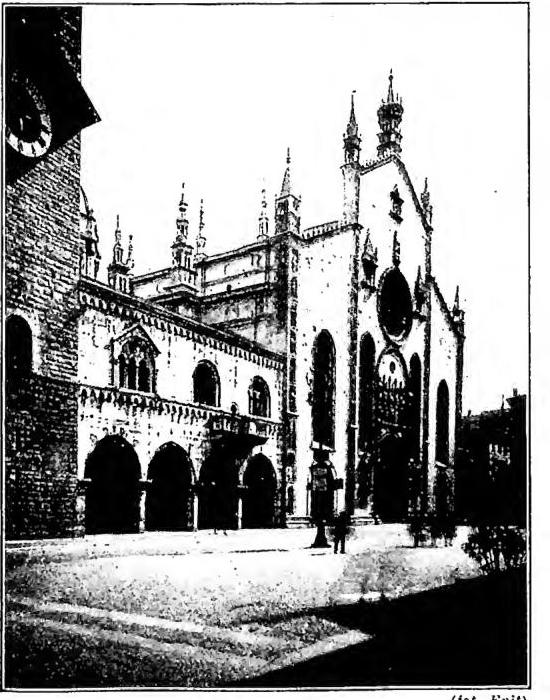
VI. MONUMENTS
C. preserves many Christian inscriptions dating as far as the 11th century. Parts of the ancient city walls of 1192 still survive, as do three of the ancient towers and the square one, called Porta Torre, which is at(Enit photograph)
COMO – Façade of the Cathedral (late 14th–15th century).