
LUDOVICO il Pio, re dei Franchi, IMPERATORE. - Le caratteristiche dominanti del carattere e del regno del figlio (n. a Chasseneuil nel 778) e successore di
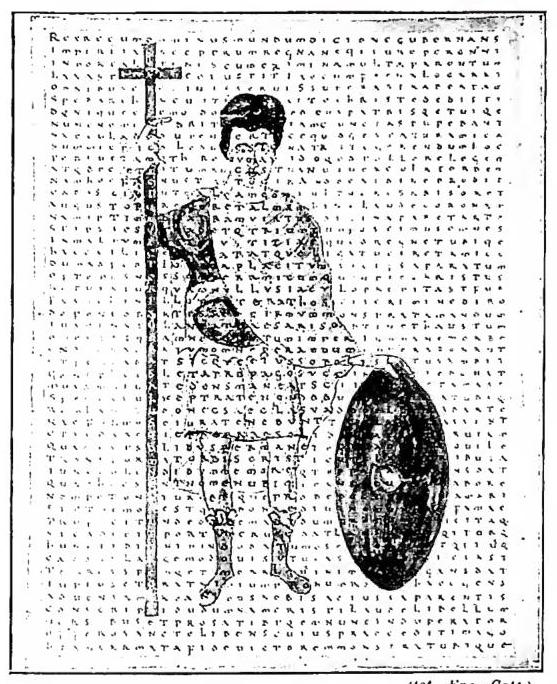
LUDOVICO IL PIO, RE DEI FRANCHI, IMPERATORE - Portrait of the Emperor. Miniature (ca. 840) in the codex containing the Laudes sanctae Crucis of Rabano Mauro, from the monastery of Fulda - Biblioteca Vaticana, cod. Reg. lat. 124, f. 4°.
Carlomagno are ecclesiastical influence and the weakness of authority. Although endowed with physical vigor and a solid Greek-Latin culture, acquired at the school of s. Benedetto di Aniane, L. lacked the resoluteness indispensable to a man of government. Preferring monastic humility, he forgot the grandeur of the imperial dignity to the point of accepting, at Attigny (822), the public confession of his penance for the punishment inflicted on his nephew Bernardo d'Italia. He lent himself to the game of the court, and rivalries degenerated into open civil wars.
The structure of the Empire undoubtedly remained similar to what it was under the preceding reign: identical geographical extension, same organization. But from the fact that the work of Carlomagno had remained unfinished, a crisis arose: Carlomagno had made himself protector of the Holy See; L., docile to the clergy that had educated him, had himself crowned by Stefano V (Oct. 816) and renounced all jurisdiction over Roma (privilege of 817); but later (824), under the influence of the "imperialist" Wala, abbot of Corbie, he withdrew the concessions previously made and demanded an oath of fidelity from the Pope. The bishops, however, affirmed the preeminence of the priesthood over the Empire and imposed a reform of the clergy (829).
The imperialist ideal of unity was opposed by the persistence of the practice of territorial partitions, by ambitions, by individual interests that reached the point of exasperation, and by regional particularisms: the Ordinatio of 817 had associated Lotario, the eldest son of the Emperor, to the throne, and assigned Aquitania and Germania to the two younger sons Pipino and Luigi. To please his second wife Giuditta, married in 819, the Emperor made a fourth share for the son had by her, Carlo (later called the Bald), in the territories already assigned to the other sons (829): these, with the help of Wala, who had been removed from the court to favor Bernardo di Settimania, plotted against their father. Lotario for a moment even snatched power from him (830). But L. succeeded in removing him, and, in a third partition, took Aquitania from Pipino to give it to Carlo. The sons of L. rose up a second time against their father and the forces of the two sides clashed in Italia. Abandoned by his soldiers at Retfeld (the "field of lies"), near Colmar, on June 24, 833, L. was taken prisoner by his own sons, despite the mediation efforts of Pope Gregorio IV.
In the abbey of S. Medardo at Soissons, before a diet presided over by Lotario, the Emperor was accused of having disturbed the peace and violated oaths; forced into a public confession, he had to strip off his royal garments and insignia, put on the garb of penitents, and was locked in a prison (Oct. 1, 833). The extremity of this humiliation altered the feelings of his sons Luigi and Pipino toward their father; they restored him to the throne and helped him drive back into Italia Lotario, whose preeminence they did not look upon favorably.
Crowned anew in 835, L. reigned until his death, which occurred in 839. While on the one hand he still had to experience the hostility of his son Luigi il Germanico, on the other he was reconciled with Lotario and, after the death of Pipino, in 839 he was able to proceed to a final partition. Luigi, ever in revolt, received nothing beyond what he had previously received; Lotario, made emperor, divided the rest of the Empire with Carlo, following a demarcation line constituted by the Mosa, the Saona, and the Rodano. A fragile solution, since to the rivalries of the princes were now added the tendencies toward autonomy of Italia, Aquitania, and Catalogna, and at the frontier the incessant incursions of the Saracens and Normans.
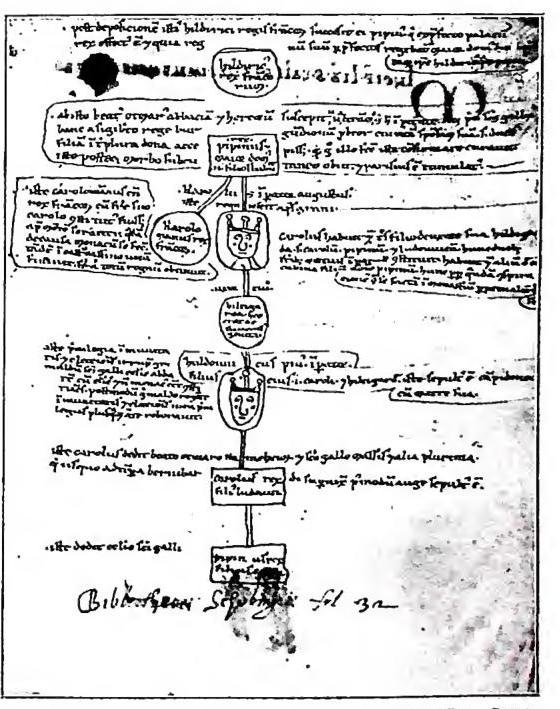
LUDOVICO IL PIO, RE DEI FRANCHI, IMPERATORE - Genealogical table of the Carolingians who granted privileges to the abbey of St. Gallen, placed as an appendix to the Vita of Charlemagne, written by Einhard - Vatican Library, cod. Reg. lat. 339 f. 7°.
Frutaz, VI, nn. 219-90; G. Calmette, L'effondrement d'un Empire et la naissance d'une Europe, Parigi 1941; L. Halphen, Charlemagne et l'Empire carolingien, ivi 1947 (con bibl.); H. Fichtenau, Das Karolingische Imperium. Soziale und geistige Problematik jenes Grossreiches, Zurigo 1949; L. Halphen, A travers l'histoire du moyen âge, Parigi 1950, pp. 58-74. Guglielmo Mollat
LAW - Under Charlemagne there had been an overlapping of civil and religious powers, with the prevalence of civil power over religious power. Under L. the situation was reversed: it was the Church that sought supremacy and to put the authority of the State at its service. L. cooperated in this action by promoting the religious and moral progress of Christendom through a general reform intended to repress abuses that had long existed in the Church. His legislative activity is preserved in capitularies that encompass religious and civil matters; some Misterium capitularies also remain, as well as a capitulary for the monastery of S. Croce del Poitou founded by the b. Radegonda. Two were transmitted under the name of Capitula, since one contains canons drawn from various councils and the other fragments taken from Roman legislation. Some of these capitularies also concern Italy. In L.'s legislation these main reforms are advocated: the administration of ecclesiastical property from now on belongs solely to the Church; bishops are to be elected freely; monasteries are authorized to choose regular abbots for themselves, with the commendatory system ceasing at least provisionally; abbots are bound only to those military services that are sanctioned in the laws. Reforms are also promoted in the moral field, especially regarding the chastity of bishops and the abduction of virgins (cf. Cap. I, pp. 275-85). The same spirit, which sometimes manifests itself even with the same words, is found in the Admonitio ad omnes regni ordinis (ibid., pp. 303-307).