
SOISSONS, DIOCESI di. — City and diocese in the department of Aisne in France. S. is ancient Noviodunum, center of the Gallic tribe of the Suessiones, later Augusta Suessionum of the Romans in Belgica Secunda. The diocese has the same dimensions as the civil department, namely an area of 7,367 sq. km., and a population of 455,000 inhabitants, of whom 423,000 are Catholics. It is divided into 2 archdeaconries, 5 deaneries and 37 rural deaneries; it has 578 parishes, served by 481 diocesan priests and 26 religious priests; it has a major and a minor seminary, 2 male and 59 female religious communities (Ann. Pont. 1953, p. 405). It is suffragan to Reims.
The archdeaconry of S. comprises the deaneries of S., Château-Thierry and Vervins; Laon (v.) comprises those of Laon and St-Quentin. Of 834 municipalities, 21 have no churches. The martyrs of S. were the ss. Crispin and Crispinian, commemorated in the Hieronymian Martyrology on 25 October; the Basilica erected in their honor is mentioned by Gregory of Tours (Hist. Francorum, V. 34; IX, 9), but their Passio is entirely legendary (BHL, 1990-93); the same must be said of the Passio of the martyrs Valerius and Rufinus (ibid., 7373-75), listed in the same Hieronymian Martyrology on 14 June, “in territorio Suessionis civitatis.” In his Historia Remensis (I, 3), Flodoard wrote that S. had the first two bishops, Sixtus and Sinicius, in common with Reims; at the end of the 3rd century or the beginning of the 4th, Divizianus was sole bishop of S.; he was succeeded, it is said, by Rufinus, Mercurius and Principius, to whom Sidonius Apollinaris wrote ca. 475; then by Bandaridus; and by Drusius, known from several documents dating from 660–67. In the time of Pope Zacharias, the Council of S. took place on 3 March 744 (Hefele-Leclercq, III, pp. 854-61; bibliography, p. 1248 suppl.; IV, pp. 192-96). Rotadus I attended the Council of Noyon in 814, where the boundaries between his diocese and that of Noyon were established; he took part in the Council of Paris in 829 and is mentioned in the account of the translation of the relics of St Sebastian in 826. Rotadus II, who was expelled in 861, appealed to Pope Nicholas I, who reinstated him in 865. Then came Hugh of Champfleury (1159-75), who was chancellor of Louis VII; Guy of Château-Porcien (1245-50), who accompanied St Louis to Palestine and was killed there; and Languet de Gergy (1715-30), author of a Life of St Mary Alacoque. The bishop of S., as dean of the suffragans of Reims, had the privilege, during periods when the see of Reims was vacant, of celebrating the ceremonies for the coronation of the kings of France. In the first half of the 12th century, a feudal county was established which successively belonged to various noble families: Bar, Nesle, Coucy, Luxembourg, St-Pol, Bourbon-Vendôme and Bourbon Condé, and finally the Savoy-Carignano family.
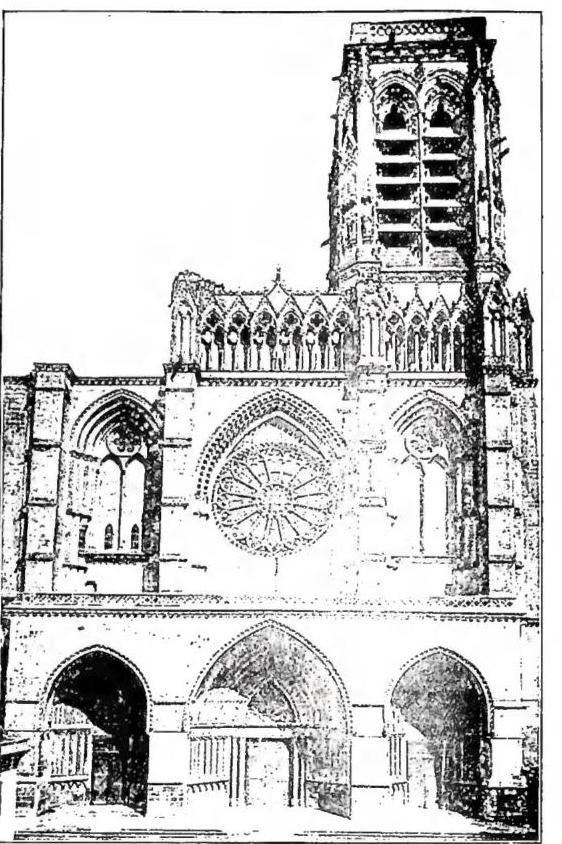
The Cathedral, dedicated to the martyrs Gervasius and Protasius, dates from the 13th century; but the façade was modified in the 18th century. It is flanked by two towers: the one to the north remained unfinished, while the other, to the south, 66 m high, was damaged during the 1914–18 war. The interior measures 100 × 27 m and reaches a height of 30 m; it was damaged by bombardment, restored and reopened for worship in 1931. The central nave is divided by cylindrical pillars. The transept was begun in 1177: in the arrangement of its choir and apse it recalls that of Noyon Cathedral, but it additionally has an ambulatory, as in Tournai Cathedral; the stained-glass windows date from the 12th century; the high altar has a sculptural group of the Annunciation; on the walls, a tapestry donated ca. 1480 by Bishop J. Millet contains episodes from the lives of the ss. Gervasius and Protasius; there is also an Adoration of the Magi by Rubens and the funerary monument of Bishop Fr. de Simony (d. 1849). Of the former church of St-Pierre-au-Parvis, dating from the 12th century, only the façade and two bays of the central nave with the two aisles remain; and only a few walls remain of the former church of the abbey of Notre-Dame, destroyed during the Revolution.
On the site where the church erected over the tomb of the martyrs Crispin and Crispinian and the adjoining abbey once stood, there is now a home run by the Sisters of Charity. The church of St-Léger, damaged by the Calvinists in 1567, preserves its 13th-century transept, while the façade and bell tower date from the 17th century; the building, together with the adjoining cloister, is occupied by the Museum and the Library, which contains more than 5,500 volumes and 200 manuscripts, including the illuminated Missal known as that of St Medard (12th century), the Bible of St-Ived-des-Braine (12th century), and the cartulary and chronicle of the abbey of St-Jean-des-Vignes, founded in 1077 and destroyed by the military authorities. The façade was erected between the 13th century and the beginning of the 14th century, with three artistic portals, a central gallery and two lateral towers equipped with buttresses. Two large 14th-century galleries of the cloister remain.
The abbey of S. Medard, later also dedicated to St Sebastian, was founded at S. by Chlothar I in 557, to house the saint’s remains. Abbot Ildunus (822-30) obtained from Pope Eugene II in 846 the relics of St Sebastian and St Gregory the Great; he rebuilt the church, which was consecrated on 27 August 841; but after it fell into ruin, it was rebuilt and reconsecrated in 1131 by Pope Innocent II, who instituted the “indulgence of St Medard” for visitors. Louis the Pious was imprisoned there in 833; it was plundered by the Calvinists in 1564; and it passed to the Congregation of St Maur in 1637. Among its abbots were St Arnold, who became bishop of S. in 1081, and Cardinal de Bernis, who was its commendatory abbot in 1756. A church with an adjoining abbey was erected over the tomb of St Medard, bishop of Noyon and Tournai (d. ca. 557). The crypt, dating from the 9th century, is surrounded by seven chapels; one of them contains the tombs of Kings Chlothar (561) and Sigibert (575). The remains of the building are used as a home for deaf-mutes.
The Benedictine abbey of Notre-Dame of S. was founded in 660 by Ebroin and his wife Leutrada, during the episcopate of Bishop Drausinus (F. Blanchard, Rech. sur l’abbaye de N.-D. de S. et ses dépendances, in Bull. de la Soc. archeol. de S., 14 [1907], pp. 75-96).
Premontré. — It was the site of the abbey founded by St Norbert (v.) in 1120, of Notre-Dame and St John the Baptist, center of the Order of the Premonstratensian Canons Regular; situated in the midst of the forest of St-Gobain, it was devastated by the Huguenots, restored in the 18th century, expropriated during the Revolution, and is now converted into a psychiatric hospital (v. PREMOSTRATENSI).
S. Quintino. — It was the civitas Veromanduorum, plundered in the 5th century. The city endured two sieges, in 1557 and 1870. The abbey was erected ca. 650 by St Eligius over the tomb of the martyr St Quintinus; its first abbot was Ebertrano, a monk of Luxeuil. It became a collegiate church ca. 900. The church was rebuilt ca. 1114, but very little remains of the Romanesque building with its double transept; it measured 96 m in length and reached a height of 40 m; it was illuminated by 110 windows more than 3 m high. The relics of St Quintinus are enclosed in a sarcophagus fashioned from a Roman column.