
SOTERIS, Saint, Virgin and Martyr. - Martyred probably in the Diocletianic persecution, she was buried in an area above the surface on the Via Appia.
She was the paternal ancestress of St. Ambrose, who praises her in 377 in the treatise De virginibus dedicated to his sister Marcellina, extolling her intrepid fortitude amid torments (III, 7: PL 16, 244), and in the Exhortatio virginitatis in which he highlights the illustrious lineage of the holy virgin of rare beauty ("decora facie valde et nobilis virgo maiorum prosapia, consulatus et praefectura parentum sacra posthabuit fide," ch. 12: PL 16, 376). Of a baker named Vitalis it is recalled that he was buried on 10 Feb. of the year 401, that is, on the "natale domnes Sitiretis" (G. B. De Rossi, Inscriptiones christianae, I, Rome 1857-61, p. 212, n. 495).
The Hieronymian Martyrology at the "octavo id. feb.," that is, on 6 Feb., indicates "Romæ via Appia in cimiterio eiusdem Sotiritis virginis"; this natale is also commemorated at the "IV id. feb." (10) and at the "III id. feb." (11), as in the inscription of a certain "Bitalis pistor" laid to rest in the year 401
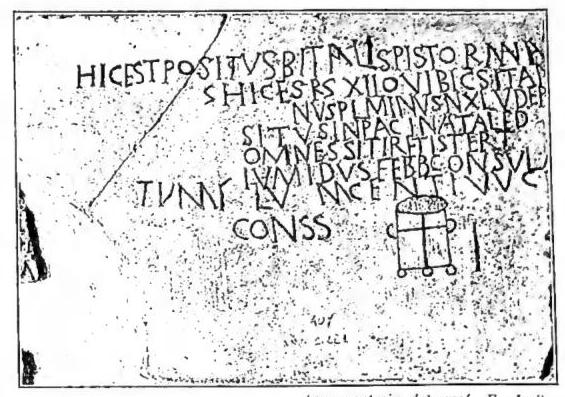
(E. Diehl, Inscriptiones christianae latinae veteres, Berlin 1925-31, n. 2115). In the time of St. Gregory the Great (590-604) a certain John collected the oil on the tomb of the Martyr and brought it to Queen Theodelinda (R. Valentini and G. Zucchetti, Codice topografico della città di Roma, II, Rome 1942, p. 41). The Notitia Ecclesiarum, which in its circuit comes from St. Sebastian, indicates her tomb on the Via Appia, after visiting the tomb of Pope Cornelius, that is, closer to the city (id., op. cit., p. 88); on the contrary, the topography "de locis," which starts from Rome, indicates her first on the Via Appia (id., op. cit., p. 110). The itinerary of the 7th century inserted in the Gesta regum Anglorum, which follows the same course as the Notitia ecclesiarum, places St. S. after St. Cornelius and before the group of martyrs called Greeks (id., op. cit., p. 149). Also in the itinerary of Einsiedeln the Martyr is remembered between the group of Sts. Mark and Marcellian and St. Sixtus II (id., op. cit., p. 172). In the biography of Pope Stephen II (752) it is read that he restored the roof of the oratory of St. S., which had fallen in (Lib. Pont., I, p. 444).
G. B. De Rossi held that he could identify the cemetery of St. S. in the area adjacent to the eastern triconch situated on the cemetery of Callistus. But in 1901 J. Wilpert, in his topographical study of the cemeteries of the Appia and the Ardeatina, guided by the itineraries of the 7th century, demonstrated that the tomb of St. S. was not to be sought in the area of the cemetery of Callistus, but north of it, in a place still on the Appia closer to the city, before the tomb of Pope Cornelius. In 1905 J. Wittig, on the basis of J. Wilpert's conclusions, proposed to recognize the cemetery of St. S. on the left of the Appia opposite St. Cornelius. J. Wilpert's attempt to identify the sarcophagus in which the Martyr would have been laid with a fragmentary one found in the area of the cemetery of Callistus, on whose lid there is a rectangular opening and an eagle gripping a crown in its beak above an orant, has no foundation (Sarcofagi, II, pl. 159, 2).
Bibliography5 works
Enrico Josi