
SOSTITUTO. – The s. (substitutus, subrogatus, vicarius) is one who takes the place of another.
In the offices of the Roman Curia there are officials so designated, with a stable assignment subordinate to the major prelates who head the various dicasteries. In the past they were more numerous and held higher or lower positions; today, in addition to the s. of the Secretariat of State for ordinary affairs, who is also secretary of the Cipher, the Curia has the s. of the assessor of the S. Congreg. Consistorial, the assessor of the S. Congreg. for the Oriental Church, and the secretary of the S. Congreg. of Rites. The Supreme S. Congreg. of the S. Office has among its officials six s. notaries. The S. Apostolic Penitentiary has one s. in its tribunal section and another s. among the officials of its indulgence section. The tribunal of the S. Roman Rota has an s. of the defender of the bond, and finally the Rev. Apostolic Camera has two Camera notaries, one of whom is s. to the other in the office of secretary and chancellor.
SOTERE, saint, virgin and martyr. – Probably martyred during the Diocletian persecution, she was buried in a subterranean area on the Via Appia.
She was the paternal ancestor of St. Ambrogio, who composed her eulogy in 377 in the treatise De virginibus, dedicated to his sister Marcellina, praising her intrepid fortitude amid torments (III, 7: PL 16, 244), and in the Exhortatio virginitatis, in which he highlights the illustrious lineage of the holy virgin of rare beauty (« decora facie valde et nobilis virgo maiorum prosapia, consulutus et praefectura parentum sacra posthabuit fide », cap. 12: PL 16, 376). A baker named Vitale is mentioned as having been buried on 10 February of the year 401, that is, on the « natale domnes Sitiretis » (G. B. De Rossi, Inscriptiones christianae, I, Rome 1857–61, p. 212, n. 495).
The Hieronymian Martyrology, under the « octavo id. feb. », that is, 6 February, indicates « Romæ via Appia in cimiterio eiusdem Sotiritis virginis »; this feast is also recalled on the « IV id. feb. » (10) and on the « III id. feb. » (11), as in the inscription of a certain « Bitalis pistor », buried in the year 401
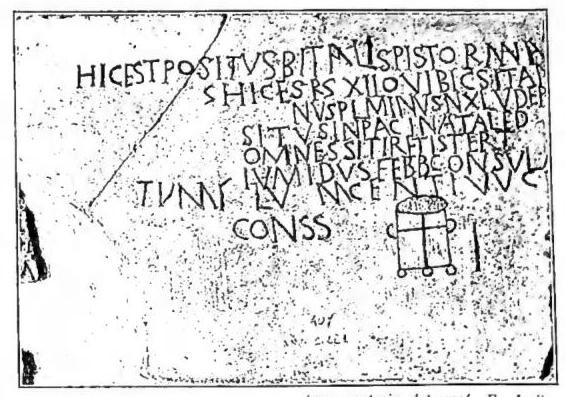
(courtesy of Prof. E. Josi)
G. B. De Rossi believed that he could identify the cemetery of S. S. in the area adjoining the eastern tricora situated over the cemetery of Callisto. But in 1901 J. Wilpert, in his topographical study of the cemeteries of the Appian and Aurelian Ways, on the basis of the itineraries of the 7th century, demonstrated that the tomb of S. S. was not to be sought in the area of the cemetery of Callisto, but to its north, in a place still on the Appian Way and closer to the city, before the tomb of Pope Cornelio. In 1905 J. Wittig, on the basis of J. Wilpert’s conclusions, proposed identifying the cemetery of S. to the left of the Appian Way, opposite S. Cornelio. J. Wilpert’s attempt to identify the sarcophagus in which the Martyr was supposedly laid with a fragmentary one found in the area of the cemetery of Callisto has no foundation; its lid bears a rectangular opening and an eagle holding a crown in its beak above an orans (Sarcofagi, II, pl. 159, 2).