
SOUTHWARK, DIOCESE of. – City and diocese in England. It has a population of 5,083,495 inhabitants (1931 census), of whom approximately 280,000 are Catholics (1950), distributed among 238 parishes, served by 418 diocesan priests, in addition to 36 coming from outside pro tempore and 338 religious. It has 288 public churches, 152 private and institutional churches, 49 male and 160 female religious communities, and 275 schools. The diocesan Seminary is located at Wonersh, Surrey; the “Training College” is at Mark Cross. In 1950 there were 1,246 conversions, 9,177 baptisms of children, and 3,568 marriages (including mixed marriages).
The diocese, established by Pope Pius IX in 1850, comprises London south of the Thames, whose principal borough is S., and the counties of Surrey, Kent, and Sussex. Before inclu-
S. comprises the ancient dioceses of Canterbury, Rochester, and Chichester, together with much of Winchester. From 1688 to 1850 it formed part of the “District,” or apostolic vicariate, of London. It is exceedingly rich in historical memories. St. Augustine landed at Richborough (Kent) in 597, converted King Ethelbert, founded the archiepiscopal see of Canterbury (597) and the episcopal see of Rochester (604). St. Wilfrid evangelized the Kingdom of Sussex in 681–86 and founded the episcopal see of Selsey, transferred to Chichester in 1075. St. Simon Stock was born at Aylesford (Kent), around 1165: the Carmelite scapular derives from him. All the glorious history of Canterbury belongs to S., from its first archbishop, St. Augustine, to Cardinal Reginald Pole (1554–58), including the martyrs St. Elphege (1012) and St. Thomas (1170); St. John Fisher, put to death by Henry VIII in 1535, was bishop of Rochester (1504–35), St. Edmund governed Canterbury (1234–40), and St. Richard Chichester (1245–53).
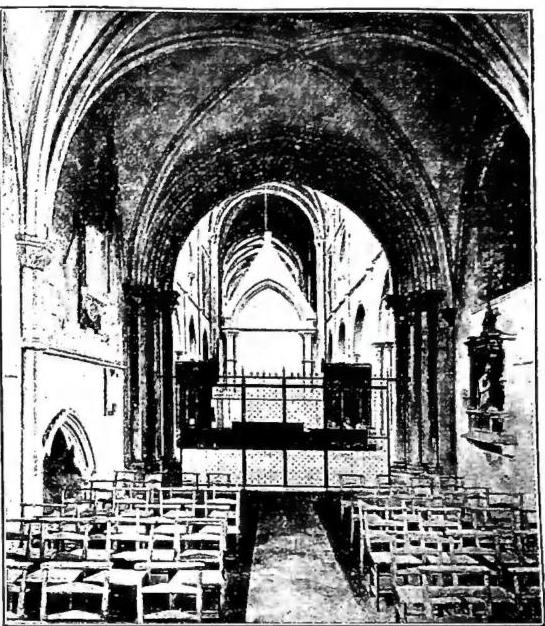
Very many notable ancient churches (now Anglican) are found in its territory, for example, the cathedrals of Canterbury, Rochester, and Chichester, the churches of Shoreham, Sompting, Worth, Rye, Winchelsea, Barleston, and St. Martin’s at Canterbury, where Queen Bertha, the Christian wife of King Ethelbert, was already hearing Mass before the arrival of St. Augustine, and others. Notable abbey ruins are found at Battle, Bayham, Lewes, Boxley, Waverley, Dover, Canterbury, and elsewhere. The chapel of the convent at Mayfield, Sussex, is the hall of a 14th-century episcopal palace. Among the modern churches, those of Arundel, Parkminster, Ramsgate, Wimbledon, Caterham, and Horsham may be mentioned.
S. gave the following martyrs to the Church: St. John Fisher (1535), the Blessed John Stone, Augustinian (1538), John Rugg (1539), David Gonson (1541), John Felton (1570), Thomas Felton (his son), and Edward Shelley (1588), Thomas Garnet (1608), and the Venerables Thomas Cort and Thomas Belchiam, Franciscans of Greenwich (1538), Thomas Pilchard (1587), Edmund Duke (1590), Roger Filcock (1601), George Gervase (1608), and Thomas Bullaker (1642). Among the confessors, the families of Roper (especially William Roper, son-in-law of St. Thomas More), Caryll, Hawkins, Gage, Weston, and others deserve notice. West Grinstead, Battle, and Sutton Place were refuges for the faithful; the first has an uninterrupted history as a Catholic mission. Thomas Goldwell, bishop of St. Asaph, the last bishop of Catholic England, was born in Kent; he died in Rome in 1585. Sir Thomas Hawkins translated the Jesuit Nicolas Caussin’s Cour Sainte (The holy Court) in 1650. John Caryll, nephew of the Earl Caryll, was a friend of the poet Pope; Richard Challoner, the most devout apostolic vicar of the London District (1758–81), was born at Lewes in 1691.
In 1883 the Carthusians founded Parkminster, the largest charterhouse in the world. In 1949 the Carmelites returned to Aylesford, reoccupied it, and repaired it, an event comparable to the revival of the Benedictine abbey of Buckfast in Devonshire.
After three years of work, the 6,000–7,000 pieces of plaster were reassembled by C. D. P. Nicholson and studied by Prof. J. Toynbee, providing an idea of the paintings. It is supposed that these fragments belonged to two painted rooms, one larger and one smaller, probably intended for worship. Coins of the emperors Arcadius, Honorius, Theodosius, and Valentinian were found there. Prof. J. Toynbee recently described the villa as one of the largest and most sumptuous among those so far discovered in England. The cultic character of the two rooms has not yet been demonstrated, but their Christian character is proved by the existence of a depiction of an orans and of two Constantinian monograms. Toynbee supposes that the larger room, immediately above the cellar, was an oratory or domestic chapel. Oriented east–west, it was 7 m wide (its length has not yet been determined), and a door in the western part of the north wall connected the larger room with the smaller one, which is thought to have served as an antechamber for catechumens. On the western wall of the large room was a row of six painted figures (so far, only five have been found), separated by columns. The figures wear colored garments decorated with pearls, with wide sleeves gathered at the wrist. Although these paintings constitute only part of the total decoration of the two rooms, they unquestionably represent the finest examples of the Roman period so far discovered in England, while the orans and the monograms provide splendid confirmation of the spread of Christianity in Great Britain.