
POLE, REGINALD. — Born at Stourton Castle (Staffordshire) in March 1500 to Sir Richard (d. 1505), whose mother was the half-sister of Margherita Beaufort, mother of Henry VII, and to Margherita Plantageneto, daughter of Giorgio, Duke of Clarence. In 1513 Henry VIII created his mother Countess of Salisbury (and later entrusted her with the education of Princess Maria) and his eldest son, Enrico, Baron Montague; as for Reginald, destined for the Church, he supported his studies at Oxford (under W. Latimer) and gave him prebends and means
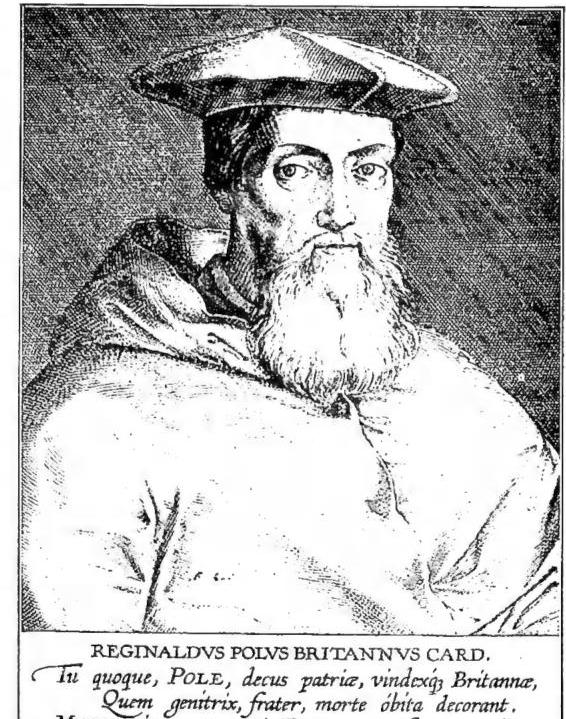
Quem genitrix, frater, morte obita devorant.
MORVS item, atq; æut FISCHERVS flos, et ocellus:
Quos et trancripsit mors violenta polo.
(from XII Cardinalium pictate doctrina rebeque postis maxime illustrium imagines, Amenta 1891, tom. D)
POLE, REGINALD — Portrait. Engraving by Theod. Gallaeus (1598).
to study in Italy, from 1521. In Padua, P. formed friendships with scholars and humanists, among them Bembo and Cristoforo di Longueil (Longolius); as early as 1525 he entered into an epistolary relationship with Erasmus and, through him, with Giovanni Laski. He was also in Rome, and in 1527 returned to England. The question of the royal divorce troubled him; he obtained permission to go to Paris, where, however, he agreed to collect—assisted by sir Richard Fox—opinions favorable to Henry’s wishes, which Francis I also supported. In the meantime he had been elected dean of Exeter; after returning to England, at Sheen, he was offered the see of York, vacant upon Wolsey’s death, provided that he declared himself; but, after a dramatic conversation with the King, and distressed by the schism now openly manifest, he preferred to depart again. In Padua and Venice he found old friends and made new ones: I. Sadoleto, G. Contarini, G. Cortese, M. A. Flaminio, G. M. Giberti, Alvise Priuli, L. Beccadelli, later his biographer, and G. P. Carafa himself.
Pressure was brought to bear from both sides for him to declare himself on the English religious situation; he preferred to act independently and, perhaps hoping still to obtain the King’s repentance, sent him in manuscript the treatise Pro ecclesiasticae unitatis defensione, completed in May 1536. Shortly afterward, summoned to Rome, he was created cardinal deacon of S. Maria in Cosmedin on 22 December, together with Carafa, Del Monte, Sadoleto, and others, and was also made a member of the commission that drafted the famous Consilium de emendanda Ecclesia (1538). He received further proofs of favor and confidence from Paul III: as legate for England, he went to Flanders (but the rebellion in which he had hoped had been stifled at its inception by Henry); he accompanied the Pope to the meeting at Nice with Charles V and Francis I, and undertook another mission to Spain. Meanwhile Henry had his brothers arrested, Geoffrey (later pardoned) and Henry (beheaded on 4 November 1538), as well as his mother Margaret (v. SORA), and sent assassins against him, so that he had to take refuge in Carpentras; nevertheless, he returned to Rome in 1540 and, appointed legate of the Patrimony of St. Peter, settled in Viterbo, where a group of «spirituali» gathered around him and Vittoria Colonna. They hoped for reconciliation with the Lutherans (and Contarini consulted P. in preparation for the Diet of Regensburg), going so far as to accept the doctrine of «double justice», later rejected by the Council of Trent. As that council approached, P. had been designated papal legate in 1542; in that capacity he took part in its proceedings from December 1545 to June 1546, when ill health forced him to withdraw to Priuli’s residence, and then once again to Rome.
He enjoyed great prestige, so much so that at the Conclave of 1549 he lacked only one vote to be elected, but he did nothing to obtain II. Mary’s accession to the throne gave him the opportunity to restore England to Catholicism. But his return as papal legate was obstructed by Charles V, who feared that he would oppose Mary’s marriage to Philip II, until November 1554; ordained a priest and consecrated archbishop of Canterbury on 22 March 1556, he became the Queen’s principal adviser. English historians observe that, already not very successful or fortunate in his diplomatic missions, P. displayed little aptitude as a statesman, since he allegedly failed to show sufficient flexibility in the matter of ecclesiastical property—with which the powerful middle class had enriched itself—in order to win its favor, nor did he know how to restrain the severity of the repression, which aroused resentment. His work as a reformer, noteworthy for many measures—including the establishment of seminaries—is of considerable interest.
In Rome, on the other hand, he had by then become suspect: for some time rumors had circulated about his political conduct and, more seriously, about his excessive leniency toward Protestants. Moreover, the conflict between Philip II and Paul IV, which also involved England, placed him in an extremely delicate situation. Deprived of his legation, he was accused before the Inquisition together with Cardinal Morone; he was preparing his written defense when he fell ill and died on 17 November 1558.
Works: editions of the Pro defensione—different from the manuscript—include Rome (n. d., but 1553 or 1554), Strasbourg (1555), and Ingolstadt? (1587); of the De Concilio, Venice (1562); of the De Summo Pontifice, Ingolstadt ([?] 1569). The correspondence, and Beccadelli’s Vita, in G. Quirini, Collectio epistolarum Reginaldi Poli (5 vols., Brescia 1744–57); also: summary of the proceedings of the Holy Office of Rome from Paul III to Paul IV, in Arch. soc. rom. di st. p., 3 (1879), p. 283 ff.