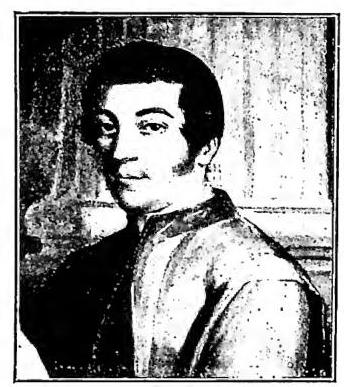
MORONE, GIOVANNI. — Cardinal, born in Milan on 25 January 1509 to Girolamo, chancellor of Massimiliano and Francesco Sforza, and Amabilia Fisiraga. He pursued the study of law at Padua, and Clemente VII appointed him, at the age of twenty, bishop of Modena on 7 April 1529, by virtue of a promise made to his father; despite the opposition of Alfonso d’Este, he held the diocese until 23 May 1550. On 12 September 1552 he received the diocese of Novara and held it until 13 March 1560. He regained the diocese of Modena on 23 February 1564 and thereafter held it until 16 September 1571. He himself declared that he was neither a theologian nor a canonist; but his consummate
His experience and dignified conduct made up for this undeniable deficiency. He may rightly be called one of the purest and most farsighted churchmen of his age.
After a brief mission to France in 1529, M. began, under Paul III, his distinguished diplomatic activity. On 21 October 1536 he was appointed to succeed Pier Paolo Vergerio in the nunciature to Ferdinand of Germany, with the special task of promoting the celebration of the Council then summoned for Mantua. On that occasion he immediately demonstrated the particular perceptiveness and almost proverbial skill that were characteristic of him. Recalled on 3 September 1538, he was sent again to Germany on 20 January 1539, above all with a view to the religious colloquy intended to be held at Speyer with the princes of the Empire in order to put an end to the religious dissensions. When it was decided that the theological discussions would be held at Hagenau, M. went there with King Ferdinand on 25 May 1540. When the conference was convened at Worms (28 October), M. arrived there on 27 November. He is found at the Diet of Regensburg on 31 January 1541; the cardinal legate Gaspare Contarini joined him there on 12 March. M.’s prudent activity at a very delicate moment for Catholicism in Germany was unable to prevent the fruitless theological disputes and the recess with the Interim of Regensburg (29 June), which proved disadvantageous to the Catholics. While Contarini returned to Italy, M. remained with King Ferdinand to advocate the convocation of the Council at Trent. He took part in the Diet of Speyer on 9 February 1542 and was appointed cardinal on 2 June, after which he left Germany.
On 16 October 1542, together with Cardinals Pole and Parisio, he was appointed legate to the Council that was to assemble at Trent (v.) and reached that city on 22 November 1542; he left it at the end of July 1543, having remained sole legate to a Council that, for political reasons, was unable at that time to function. On 2 April 1544 Paul III appointed M. legate to Bologna, and he held that legation until 1548. During this period, on 23 July 1544, he was sent as legate to Charles V regarding the affairs of the Council; but Charles V refused to receive him, so that he returned to Bologna at the end of September. M. was convinced that it was necessary to advance the reform of the Church if the progress of heresy was to be curbed, and during his absences he had taken care to safeguard the purity of the faith in his diocese of Modena. It was during these years that the particular friendship developed which bound him to Cardinal Pole and to the spiritual circle that gathered around him, first at Capranica and then at Viterbo (1541–45), where Vittoria Colonna, Marco Antonio Flaminio, and Alvise Priuli met, and where Pietro Carnesecchi, Donato Rullo, Vittore Soranzo, Apollonio Merenda, and others whose orthodoxy was not entirely secure sometimes joined them. Hence the suspicions formed against him by Cardinal Gian Pietro Carafa, which caused him so much trouble when the latter became Paul IV. Like these men, M. at that time inclined toward the Lutheran principle of justification by faith alone, through the merits of the Savior, without, however, undermining the mystery of the real presence; he acknowledged the obligation of good works and the authority of the Church. Like many Catholics, he was at fault in contributing to the dissemination of the heretical treatise Beneficio di Cristo (1541–43), later condemned. Nevertheless, on 27 February 1550 M. became a member of the Roman Inquisition, assisted the nascent Society of Jesus, and promoted the foundation of the German College in Rome (1552). Julius III turned to him when the Diet of Augsburg was being prepared in 1553 and appointed him legate to King Ferdinand (7 January 1555), with the task of safeguarding the dignity of the Apostolic See. M., who had departed on 18 February, soon had to return in order to take part in the conclave at the end of March.
In June 1555, immediately after his election, Paul IV appointed the commissioner charged with gathering the accusations of heresy against M. M. himself was imprisoned in Castel S. Angelo on 31 May 1557, and a commission of cardinals was appointed to judge him on the charge that, “forgetful of the benefits received from the Roman Church, he had dissented from the Catholic faith in pluribus dictis et factis, clam et publice.” When the trial resumed in October, it produced no positive evidence, and Paul IV wished to free M. by an act of grace; but M. wanted a sentence and composed a defense (cf. C. Cantù, Gli eretici d'Italia, II, Turin 1866, pp. 176–90; P. Tacchi-Venturi, Storia della Compagnia di Gesù, II, Rome 1950, p. 125, 156 ff.). The sad episode ended with the death of Paul IV, when M. (18 August 1559) was released and then admitted to the conclave from which Pius IV was elected. At the consistory of 13 March he was cleared of every charge and recognized as innocent. On that same day he opted for the suburbicarian see of Albano. When Cardinals Seripando and Gonzaga, legates to the reopened Council of Trent, died, Pius IV replaced them on 7 March 1563 with M. and Navagero. From that moment M. was the soul of the Council, which seemed on the point of foundering, and he succeeded in bringing it happily to completion in December, overcoming the many difficulties that arose at every moment. By Christmas 1563 he was already in Rome, working for the solemn approval of the Council. At the conclave of 1566, a strong party led by Cardinal Borromeo supported his election, but he was greatly disadvantaged by the fact that he had been subjected to an inquisition. Even under Pius V, who was never entirely favorable toward him, he continued to be consulted on German affairs, since he was regarded as the best informed man on German matters, and also on the occasion of the war against the Turks. Gregory XIII held him in particular esteem and, on 18 March 1575, sent him to Genoa to settle the civic disputes and prevent the intrigues of Philip II. Having settled Genoese affairs in the best possible manner, M. returned to Rome on 14 April 1576. But a few days later he left again as legate to Germany for the Diet of Regensburg, concerning the league against the Turks, and there he worked most effectively to restore discipline among the Catholics, in whom he rekindled courage “with incomparable prudence.” He returned to Rome on 17 November. As early as 3 July 1570 he had become bishop of Ostia and dean of the Sacred College. He died on 1 December 1580, “with the whole city weeping,” poor because he had never importuned the popes “to give him [anything], but had devoted all his industry solely to overcoming envy and ill will.” He was protector of several religious orders and of the new German Colleges and