
CANTÙ, CESARE. – Historian, man of letters, patriot, and politician, b. at Brivio (Como) on 5 December 1804, d. at Milan on 11 March 1805. Born into a deeply religious working-class family, he studied for the clerical state, with scant means, at the Milanese gymnasium of S. Alessandro; and, abandoning the idea of entering ecclesiastical life, at the age of eighteen began teaching at the gymnasium of Sondrio, subsequently moving to that of Como, while soon turning toward the fertile field of historical research and erudition.
An indefatigable worker, he read, investigated, and wrote as much and as well as he could, always keeping before him the great and noble ideal of religion and country. Thus it may rightly be said of him that he was at once the first and the last of the most convinced among the neo-Guelphs.
A lover and student of the beautiful Catholic and patriotic Middle Ages, in that full and «romantic» sense proper to his age, he followed the publication of the polished short poem Algio (1828) very soon afterward with that of the Storia della città e della diocesi di Como (1829–51), which thrilled Manzoni and remains a typical example among our municipal historical monographs. Already implicit in it was the formula that was later to characterize his entire historiographical work: «A commune and a saint: these are the elements from which Italians have always composed their liberty». Having thus suddenly attained well-deserved fame, in 1832 he moved to teach at that same Milanese institution where he had spent the decisive years of his education, entered the Manzonian milieu, and, after a collection of sentimental verse, published in the Indicatore a historical commentary on I promessi sposi (Ragionamenti sulla storia lombarda del sec. XVIII, Milan 1833). To this commentary the volume on L'abate Parini e la Lombardia nel secolo passato (1854) should rightly be connected, likewise the fruit of that acquaintance—never entirely intimate, harmonious, or cordial—with the great Lombard writer, from which much later the famous and much-debated Reminiscenze su Alessandro Manzoni (1882) were to spring. These, too, were rich in precious and penetrating biographical elements that clearly highlight the most significant similarities and differences in character and in ideological and practical outlook between the two.
Thus began—and did not end until his death—that whirl of manuscript folders, printing proofs, volumes, pamphlets, essays, articles, translations, revisions and reworkings of what had already been published, bibliographical researches, and archival discoveries of every kind, with frequent transitions from the historical field to the literary one, which, to the vexation and dismay of his belated and indolent rivals and critics, would always constitute C.’s sole true satisfaction.
Not a conspirator and patriot in the manner of others, but the faithful custodian of many other people’s political secrets, and above all a convinced adherent to the neo-Guelph «open conspiracy», whose clearly defined aim was to educate and elevate our people in the spirit of the Christian tradition in the face of foreigners, he fell under suspicion of the Aus-
Consequently, in order to live, he had to rely on his inexhaustible pen, and between the Notizia di G. D. Romagnosi (1835) and the well-known and widely read historical novel Margherita Pusterla (1838), he produced various occasional educational works such as Carlambrogio da Montevecchio (1836), Galantuomo (1837), Buon fanciullo, Giovinetto, down to an article entitled Sulle precauzioni nella cultura del pomo di terra (1848), and the very widely circulated Buon senso and Buon cuore (1870).
His release from prison coincided with his meeting the bookseller Pomba, who opened for C. the path to renown in Italy and beyond the Alps. From Pomba’s cherished idea of a historical encyclopedia originated the thirty-five volumes of the Storia universale (1846), which immediately established themselves with extraordinary and lasting success. In it, history is regarded as the constant and perpetual work of Providence, which watches over, guides, and judges men and institutions, and which, through Christianity, leads to a work of pacification, fraternity, and cultural and social civilization by means of the Church and the Papacy. It clearly revealed the author’s inner certainty that, trusting in the soundest demands of liberty, he foresaw a future far less gloomy than was commonly believed, thanks to the promises of neo-Guelphism, understood as a great, universal return of civil society to Christianity.
In the persuasive and truly powerful force of the Storia universale lies, without doubt, the measure by which C.’s entire work and singular personality must be judged. Although he did not always meet the modern demands of criticism and scientific historiography, he nevertheless succeeded in organizing an enormous mass of facts, institutions, and customs, of texts and figures that had until then been obscure or unknown. He thus made an immense heritage of the past readily accessible to scholars and educated people, and thereby enormously broadened the narrow historical horizon of his time. And while its narrative sections may today be regarded as superseded, the others—no less rich and numerous—those comprising its bibliographical and documentary apparatus, remain alive and useful.
If, after the publication of the Storia Universale, the envy of unworthy rivals and the hostility of anticlerical radicalism continued to persecute C., on the other hand he was generously compensated by the admiring esteem of good men, by a fame of which he made little account, and also by the prosperity which, strengthening his innate and intimate sense of proud independence, led him to write in the preface to his most combative study: «Fortunately, to princes, heroes, and ministers I owe no gratitude other than that of having allowed me to speak the truth, free to make me pay for it». And it was precisely from the complex and multiform fabric of the Storia universale that almost all his numerous later writings derived, among which should be remembered Storia di cento anni (1851), Storia degli Italiani (1854–56), Beccaria e il diritto penale (1862), the Storie della letteratura (Greek, Latin, and Italian, 1865–66), Gli eretici d'Italia (same date), Alcuni Italiani contemporanei (1868), Italiani illustri (1873–74), Il Consiliatore e i Carbonari (1878), Monti e l'età che fu sua (1870), Gli ultimi trent'anni (same date), etc. These and his other volumes and essays contain no shortage of eloquent pages, rich in valuable observations and grave meditations.
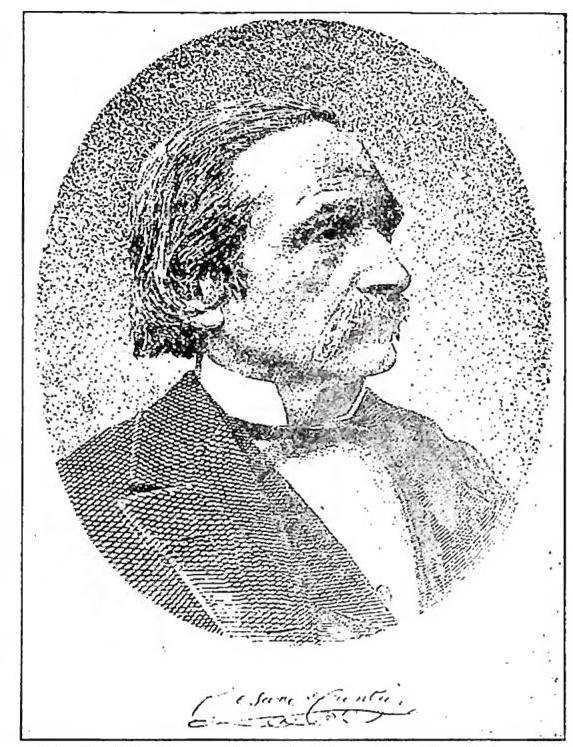
(from M. della Rocca, Di G. C. abbozzo biografico, Turin 1882)
CANTÙ, CESARE - Portrait with autograph signature.
as an abyss between faith and the dearest political aspirations. And it is precisely in the constant and inflexible rectitude of C.’s thought and work that lies the explanation of the attitude and orientation, decidedly neo-Guelph, which he alone, and despite everything, followed during the crucial years that came thereafter, and which in practice earned him exclusion from political life and the ungrateful unpopularity of the new Italy.
In truth, C. could not have approved of that Italy pieced together through dynastic and revolutionary audacity, that reconstruction of the most Catholic of nations carried out in an anti-papal and anticlerical sense, that monarchical predominance over all the ancestral and finest republican traditions, those destructive frenzies directed against every sound tradition; nor, moreover, did such things please, among others, either Capponi or D’Azeglio. Thus, as a member of Parliament, from 1860 to 1867 he was an open and declared opponent of that laborious offspring of the Right which was called the «liberal State». And indeed, “certain, as has rightly been written precisely in these days, that behind him he had real Italy against legal Italy, the assent of the masses of humble Christian people against a minority installed in power thanks to an artificial electoral law, he struck at the heart of and loudly denounced all the equivocation and all the inner emptiness concealed beneath the new state structure, infallibly destined—as he foresaw—to sink as soon as all Italian Catholics either were able to affirm their faith by voting, or lost it by becoming revolutionaries.”
From this was to arise, amid the welcoming quiet of the State Archives of Milan, whose superintendence was the only office that no one dared deny or revoke him, that interesting and harsh, often impassioned and violent, but at bottom truthful and honest indictment of the actors and events of the new Italy, and of the omissions and adulterations of the official, unofficial, or simply celebratory and partisan historiography of the Risorgimento, which is his chronicle Della indipendenza italiana (1872–77): a bold attempt to revise obsolete interpretations; a firm warning to Italians concerning unresolved problems.
And, moreover, circumstances, times, and studies seem in our own day to have rendered justice to C. as well, at times lending his writings and thought a deservedly timely relevance.