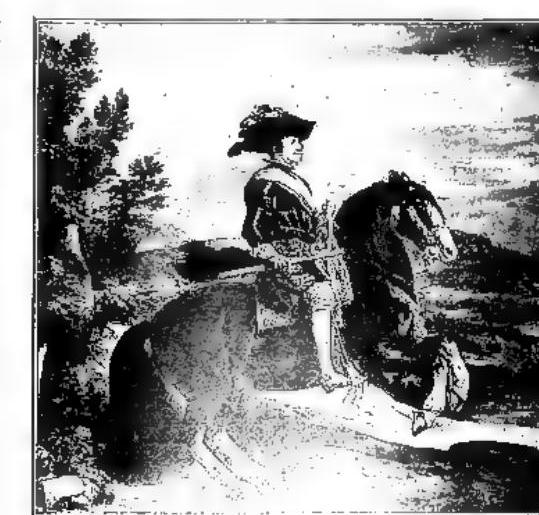
FILIPPO II, king of SPAGNA. — Born in Valladolid on 21 May 1527 to Carlo V and Elisabetta di Portogallo.
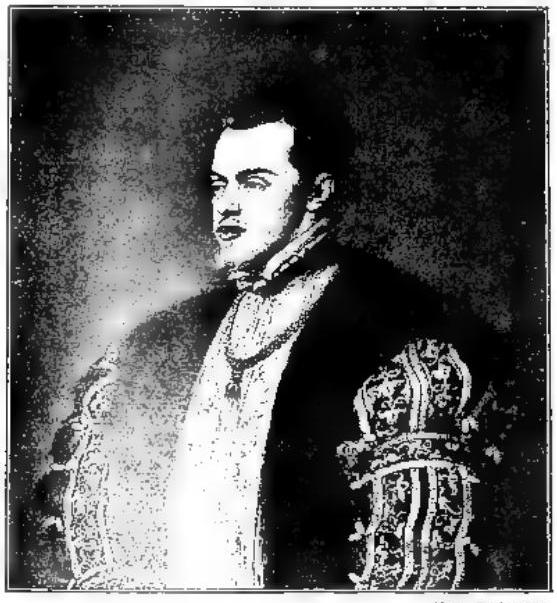
FILIPPO II, king of SPAGNA — Portrait of F. II by Tiziano (1551). Detail — Naples, Museo Nazionale.
because F. had no children by Maria, and the English succession went, as is known, to Elisabetta (1558). In 1556, when Carlo V abdicated, F. had already been invested with the duchy of Milan, the Kingdom of Naples, and Flanders. The separation of the Spanish crown from the imperial one initially facilitated the extremely serious tasks inherited from his father, all the more since the German princes had never wished to recognize him as King of the Romans. The peace of Cateau-Cambrésis brought the France-Spain duel to an end, and the tasks of predominant power fell to the latter. But although this situation reached its culmination with the annexation of Portugal in 1580, its very weight was later to bring about its collapse. F. transferred the court, and with it the center of all his affairs, to Madrid; indeed, in 1561 he began the construction of the Escurial and governed his many affairs from that sort of royal palace-convent. The administration was based on eleven councils; but the king, who never took part in them, subsequently examined everything with meticulous zeal and exhausting activity, and consequently with a slowness often harmful to the processing of business.
F. II regarded his sovereignty as a mission entrusted to him by God for the good of his peoples and the defense of Catholicism, of which he considered himself the most disinterested champion. In this he was supported by the conviction of the Spanish clergy, which had remained untouched by the contamination of the new doctrines that had shattered Europe’s spiritual unity; it indeed regarded its own nation as the only one that had remained faithful to traditional Catholicism and that, now that political unity had been restored, was capable of providing for a new ordering of Europe, in which political power would restrain and overcome the predominance achieved by the Protestants.
As a sincere believer, F. II could not fail to be a convinced supporter of the Catholic reform, and he demonstrated this particularly during the third period of the Council of Trent, intervening to direct the activity of his bishops in this regard. He was likewise concerned with the spread of Catholicism in the overseas countries over which Spanish sovereignty extended. For example, in 1567 he requested Jesuit missionaries for Peru from s. Francesco Borgia and supplied them with the greatest generosity; he did the same in 1571 with the Jesuits sent to Mexico. To Francesco Toledo, viceroy of Peru in 1568, F. II effectively entrusted « la doctrina y conversion de los naturales »; he did not, however, accept Gregorio XIII’s proposal to establish an apostolic nuncio for the Spanish possessions in America, wishing to maintain exclusive control over those regions. F. II showed a similar interest in the missions in the East, sponsoring the bishopric established by Sisto V in Japan in 1588 and promoting the missions of the Dominicans and Franciscans in the Philippines. Convinced that Rome was not attending to the work of reform with due zeal and did not sufficiently appreciate his political directives, he sometimes did not hesitate to offer determined opposition to the measures of the Holy See; while the latter did not intend to surrender its rights, as was seen particularly on the occasion of the controversies concerning Bartolomeo Carranza, archbishop of Toledo, prosecuted by the Spanish Inquisition with the king’s support, when Rome claimed the case for itself and F. II was even threatened with excommunication. Another dangerous dispute between Spain and the Holy See arose from the attitude of the governor of Milan, the duke of Albuquerque, toward s. Carlo Borromeo in a matter of jurisdiction. But the gravest cause of conflict was that which arose following the promulgation of the bull In coma Domini (1568), which provoked extremely bitter disputes in the Kingdom of Naples because of the refusal of the exequatur placed upon it by the Collateral Council. These jurisdictional disputes very nearly compromised the expedition then being prepared against the Turks. Fortunately, the anti-Ottoman issue prevailed, and the undertaking was carried out, culminating in the battle of Lepanto (7 October 1571).
But alongside this victory, the reign of F. II also witnessed defeats. The revolt of the Low Countries, rebellious against Spain’s fiscal and religious policy, was never again to give the king peace, even after Alessandro Farnese had reconquered the southern provinces; the seven northern provinces, joined in the Union of Utrecht (1579), were to continue the struggle under the leadership of the Orange family (until their independence was recognized).
While this exhausting duel continued, F. II attempted to interfere in the religious wars agitating France, in order to secure, through a Catholic victory, influence beyond the Pyrenees. He likewise came into conflict with England. The dispute reached its most dramatic phase when the question of Maria Stuarda led him to take the field. But the Spanish fleet destined to sail up the Thames and violate the English capital, the famous armada invencible, composed of 130 ships, was destroyed first by the storm and then by the enemy (27 June 1588), while Cadiz instead suffered the disgrace and damage of the destruction inflicted upon it by the English fleet. Meanwhile, after Enrico di Borbone had resolved the long religious crisis in France, F. was forced to recognize the new state of affairs and accept the Peace of Vervins (2 May 1598). The king’s constitution resisted for a few more months the immense exhaustion to which it had been subjected. He died at the Escurial on 13 September 1598 (Clemente VIII, in his address of 9 October 1598, recalled his services to Catholicism).