
CADICE AND CEUTA, DIOCESE OF. — Cadice is a very ancient maritime city on the Atlantic, founded around 140 B.C. by the Phoenicians, who called it Gadir; the Romans conquered it in 203 B.C. and called it Gades; under G. Cesare it became the Julia Gaditana, and under Augusto the Augusta Gaditana and the center, during the Roman period, of the conventus Gaditanus. It is believed to correspond to the ancient church of Asido, founded at Medina Sidonia after the Visigothic conquest. Its first bishop, Rufino, appears at the Second Council of Seville (A.D. 619). Bishop Pimenio took part in the three Councils of Toledo (the Fourth, Sixth, and Seventh, held in 633, 638, and 646). The diocese was transferred to Cadice in 1265, after having been located for some time at Algeciras. After the city of Cadice was destroyed in 1379 by Maometto II, the episcopal see was returned to Medina Sidonia; when it returned once again to Cadice, it remained there until 1596, when it had to move again for a few months to Medina Sidonia because of the English raid on Cadice, during which they destroyed the Cathedral and took most of the Chapter prisoner. At present it is called «C. e C.», since the other diocese of Morocco, founded in 1841 and suppressed in 1851, was united to II.
The area of the united diocese is 3819 sq. km., with 460,004 inhabitants, of whom 446,991 are Catholics. It has 61 parishes served by 131 diocesan priests and 73 religious priests. It is a suffragan of Seville. The patroness of the diocese is the Most Holy Virgin of the Rosary, by a vow made in 1630, renewed on 9 November 1755, and confirmed by Pio IX on 27 June 1867; the martyrs Servando and Germano (BHL, 7608) were proclaimed patrons on 21 October 1619, and s. Giuseppe on 10 April.
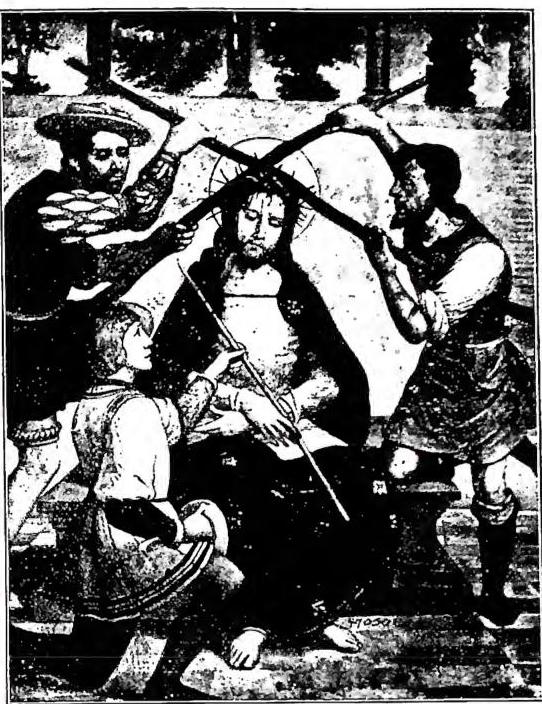
(from Chandler Rathlon Post, A history of Spanish painting, IX, Cambridge BGT, p. 1) CADICE – Crowning with Thorns – Fresco by Juan Correa de Vivai (16th century) – Cathedral.