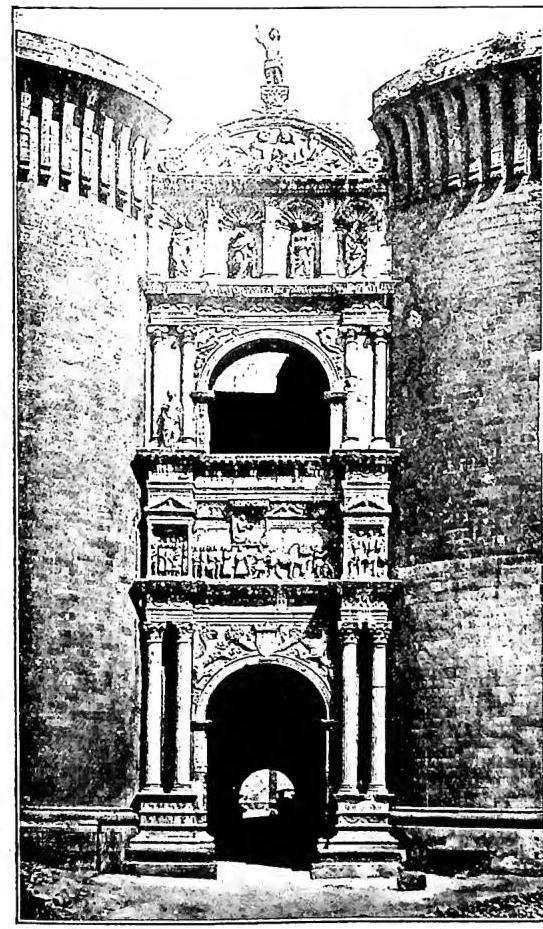
ALFONSO X, the Wise (el Sabio), of CASTILE. — B. in 1221 and d. in 1284, he succeeded his father Ferdinand III the Saint in 1252. Military preoccupations and political struggles marred his reign: his imperial aspirations, poorly tolerated at home (of his unfortunate candidacy there remained only the memory in that title of *rex electus Romanorum* with which he adorned himself with naive vanity), brought him bitter disappointments; within his realm, the insubordination of the nobility, stirred by unbridled ambitions, which he vainly tried to placate with ample concessions, disturbed the peace; he aspired in vain to extend his reconquered forces into Africa; he was embittered by the rebellion of his second son Sancho, who obtained to succeed him by trampling on the rights of the infante de la Cerda (heir of the firstborn Ferdinand, who had died prematurely in 1275 and was supported by the king of France). Finally deposed by the *cortes* of Valladolid, he ended by invoking the aid of the sultan of Morocco.
A master of law and learning, uncertain and inept in practice with his unstable and dubious politics, none of his dearest aspirations was realized during his long reign, though its significance for culture remains very high. A man of vast knowledge and broad tolerance, he availed himself, without distinction of race, nationality, or religion, of the work of learned collaborators whom he summoned to his court to carry out a vast enterprise of cultural systematization based on translations, compilations, and commentaries of numerous juridical, historical, and scientific works.
Indeed, fruitful and fecund was his action aimed at unifying the multiple and incongruous legislation of the municipal *fueros*, as Ferdinand III had already begun, and which resulted in that formidable juridical corpus known as the *Libro de las Siete Partidas*, which for centuries remained the sole source of law, and in which Roman and canon law, the Digest and Decretals, the Justinian Code and the *Fuero Juzgo* are harmonized and interwoven. The same spirit of unification inspired the *Espéculo*, the *Fuero Real*, and other minor compilations.
The same breadth of vision inspired in the field of historiography the composition of the *General Historia*, which remained unfinished at the narration of the ancestry of the Virgin Mary, in which are utilized, with logical adherence to the universalist principles of the saintly king, the Bible and the classics, Arab historians alongside St. Augustine, and the major medieval writers and works, from Orosius to John of Garland and Luke of Tuy, from the *Roman de Troie* to the *Libro de Alexandre*.
A similar attempt at unitary organization underlies the *Crónica general*, in which the history of Castile is framed within that of the entire peninsula.
Among his scientific works, alongside the *Libros del saber de astronomía*, which include the *Tablas alfonsinas* that enjoyed fame throughout Europe until the 16th century, the *Lapidario* should not be forgotten, while among the various and entertaining works are, among others, the translation of *Kalīla wa-Dimna*, the work entitled *Poridad de las Poridades*, the *Libros de ajedrez, dados y tablas*, the *Bocados de oro*, and the *Libro de la Montería*.
A patron of musicians and poets, and a poet himself, he gathered around him poets from Spain and abroad, welcoming G. Riquier and B. Calvo, competing with them in delicate conventional love poetry or in shameless and obscene satirical verses; poetry, however, which he, contravening his own attempt at linguistic unification (for which he had imposed Castilian as the official language), cultivated in that Galician-Portuguese tongue which was by then generally adopted in lyric poetry throughout the peninsula. Far richer is his sacred songbook (over 400 compositions), composed in praise of the Virgin, from which he drew motifs and themes from Latin collections, Spanish traditions, and vernacular poetry, which unfold in a rich variety of metrical forms, and in which the precise and picturesque realistic touches do not clash, softened and veiled as they are by an atmosphere of ingenuous devotion. In this work he reveals himself as one of the most sincere and fervent singers of the Virgin, whom he exalted with accents and motifs that would later be repeatedly taken up and elaborated in poetry.
A. García Solalinde has also edited an anthology of the works of the Wise King (*J. X. Antología de sus obras*, 2 vols., Madrid 1922).
Literature: A. F. G. Bell, *The Cantigas de Santa María*, ed. A. X. in *Mod. Lang. Rev.*, 10 (1915), pp. 338–348; A. G. Solalinde, *Intervención de A. X en la redacción de sus obras*, in *Rev. de fil. esp.*, 2 (1915), pp. 283–288; J. Ribera, *La música de las Cantigas*, Madrid 1922; J. M. Dihigo, *Las Siete Partidas. Estudio lingüístico*, in *Rev. de la fac. de filos. y cienc.*, Havana 1923; E. F. Dexter, *Sources of the Cantigas of Alfonso el Sabio*, Wisconsin 1926; R. Rübeckamp, *Die Sprache der altgalizischen Cantigas de S. María von A. X el Sabio*, Hamburg 1933; J. A. Sánchez Pérez, *A. X. el Sabio*, Madrid 1935 (includes a study, an anthology, and a bibliography); H. Anglés, *La música de las Cantigas de S. María del rey A. el Sabio*, Barcelona 1943; S. Pellegrini, *A. X re di Castiglia*, in *Glauco*, 1 (1945).
Jole Scudieri Ruggieri