
MOROCCO. -
I. GEOGRAPHY
Morocco embraces the northwestern extremity of the African continent, between the Mediterranean, the Atlantic and the Sahara, and is the only one among the countries of North Africa (Magrib) to enjoy the benefit of a double sea frontage, although, while the Atlantic frontage is almost entirely controlled by France, the Mediterranean one lies wholly within the borders of Spanish Morocco.By far the greater part of Morocco (398,600 sq km, with 9 million inhabitants) is represented by the Sultanate of Morocco, a French protectorate since 1912 and, since 1947, included as an associated State in the French Union. Capital Fez (201,000 inhabitants). In addition to a notable and varied agricultural production (barley, wheat, maize and, more recently, fruit, early crops, grapes and olives), and a rich livestock wealth, the Sultanate is recording promising achievements in the mining sector (phosphates, manganese, cobalt, lead, zinc, antimony, molybdenum), while attempts are being made to compensate for the shortage of raw materials for motive power (coal, petroleum) by exploiting the hydroelectric potential of the Atlas.
Spanish Morocco, too, is a protectorate, under the control of a high commissioner. The territory essentially coincides with the Rif region (22,000 sq km), inhabited by industrious agricultural populations (1.1 million souls), and economically noteworthy for the presence of rich deposits of iron ores, as well as antimony, lead and zinc, all concentrated in the hinterland of Melilla. Alongside the capital, Tetuan, which has 73,000 inhabitants, the two ports of Melilla (62,000 inhabitants) and Ceuta (50,000 inhabitants) retain their importance; together with the Alhucemas Islands, Chafarinas and the Peñon de Velez de la Gomera, they are detached from the protectorate proper, constituting the so-called Presidios. For the geographical map V. AFRICA (I, cols. 707-708).
II. CIVIL HISTORY
Present-day M., bounded on the east by the Muluya River, constituted, during the Roman imperial age, the province of Mauretania Tingitana, established around A.D. 45 by the Emperor Claudius. Previously, various Berber kingdoms of uncertain extent and political organization existed in this territory; after coming into contact with Rome following the destruction of Carthage, they generally maintained good-neighborly relations with the Roman Republic. With(Alinari photograph)
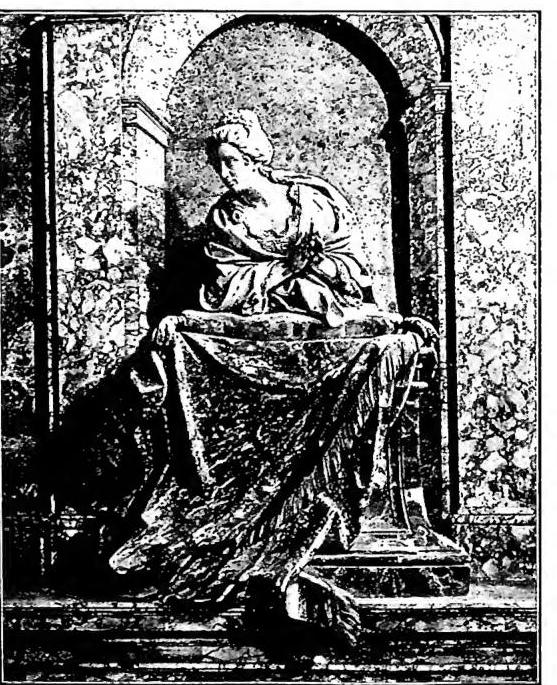
MARBLE — Example of a tomb in polychrome marble. Tomb of M. C. Vicentini (1725) — Rome, church of S. Marcello.
With the reorganization under Diocletian, Mauretania Tingitana passed, around 297, under the authority of Spanish Baetica. The expansion of Christianity was slow, owing to the difficulties created by the indigenous populations and the changing course of historical events. After Mauretania was conquered in 429 by Genseric, king of the Vandals, he introduced Arianism there.
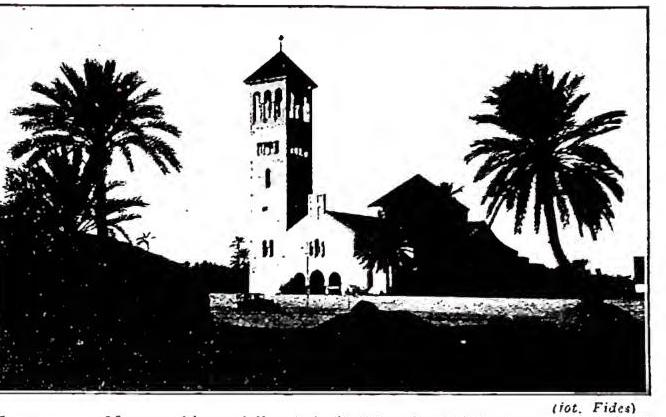
MAROCCO—New church in the city of Marrakech (apostolic vicariate of Rabat), dedicated to the holy protomartyrs of the Franciscan Order, blessed on 13 Nov. 1931.
the signatory powers the enjoyment of equal economic and commercial rights in M., without compromising the interests and rights of the individual states, as established by the treaties and agreements concluded. On 30 March 1912, France, by signing a convention with the Sultan, asserted its protectorate over M. A subsequent Franco-Spanish agreement of 27 Nov. of the same year delimited the zone of influence of Madrid. Today M. is politically divided into four parts: 1) a protectorate zone administered by France; 2) a protectorate zone administered by Spain; 3) the neutralized and internationalized zone of Tangier; 4) direct Spanish possessions: the so-called Presidios (Melilla, Alhucemas Islands, Velez de la Gomera, Ceuta, Chafarinas Islands) and Ifni.
III. EVANGELIZATION
In the time of the Roman and Byzantine Empire, throughout North Africa, and likewise in M., flourishing Christian communities with numerous episcopal sees existed; the Arabs succeeded in completely destroying Christianity in those regions. From the ninth century onward, there is no further mention of dioceses in M. In 1137 mention is made of a bishop Miguel, son of ‘Abd al-‘Aziz, together with the Mozarabic Christians exiled in the twelfth century from Granada and settled near Fez and Mequinez. It must be supposed that they were gradually exterminated. However, in 1225 a Dominican, Friar Domenico, was consecrated bishop of Baeza (in Spain, which was still Islamic), with M. as his assigned territory, and, by order of Rome, presumably in 1226 or 1227, a Franciscan named Agnello was ordained for M. or Fez. S. Francesco d’Assisi sent the first missionaries there in 1219 to preach the Gospel to the Saracens. They suffered martyrdom on 16 January 1220 at Marrakech and were the protomartyrs of the Franciscan Order: Berardo, Pietro, Ottone, Accursio, and Adiuto.In 1225 the Pope sent Dominicans and Franciscans to M., and thus the reorganization of the Moroccan Church officially began. Their activity was limited to Christians: soldiers in the Sultan’s service, mer-
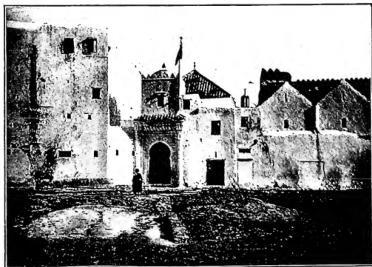
With the appointment of the Franciscan Juan de Prado as apostolic prefect in 1630, the Franciscan mission was reestablished. Although he was martyred in 1631, the Franciscans were later able to found a permanent convent at Meknes and hospices at Fez, Sale, Marrakech, and Tetuan, until their new expulsion in 1790. In Tangier alone, some missionaries were able to remain, and in the end only one Franciscan. In 1859, the apostolic prefect Sabaté renewed the mission. It is the particular merit of Fr. José Lerchundi, apostolic prefect from 1877 to 1896, to have organized the mission by founding stations, schools, and hospices, and by calling in nuns to educate young women. Even during this period, the Franciscans’ activity had to be restricted to the Christians of the sultanate of M. In 1909, the apostolic vicariate of M. was erected. Once the international zone of Tangier had been established and the Spanish and French protectorates proclaimed in 1912, the French Franciscans assumed pastoral care in the French protectorate, which was detached in 1923 as the apostolic vicariate of Rabat.