
MONACO. — This is, apart from the State of Vatican City, the smallest state in the world.
It consists of a narrow coastal strip on the western Ligurian Riviera, between the Roia and the Var, 11 km. from the Italo-French border, with an area of 1,580 sq. km. and 19,242 inhabitants (in 1946).
Almost its entire population lives in a single urban agglomeration, comprising the centers of Montecarlo, La Condamine, and M. The latter is the seat of the Government. Renowned for the exceptional mildness of its climate, the region is a center of intensive hotel activity of an international character. M. is a hereditary constitutional principality.
I. HISTORY
The “portus Herculis Monoeci” was founded, in Ligurian territory, probably by Phocaean colonists who had emigrated from Massilia (Marseilles), and was subsequently occupiedby the Romans. Hecataeus of Miletus mentions it as early as the sixth century B.C.; Strabo and Servius refer to the sanctuary that stood on the citadel in honour of Hercules Monoecus (or the Solitary One), so called because his cult was not connected with that of Ashtoret. Its harbour, “sub Herculeo sacratus numine,” exposed to south-westerly winds, was too small and unsuitable for sheltering numerous or large ships, and thus soon declined once the city of “Forum Iulii” (Fréjus), together with its harbour, had been founded. On the mountain above M. (La Turbie), Augustus opened the great “via Iulia Augusta,” and there he erected the “Tropaeum Alpium” in commemoration of the victories won over the peoples of the Alps. In the early Middle Ages M. was subjected to raids by the Saracens, and in 1191 was granted in fief to the Republic of Genoa by the Emperor Henry VI.
During the struggles between the Ghibellines and the Guelphs, the Grimaldi, who were Guelphs, succeeded in taking possession of M. as early as 1297; after various vicissitudes, during which they were also dispossessed, their sovereignty was ultimately and successively recognized by the dukes of Savoy, the popes, and the emperors. M. remained under the protectorate of Spain until 1641, when Prince Onorio II, in a coup de main, expelled the Spanish garrison, formed a close alliance with the French, and accepted their protection. During the French Revolution, in 1793, M. was annexed to France, but in 1814 the Grimaldi, under Onorio IV, returned to power. The Congress of Vienna established that the protectorate over the Principality belonged to the Kingdom of Sardinia. The Principality once again forged strong ties with France (in 1860), and France, by a treaty of 1919, guaranteed its independence, sovereignty, and territorial integrity.
II. DIOCESE OF M
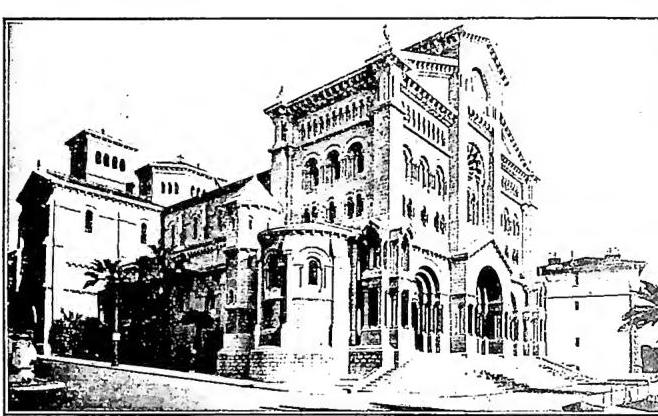
The diocese of M. has 4 parishes, served by 20 diocesan priests, 15 regular priests, 6 male and 9 female religious communities (Ann. Pont., 1951, p. 274).The oldest Christian memorial of the diocese is constituted by the Benedictine priory of S. Devota at St-Pons, erected in 1075 (Cottineau, II, col. 1876). The church of S. Maria dates from 1078, and that of S. Donato from a little later. Until 1868 M. formed part of the diocese of Nice. On 30 April 1868, Pope Pius IX erected in M. the abbey nullius of SS. Nicola and Benedetto. Pope Leo XIII created the diocese of M. on 15 March 1887, assigning it the same civil boundaries as the Principality and making it immediately subject to the Holy See. Its first bishop was Msgr. Carlo Francesco Bonaventura Theuret (1887–1901). The Cathedral is dedicated to the Immaculate Conception. The old Ducal Palace contains frescoes by Annibale Carracci and Orazio Ferrari. In 1910 an oceanographic museum was founded in M.
III. LEGAL STATUS OF THE CHURCH
The legal status of the Church in the Principality of M. is regulated by the bull Quemadmodum of Leo XIII, issued on 15 March 1886.The document, which is essentially an agreement between the Supreme Pontiff and the sovereign prince of M., intended to regulate the organization of the Monegasque diocese
erected by the same bull, was put into effect the following year (28 September by the Principality, 10 October by the Holy See).
The diocese, which is immediately subject to the Holy See, comprises the entire territory of the Principality, previously removed from the spiritual jurisdiction of the bishop of Nice and erected into an abbey nullius by Pius IX in 1868. Legal personality is recognized, in addition to the diocese, for all existing and future ecclesiastical entities and religious institutes. The State assumes responsibility for all
The Principality of M. nevertheless also has the institution of divorce, regulated by the ordinances of 3 July 1907 and 11 June 1919.
The Principality of M. maintains diplomatic relations with the Holy See, where it is represented by a plenipotentiary minister. Ippolito Rotoli