DONATO, SANTO

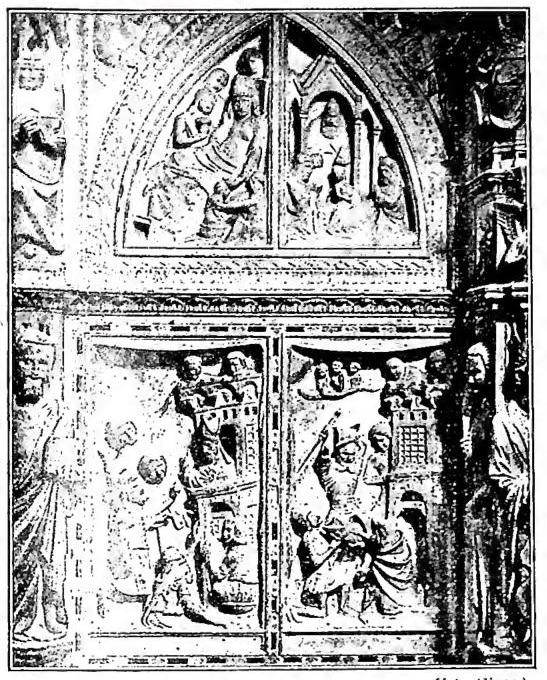
DONATUS, Saint. – Bishop and patron of Arezzo. In an Arezzo episcopal catalogue from the 11th century, he occupies the second place, after SATYRUS.

According to the legendary *Passio Donati* (BHL, no. 2289), composed between the 5th and 6th centuries and known, it seems, even to St. Gregory the Great (*Dialogues*, I, 7), DONATUS was a young Roman cleric who, during the persecution of Julian the Apostate, fled to Arezzo, where he was later ordained priest by Bishop SATYRUS. Upon the latter’s death, having been designated as his successor by the clergy and people, he went to Rome and was consecrated bishop of Arezzo by Pope JULIUS (337–52); finally, he is said to have been martyred under the same Julian the Apostate. In the *Martyrologium Hieronymianum*, however, DONATUS appears on August 7 as *episcopus et confessor*. He enjoyed a wide cult even outside Italy.

BIBL.: A. Dufourcq, *Étude sur les Gesta Martyrum romains*, III, Paris 1907, pp. 165–69; H. Quentin, *Les Martyrologes historiques du moyen âge*, ibid. 1908, p. 514 sq.; Lanzoni, p. 596 sq.; *Martyrologium Hieronymianum*, p. 422.

---

DONATION. – In Roman law, a donation (*donatio*) was a juridical act by which a person, out of liberality (*animus donandi*), enriched another by disposing of a right in his favor or assuming an obligation toward him.

Depending on the purpose of the enrichment, or whether one wished to effect the transfer of a credit or the release from one, donations were said to be real, obligatory, or liberating, and were carried out with the same formalities required for the corresponding acts for valuable consideration. They could be subject to an obligation of performance (*sub modo*), constitute a reward for services rendered by the donee to the donor (*donationes remuneratoriae*), or be made in contemplation of death (*mortis causa*).

The earliest provision containing special rules for donations was probably the *lex Cincia de donis et muneribus* (204 BC), which prohibited donations beyond a certain measure (*ultra modum*), except those between persons of a specified category, including, for example, those bound by kinship (*personae exceptae*). It was a *lex imperfecta*, since it merely prohibited the act without imposing a sanction. During the period of formulary procedure, the use of the *exceptio legis Cinciae* was granted to oppose an action for the fulfillment of a promise. Later, the heirs were deprived of the power to avail themselves of this exception if the donor had not changed his will before dying. This law fell into disuse in the Greco-Roman age, and the donation was subjected to the obligation of being drawn up in writing and transcribed in public registers (*insinuatio*), which under Justinian was mandatory for donations exceeding 500 *solidi*.

A donation could be revoked for failure to fulfill the burden imposed on the donee, in donations by a patron to a freedman for the subsequent birth of children, and under Justinian the donor was granted a personal action for revocation on account of the donee’s ingratitude. Revocation was not permitted for *donationes remuneratoriae*; those made *mortis causa* were revocable for the donee’s premature death or at the donor’s discretion.

Canon law, which in matters of contracts had adopted Roman law, incorporated into the *Codex Iuris Canonici* the norms of civil law, provided they did not conflict with divine law or with canon laws that expressly stipulate otherwise (can. 1529). Therefore, provisions of civil authority by which a professed religious could not acquire for himself or for the monastery are without effect in the ecclesiastical forum (can. 582); for donations to pious causes, only natural and canonical capacity is required (can. 1513), and strict observance of civil formalities is not necessary (can. 1516); prelates and rectors of churches cannot alienate substantial portions of the movable property of the churches entrusted to them without a just cause of remuneration, piety, or Christian charity, and their donations are revocable by their successors (can. 1535); superiors of religious orders must likewise refrain from doing so (can. 537). In the absence of contrary proof, donations made to the rectors of churches are presumed to have been made to the churches themselves (can. 1536 § 1). Without the Ordinary’s license, a donation made to the rector of a church cannot be refused, and if refused unlawfully, an action for *restitutio in integrum* or for compensation for damages suffered by the church as a result of the refusal is admitted (can. 1536 § 2 and 3). A donation made to a church or to pious causes cannot be revoked on account of the ingratitude of the administrator (can. 1536 § 4).

The current Italian Civil Code replaced the definition of art. 1050 of the Code of 1865 with the following: “A donation is the contract by which, out of liberality, one party enriches the other by disposing in favor of the latter of a right or by assuming an obligation toward the latter” (art. 769), thereby distinguishing among acts of liberality those that have a contractual character and for which solemn form is required.

A donation of future goods is void (art. 771), and one who lacks full capacity to dispose of his own goods is incapable of donating (art. 774). Void is the mandate by which the power is conferred on another to designate the person of the donee or to determine the object of the donation (art. 778). Donations by a parent to a