
FENICIA and FENICI. — Fenici (Φοίνιτζες) is the name given by the Greeks to the inhabitants of the coastal region west of Lebanon, who, for their part, called themselves Canaanites (v. CANANEI).
It seems that the Egyptian Fahra is the same word: etymologically, φοίνιξ seems to derive from φοίνιξ: «red», which is the color of purple, the principal product exported from that region. Both the Greeks (cf., e.g., Odys., 4, 618) and the Israelites (cf. Dent. 3,9; Jud. 10, 6.12, etc.) also called the inhabitants of the whole of Phoenicia Sidonians.
Phoenicia properly so called, that is, the region extending from Ras en-Naqūrah (the present-day frontier between Palestine and Syria) to the Nahr el-Kebir (the ancient Eleutherus), is for the most part a narrow strip of cultivable land, broader only at the mouths of the rivers Nahr el-Qāsimijeh (in ancient times the Litas) and Nahr el-Kebir, and behind the great coastal cities of Tyre, Sidon, Beirut, and Byblos. Well irrigated by waters descending from Lebanon, this land is extremely fertile (grain, figs, wine, olives); the lower slopes of Lebanon are suitable for horticulture and vine cultivation, whereas the higher regions were formerly occupied by forests of cedars and cypresses. The abundance of produce, on the one hand, and the narrowness of the territory, on the other, drove the inhabitants from ancient times toward exportation and colonization, first in the neighboring lands: southward as far as Carmel, northward as far as Mount Cassius (G. el-Aqra'); evidence of this is provided by the cities of Akko, Arados (Ruād), Ugarit (Raš Šamra), and, later, Tripoli (at the mouth of the Nahr el-Qadīšah). The entire region between Akko and Mount Cassius was called Phoenicia in the broader sense. Overseas colonization developed particularly in the second half of the 2nd millennium down to about 800 B.C. along the northern coast of Africa, where Carthage (founded under King Pygmalion, 820–774) was the most important colony. Phoenician ships reached even Spain (Tarāš, Tartessus, at the mouth of the Guadalquivir).
The inhabitants of Phoenicia were, at least from about 3000 B.C., Semites, as attested by their figures represented on Egyptian monuments, which are of the same type as the «Canaanites» of pre-Israelite Palestine. So far, it is not known what race or origin the inhabitants who preceded them belonged to. The Phoenician language is known from many inscriptions found in Phoenicia itself, among which the oldest are the inscriptions of the kings of Byblos recently discovered
History. — The earliest information about Phoenicia comes from Egyptian documents. Egypt, lacking timber, from the earliest times obtained it by sea from the cedar and cypress forests of Phoenicia. Such commercial expeditions, Byblos (v.), then the most important port of Phoenicia, were undertaken from the time of the earliest Egyptian dynasties, especially under the Sixth Dynasty (ca. 2420–2280 B.C.) and the Twelfth Dynasty (ca. 2000–1785). As a result of these expeditions, the Egyptians also acquired a certain political supremacy, or at least a very considerable influence over the government of some cities, as the excavations at Byblos and Ugarit (Rās Samra) attest. This Egyptian supremacy, interrupted during the period of the Hylēns (ca. 1750–1580), was regained after their expulsion from Egypt (ca. 1580), especially under the powerful Thutmosis III (ca. 1501–1447), but soon declined, as the Amarna letters attest, because of the invasions of the Ḥabiru and the intrigues of the Amorite princes settled beyond Lebanon, and came to an end entirely at the time of the invasion of the «Sea Peoples» (ca. 1200 B.C.). The independent political organization of the individual great cities now begins: Sidon, Tyre, Arados, Byblos, and Akko, which compete for hegemony. From the 12th century the authority of Sidon prevailed; around the year 1000 it was replaced by that of Tyre, whose king Hiram I (996–936) maintained political and commercial relations with David and Solomon (cf. II Sam. 5, 11; I Reg. 5, 15-32; 9, 11-14, 27; 10, 11). Ittobaal (887–850), Hiram’s third successor, formed an alliance with Omri and Aehab, kings of Israel (884–854), and under Pygmalion (820–774) Carthage arose (or arose again) (814–815), Tyre’s most important colony on the northern coast of Africa. But the expansionist policy of the resurgent Assyrian kingdom also threatened Phoenicia: its northern part was made an Assyrian province by Tiglath-pileser I (756–727), while the southern part became tributary. The political situation remained more or less the same after the defeat of Assyria under the Neo-Babylonian kings. Although leaving the individual cities a certain autonomy, the Persians included Phoenicia under the 5th satrapy, Abernahara (Syria): cf. Herodotus, III, 91. Conquered in part by Alexander the Great, Phoenicia became the object of disputes among the Diadochi until, in 64 B.C., the Romans definitively occupied it, incorporating it into the Province of Syria. This situation remained essentially stable until the invasion of the Arabs (A.D. 638).
Phoenician civilization presents a highly complex character. Since Phoenicia was a land of transit from the Aegean and Egypt to Mesopotamia, its civilization was open to the influence of the cultures of all those countries, particularly Egypt, as the excavations at Byblos and Rās Samra prove. Nevertheless, Phoenician art contains original elements, attributable to the Phoenicians’ uncommon artistic talent and great technical skill. The opinion attributed by ancient writers ...
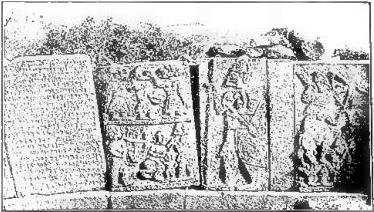
FENICIA E FENICI - Inscription and reliefs of Karatepe (8th century B.C.).
The Phoenicians’ claim that their people had discovered and transmitted to the other nations nearly all the arts and crafts is certainly false, but it nevertheless remains true that quite a few Phoenician inventions and works of art passed into the civilizations of the West, especially that of the Greeks. The most valuable contribution made by Phoenicia to the West is alphabetic writing, which passed to the Greeks in the 11th or 10th century and was itself called by them Φανιλοξία γράμματα (Herodotus, V, 58).
alphabet (v.) or received it from others is still a disputed question. Until recently, the oldest Phoenician alphabetic inscription known was considered to be that on the sarcophagus of King Aḥiram of Byblos (probably written around 1100 B.C.); but recently a brief inscription has been found that is dated to the 15th century B.C. and is much more archaic than that on Aḥiram’s sarcophagus. The invention of Phoenician alphabetic writing therefore dates back at least to the middle of the second millennium B.C.
The religion of the Phoenicians, previously known almost exclusively through the information provided on the subject by Sanchuniathon (the last third of the second millennium [?]), transmitted to us by Philo of Byblos (A.D. 64–140), is today being elucidated by monuments discovered in recent decades. The Phoenician pantheon is not entirely identical in the various cities of Phoenicia, but the principal deities may be reduced to three fundamental types: an “older” god (El); a female divinity representing generative power (Astarte, Baalar, Ašera); and a “young god,” representing the rising and dying vegetation (Adonis; at Ugarit, Mōt and Alijan; at Tyre, Melqart).
Alongside these fundamental types there are several other, new ones, probably imported from abroad, representing both atmospheric phenomena (Rešef, Baal-Šamen, at Ugarit Baal) and other elements important to social life (hypostases of the arts, etc.). Compared with the Canaanite religion of Palestine, the Phoenician religion displays the same foundation, but a somewhat different and richer development, owing to the political separation of the two regions and to foreign influences, to which Phoenicia was more open than
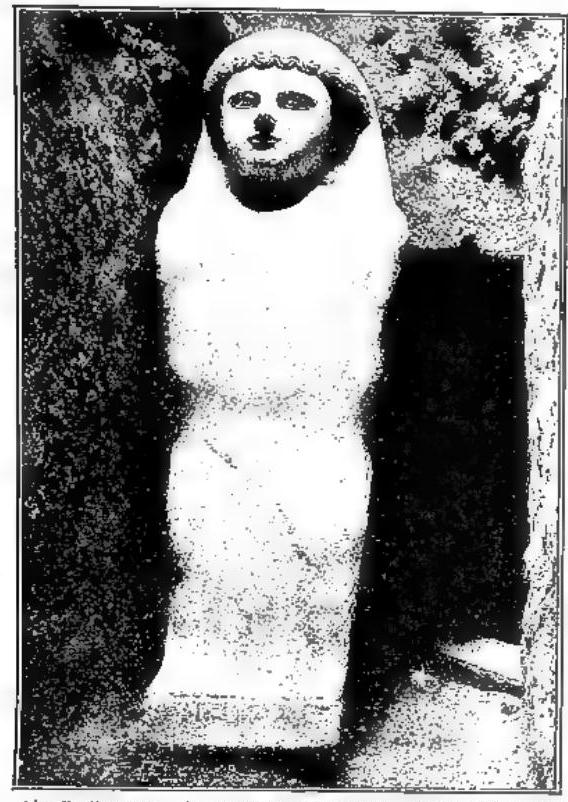
underwent further modifications owing to infiltrations coming
from Libya and the interior of Africa.
BIBLI: F. C. MOVERS, Die Phénicier, I, Bonn-Berlino 1841;
II, 1-3, ibid. 1849-56; R. Pietschmann, Geschichte der Phœnicier,
Berlino 1889; G. Rawlinson, History of Phoenicia, Londra
1889; M.-J. Lagrange, Études sur les religions semitiques, 2e
ed., Parigi 1905; W. Graf Baudissin, Adonis und Esmun, Lips-
na 1911; G. Centenau, La civilisation phénicienne, Parigi 1928;
G. Levi Della Vida, Fenici, in Enc. Ital., XIV, pp. 997-1002;
Z. S. Harris, A Grammar of the Phoenician Language, Nuova
Haven 1936; R. Dussaud, Les découvertes de Ros Shaura et
l'Ancien Testament, Parigi 1937; O. Eissfeldt, Phénicier (Phén-
icia), in Pauly-Wissowa, XVIII, II, coll. 350-80.