
UGARIT. – Ancient city of Upper Syria, today Rās Samrah, brought to light by French excavations begun in 1929.
Rās Samrah is an artificial mound, approximately 20 m. high and covering about 25 hectares, situated approximately 12 km. north of Laodicea and 1 km. east of the coast. The chance discoveries made by a peasant in the nearby port known as Minat al-Bajdā' (1928) attracted the attention of the Archaeological Service of Beirut and subsequently of the Académie des inscriptions et belles-lettres, which decided to begin systematic excavations. C. F.-A. Schaeffer was placed in charge of them, assisted by G. Chenet. Between 1929 and 1939, 11 campaigns were conducted; after the interruption caused by the war, and following soundings in 1948–49, the excavations resumed in 1950. In 1939 it was estimated that approximately one-eighth of the area had been explored, and this proportion has not been greatly altered by the new excavations.
Five archaeological strata have been distinguished at Rās Samrah, dating from the 2nd to the 5th millennia B.C. The first (12th–15th centuries) reveals notable prosperity, interrupted around the middle of the 14th century by a serious fire; the city must consequently have recovered, only to decline definitively at the beginning of the Iron Age under the action of the “Sea Peoples.” The second stratum (16th–21st centuries) indicates the predominance of the Semitic element: the temples of Ba'al and Dagon and numerous Canaanite-type vessels belong to this period; Egyptian and Cretan influences are also present, and traces of the passage of the Hyksos remain. In the third stratum (approximately the 3rd millennium), Canaanite pottery is still found, indicating the presence of Semites in the area from that period onward. The fourth stratum (approximately the 4th millennium) is characterized by elegant pottery, sometimes in two or three colours, closely resembling Mesopotamian pottery. Finally, in the fifth stratum (approximately the 5th millennium), painted pottery disappears and a much more archaic type is found.
The identification of modern Rās Samrah with ancient U. was neither immediate nor easy. Mentions of U. had already been found in Egyptian, Hittite, and Akkadian texts. After various hypotheses, the location of U. at Rās Samrah was proposed by W. F. Albright in 1931 and subsequently confirmed by a series of findings: the repeated discovery of the name U. in the texts of Rās Samrah; the discovery in 1933 of a colophon mentioning an Nqmd mle Ugrt (“Nqmd, king of U.”); and finally, an Akkadian letter found in 1934 and written to an addressee in the city, in which it says: “May the gods of U. protect you, my brother!”
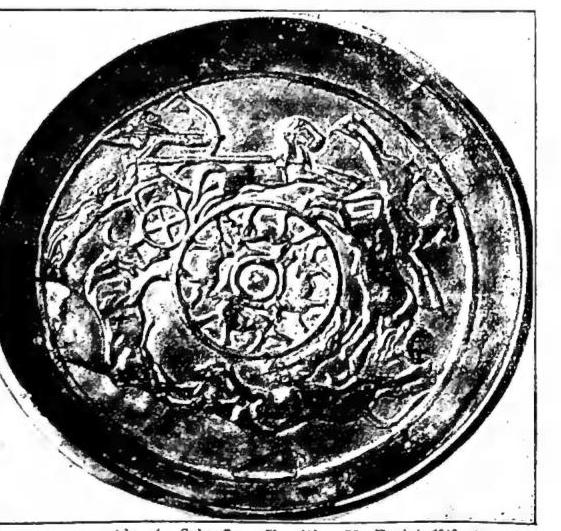
(from A. Schaeffer, Ugaritica II, Paris 1890, pl. 1)
UGARIT - Golden patera with hunting scenes in relief (15th–14th centuries B.C.), found at Rās Samrah.
many and of composite culture, important are the discoveries of texts, which immediately accompanied the excavation campaigns. Egyptian, Hittite, Hurrian, and especially Sumerian and Akkadian documents were found. But what above all aroused the researchers’ interest was the discovery of many hundreds of clay tablets, covered with a cuneiform script of Mesopotamian type, but differing in the form of the signs and in their number, which barely reached thirty. C. Viroleaud, H. Bauer, and E. Dhorme worked independently on its decipherment. The number of signs immediately suggested that it was an alphabetic script; the fact that the individual words (separated from one another by small vertical strokes) averaged 3–4 signs each indicated that the language must belong to the Semitic group, in which this is precisely the average number of consonants per word: this, moreover, was confirmed by the region in which the texts had been found. Through a successive series of hypotheses, in which priority among the researchers cannot always be established, the script of U. had already been deciphered by 1930.
The language of the texts of U. displays many features in common with the northwestern group of Semitic languages, to which it also belongs geographically, and in particular with Canaanite. However, just as the definition and limits of Canaanite are disputed, so Ugaritic contains certain autonomous and divergent elements. First of all, it presents a more precisely defined and more conservative phonetic system of the Proto-Semitic sounds: the dentals t and t (> t) and the gutturals g and h, lost in the rest of the Canaanite area, are in fact found in II. In phonetics too, it differs from Canaanite in the change d > d (common to Aramaic), instead of d > z, and in the absence of the characteristic phenomenon d > b. The vocalism is identical to Proto-Semitic: a, i, u; and it is a peculiarity of the script that it uses three signs for the consonant, according to the vowel accompanying II. The morphology shows the survival of the ancient Semitic case endings; in the verb, the imperfect retains, alongside the indicative, the subjunctive, jussive, and energetic moods.
The Ugaritic texts, whose period of composition falls around the 15th–14th centuries B.C., contain economic and diplomatic writings, hymns, prayers, and finally a series of mythological poems, which constitute the most important material for reconstructing the beliefs and customs not only of the city but, as may be supposed, also of a large part of the Canaanite milieu. The most important cycle is that of the god Ba'al, whose struggle and victory over the sea god Jam and the construction of a great palace are recounted; Ba'al is killed by Môt, god of the underworld, and dragged by him into his kingdom, but is then brought back to life and led again to earth by his sister 'Anat, who in turn kills Môt: the cycle, which appears as a series of different episodes, most probably reflects a seasonal myth, in which Ba'al represents the fertility of spring and Môt the summer aridity that destroys it, but is then itself vanquished. Another poem concerns the hero Aqhat, son of the wise Danel, who, having refused the goddess 'Anat his hunter’s bow, arouses her anger and is killed; his sister Paghat sets out to avenge him, and it is possible that the end of the poem, preserved in fragmentary form, contains the hero’s resurrection. The poem of Keret probably has some historical basis: it concerns a king who has lost his entire family and who, advised in a dream by the god El, undertakes an expedition to the land of Udum, defeats its king, and marries his daughter, by whom he will have new offspring. The poem of the Dawn and the Sunset is regarded as a short religious drama; in its first part it sets out the ritual acts and accompanying songs of a cultic ceremony connected with the grape harvest, while in its second it recounts the birth from El of two divinities, called Dawn and Sunset precisely.
The interpretation of the Ugaritic texts is not yet
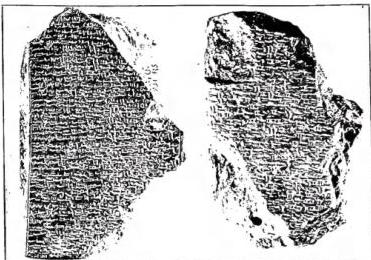
UGARIT – Ugaritic cuneiform tablets containing fragments of the poem of Danel (15th–14th centuries B.C.), discovered at Rās Samrah. On the left, the recto (?), on the right, the verso (?).
entirely clear; it is to be hoped that the coming years will bring, with the expansion of the discoveries, a parallel advance in knowledge of this important center of the ancient Near East. – Vedi tav. LXIX.