Machine translation of the 1948–1954 Italian original. The original text is authoritative.
UGANDA. – British Protectorate, comprising a territory of 243,382 sq km north and west of Lake Victoria, between Sudan, Kenya, Tanganyika, and the Belgian Congo, and consisting of a series of plateaus (1,000 m, on average), which, to the west, abut upon the volcanic masses of Ruwenzori and Elgon.
More than the tropical climate, malaria and sleeping sickness render the country unsuitable for whites. The population (5.1 million inhabitants; 21 per sq km) consists of Negroes (Bantu and Nilotic), with groups of Pygmies, Arabs, and Indians. The principal crops are cotton, coffee, tea, sesame, peanuts, sugar cane, and tobacco. The rubber harvest is noteworthy. Indigenous livestock numbers 2.6 million cattle, 2.3 million goats, and 1.1 million sheep. The capital, Entebbe (8,000 inhabitants), lies on Lake Victoria.
BIBL.: Saben's Commercial Directory and Handbook of U., Kampala 1947. Giuseppe Caraci
THE ARCHDIOCESE OF RUBAGA, FORMERLY THE APOSTOLIC VICARIATE OF U. — It is situated in the central part of the Protectorate. It has an area of 40,560 sq. km. and a population of more than 488,000 inhabitants, and is entrusted to the Missionaries of Africa (White Fathers).
It currently has 226,342 Catholics, of whom 213,015 are indigenous, 8,863 foreign, 32 of mixed descent, and 4,432 catechumens; it also has 156,980 Eastern dissidents, approximately 31,000 Muslims, and approximately 74,000 pagans; 30 indigenous priests, 70 foreign priests; 47 indigenous brothers and 7 foreign brothers of the Missionaries of Africa, 47 of Ploërmel (= Brothers of Christian Instruction); 18 major seminarians, educated at Katigondo (Masaka), and 71 minor seminarians; 56 male catechists and 32 female catechists; 419 male teachers and 257 female teachers; 1 physician; 26 principal mission stations and 482 secondary ones, 26 churches and 483 chapels; 2 hospitals; 5 dispensaries; assistance programs for maternity and childhood; 1 printing press with a weekly newspaper (Munno) in 9,000 copies, and other minor publishing initiatives; schools
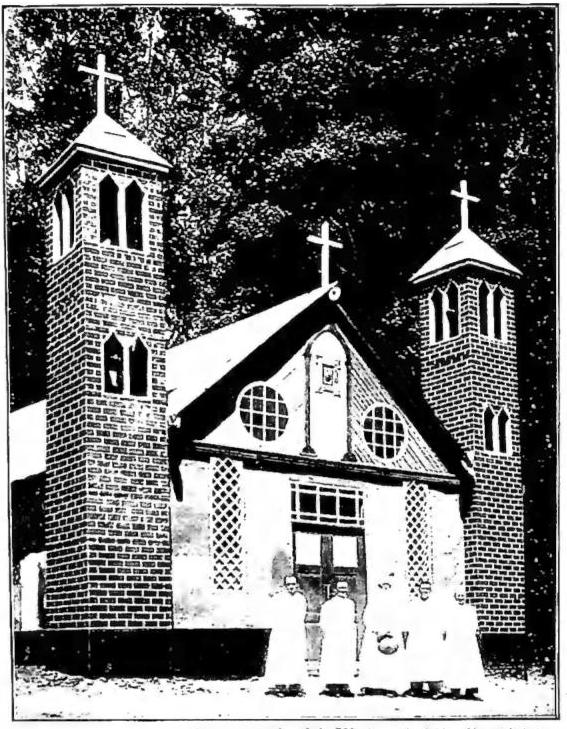
196. In 1951 there were 1,388 adult baptisms; Catholic Action is flourishing there. (courtesy of the Missionaries of the Consolata) UGANDA – Church of Tinderet. Agricultural school of the Consolata Mission.The region of the great lakes, explored by Livingstone and Stanley, was entrusted to the White Fathers by Pope Leo XIII by rescript of 24 February 1878. The first two missionaries arrived at Entebbe on 17 February 1879. The first four baptisms were administered on 27 March 1880 and were followed by numerous others. The Vicariate of Nyanza, which on 15 January 1915 became the Vicariate of U., was established in 1883. At that time it included the territories that today form the vicariates of Bukoba and Lower Kagera, of Lake Albert in the Belgian Congo, of Kisumu in Kenya, of Ruwenzori, of Masaka, of Kampala and of Tororo in the Protectorate of U. The progress of evangelization alarmed the indigenous chiefs, and the missionaries deemed it advisable to withdraw southward in that same year, 1883. There were already 200 catechumens. Only in 1885 did they return to the territory of U., under the indigenous king Mwanga I, who nevertheless in 1886 sought to annihilate the nascent Christian community, which numbered 200 baptized persons and 800 catechumens. More than one hundred were killed, 22 of whom were beatified on 6 June 1920. In 1890 U. already had 50,000 Catholics, when the English Protestants, allied with the Muslims, sought in 1892 to ruin that Christian community once again. But, once the storm had passed, the mission resumed its progress, to such an extent that it deservedly earned the title of “Pearl of the Missions of Africa,” despite the fact that its territory is now reduced to the proportions indicated above as a result of all the divisions it has undergone for the establishment of other flourishing and fully developing missions. On 25 March 1953, the ecclesiastical hierarchy was established in U., comprising the archdiocese of Rubaga, formerly the Apostolic Vicariate of U.; the diocese of Gulu, formerly an Apostolic Vicariate; the diocese of Kampala, formerly an Apostolic Vicariate; the diocese of Masaka, formerly an Apostolic Vicariate; the diocese of Mbarara, formerly the Apostolic Vicariate of Ruwenzori; and the diocese of Tororo, formerly the Apostolic Vicariate of the Upper Nile. - Vedi tav. LXVIII.
BIBL.: AAS, 7 (1945), pp. 47-48; MC, 1950, pp. 193-94; A cath. Direct. of East Africa, Mombasa 1940, pp. 23-33; Archivio S. Congr. de P. F., pos. prot. n. 3674/52. Carlo Corvo
Cite this article
“UGANDA.” Enciclopedia Cattolica, vol. XII (1954), p. 445. Azione Romana digital edition, https://azioneromana.com/article/uganda.