
MISSIONARIES OF AFRICA (WHITE FATHERS). — The Society, founded by Cardinal Lavigerie in 1868, is composed of priests and lay coadjutor brothers, who are not religious, since they are bound only by an oath. Their special purpose is the apostolate among Africans; they are known by the name of «White Fathers» because they wear a habit similar to that of the Arabs, namely a robe called a gandurah and a cloak called a burnus, both white in color, with a red woolen headdress called a scescià; indeed, it was to the Arabs that their apostolate was first directed.
Their beginnings were humble: on 20 January 1890, three seminarians, after hearing a conference by the rector of the Seminary of Kuba (Algiers) on the Arab mission, then presented themselves to the archbishop of Algiers and offered themselves for that mission. Mons. Lavigerie saw in this offer a response from heaven to his plans for an apostolate toward the center of Africa. The first novitiate was opened under the direction of Fr. Vincent. On 2 February 1869, four were the first to be clothed in the habit of the White Fathers. Subsequently, the novitiate was established at Maison-Carrée, where the Seminary was also later organized and where the Society’s Mother House was located. Although the immediate purpose was the conversion of the Arabs, from that time onward all the regions of Africa where there was hope of converting infidels were indicated as a field of apostolate. In 1872 new Rules were published, and on 1 October seven priests and five scholastics pronounced the oath. In 1875 the Jesuits left the direction of the Novitiate, which was entrusted to a White Father. At the Chapter of 1886 the first division into provinces took place; on 15 May 1895, the Society was approved and its Rules received approval ad decennium. Pius X, by decree of 15 February 1908, gave definitive approval to the Constitutions. By rescript of 15 March 1910, the Society depends on the Sacred Congregation
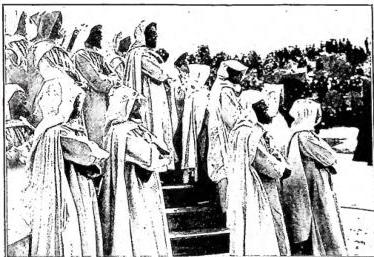

The development of the Society and its works was very rapid. At the beginning, the missionaries cared for the orphans gathered by the founder during the great famine of 1867–1869. In 1873 missions were founded in Kabylia (Algeria); in 1876 three White Fathers, sent by Mons. Lavigerie to Timbuktu, were massacred in the desert. In 1881, three other missionaries who had departed from Tripoli were killed in the region of Ghadames, in Libya. In 1878 Mons. Lavigerie accepted the foundation of St. Anne of Jerusalem, where the White Fathers devote themselves to the formation of the Greek-Melkite clergy. In the same year the missions of the equatorial Great Lakes were founded, at the Nyanza and Tanganyika. In Uganda, during the first years there were struggle and persecution and, in 1886, several Christians were martyred there.
In 1950, the missions entrusted to the White Fathers were divided into three fields: 1) North Africa, with the missions of Kabylia and the Sahara; 2) West Africa, with the missions of Bamako, Bobo Diulasso, Gao, Kayes, Nuna, Nzérékoré, Uagadugu, Ushiguya, Sikasso, Tamale, and Oyo. 3) Equatorial and East Africa, with the missions of Uganda, Rwenzori, Masaka, Bukoba, Musoma, Maswa, Mwanza, Tabora, Kigoma, Karema, Mbeya, Bangweolo, Lwangwa, Nyassa, North Nyassa, Fort Jameson, Baudouinville, Kivu, Lake Albert, Ruanda, Kitega, and Ngozi in Urundi, and the mission in Mozambique.
The organization of the indigenous clergy is important, with 368 priests and seven regional seminaries with 465 seminarians. Several residences have been entrusted to the indigenous clergy. The vicariate of Masaka, in Uganda, of which Mons. Giuseppe Kiwanuka, a native Ugandan, is apostolic vicar, has 58 indigenous priests.