
PIO X, POPE, BEATUS. — Giuseppe Melchiorre Sarto, born in Riese, a village in the diocese of Treviso, on 2 June 1835 to Giovanni Battista Sarto, town messenger, and Margherita Sanson, a seamstress, was the second of ten children. After completing his early studies, not without sacrifice, in nearby Castelfranco, at the age of fifteen, through the intercession of his fellow townsman Cardinal Monico, Patriarch of Venice, he obtained a free place in the Seminary of Padua, where he immediately distinguished himself for the acuteness of his intellect, nobility of character, and love of virtue.
Ordained priest on 18 September 1858, he served as chaplain for nine years in the small village of Tombolo, then for the same period as parish priest in the large town of Salzano, demonstrating outstanding gifts as a shepherd of souls. In 1875 he was called to Treviso as episcopal chancellor, spiritual director of the Seminary, canon in the Cathedral, and, during the vacancy of the see, vicar capitular. Elected at the end of 1884 Bishop of Mantua, in nine years of wise and strong governance he reorganized catechesis, renewed the Seminary, carried out two pastoral visits, celebrated the Synod, and countered socialist propaganda with institutions of charity and social assistance. Created cardinal in June 1893 and promoted to the patriarchal see of Venice, his exequatur was delayed until November 1894. His principal concerns were the Seminary and the clergy, catechism and the Opera dei Congressi, the spread of Catholic press and socio-economic works. He ensured the decorum of liturgical functions and sacred music. He fostered the emergence of a civic administration formed by a coalition of Catholics and moderates. He manifested the goodness of his heart through acts of inexhaustible charity, veiled in sincere humility and austere simplicity.
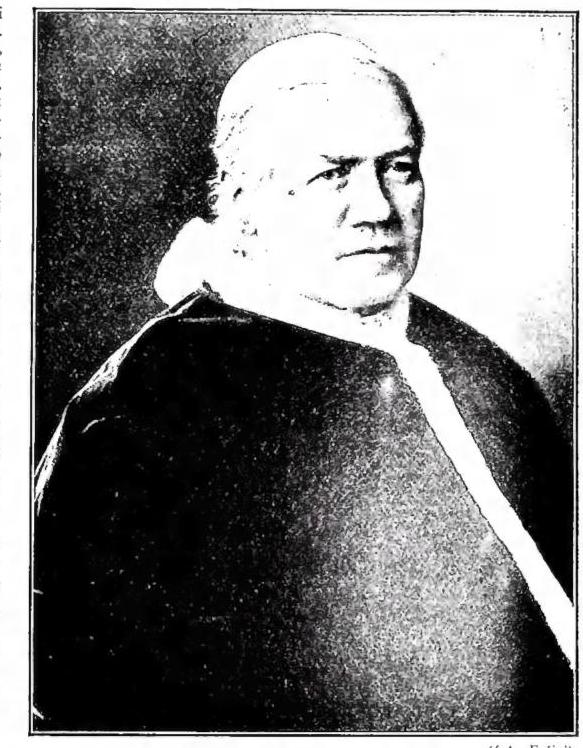
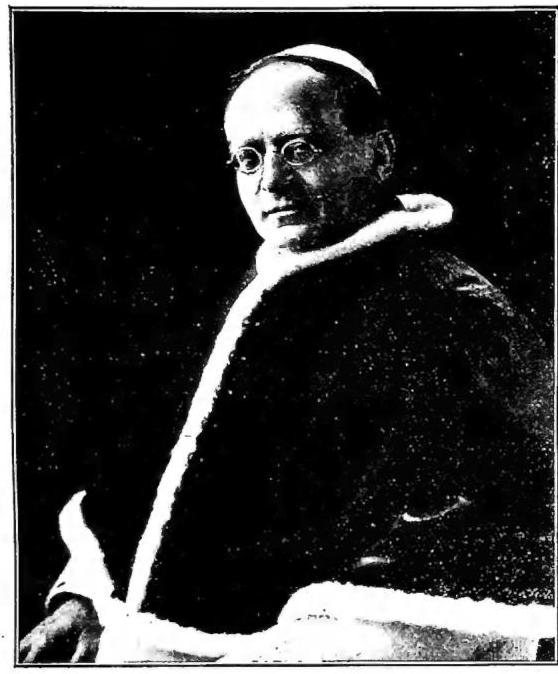
On the Roman See, Pius X immediately revealed to the astonished and admiring world sovereign greatness, heroic virtue, governing wisdom, and captivating goodness, in an ascent year by year ever more evident on the sublime path of holiness. Of medium stature, with a robust build, an amiable countenance; his eye lively and penetrating, his gait slow, almost weary, naturally majestic; his gestures broad, measured, paternal; his speech simple, familiar, persuasive with a marked Venetian accent. From his person there emanated an attraction of gentleness and at the same time of strength that captivated all. His quick and penetrating intelligence, his strong, resolute will, his frank and naturally impetuous temperament, yet restrained by firm self-mastery. His long ministerial experience fostered an innate good sense, which expressed itself in immediate intuition of problems and swift, appropriate solutions. Extremely sensitive of heart, he possessed a vigilant conscience of duty, nourished by reflective and courageous prudence. He faced grave responsibilities with decision; his soul serene through an unshakable faith in the designs of Providence. His love of justice rendered him austere, at times severe in demanding obedience, in defending the rights of God, in asserting the independence of the Church. His natural goodness, sanctified by the grace of the Holy Spirit and rendered more endearing by an enchanting simplicity of manner, radiated from him in countless acts of charity, always intelligent, often heroic. A keen judge of men, of their potential and weaknesses; understanding and merciful toward the erring, yet uncompromising and most severe against errors; an enemy of every kind, even veiled, of nepotism; a lover of genuine spirit of poverty; faithful and constant in friendship; cordial and generous toward his collaborators; averse to flattery; resolute in pursuing solely the apostolic ideal, he inspired in those near and far the fascination of a holiness all the more compelling for being less singular and contrived. From Leo XIII, Pius X inherited a heavy and complex situation, of which the clamorous interference of Austria in the Conclave was one revealing sign. In Italy, the separation between Church and State, a consequence of the complex and thorny “Roman Question,” required a prudent course of action that would safeguard on the one hand the sacred rights of the freedom and sovereignty of the Church, and on the other take account of the supreme religious interests of the Italian people in their historical and civic evolution. In France, the radical-Masonic government threatened to break the Concordat and sought to subject the episcopate and clergy to the Third Republic. In other Catholic countries of Europe and America, anticlericalism was promoted by Freemasonry, which now gave it a legal veneer in parliaments and courts, now incited it in vulgar forms through a venomous, blatant, blasphemous press and not infrequent public demonstrations.
The spirit of the age is the total denial of the supernatural world; it is the spread of a practical atheism that gives rise to the rejection of Catholic tradition and dissolves faith into a vague sentiment of religiosity. Positivism, in its expression of dialectical materialism, and idealism, in the guise of a two-faced subjectivism, align Christianity, in a rationalist syncretism, with all other historical religions. The social, political, and economic world suffers from a capitalist conception protected by a liberalism that, by elevating freedom to the status of a myth, favors the excessive wealth of the few and creates the wretched poverty of the many. Social inequality, exacerbated by industrial development, offers socialism—materialist in origin and anticlerical by habit—excellent grounds for its claims, wielding the weapon of the strike. Dynamism, born of technology, insinuating itself even into the sanctuary, proclaims the primacy of action, relegating the so-called passive virtues to the monasteries.
Even within the Catholic fold, there is a ferment not without danger and deviation. Catholic laity, though organizing themselves into flourishing associations of diverse economic, union, charitable, and political structures, nevertheless feel, because of the audacity and intemperance of a few, a discomfort that threatens unity, concord, and the life of the nascent “Christian democracy.” Within the Church’s internal life, there is a desire for reforms to structures worn by time; there is a call for renewal in ecclesiastical discipline and an updating of pastoral care, especially regarding sacred studies, catechesis, liturgy, and sacred music. The poison of modernism slithers subtly everywhere.
In the light of God, the blessed Pope Pius X is conscious of the immense task that Providence entrusts to him. His hope is in the Lord.
The man reveals his mettle and measures his awareness from his very first encyclical, E supremi apostolatus cathedra, of 4 October 1903, two months after his election. The diagnosis of the malady afflicting society is precise: apostasy from God. And the remedy? “Supported by the virtue of God,” he writes, “we proclaim that in Our pontificate We have no other program than this: to restore all things in Christ, so that Christ may be all and in all... The interests of God will be Our interests, for which We are determined to expend all Our strength and even Our life. It is the duty of the Pope to lead all men—both those who obey and those who command—back to the path of equity, in public as in private life, on the political as on the social plane. The Pope ‘can absolutely not separate the things that pertain to faith and morals from politics.’ ‘A sublime mission... which, transcending these fleeting goods of earth, extends even to eternity, unbounded by local frontiers, embracing all the nations of the earth; which includes the defense of the Gospel in every sphere, even in the stormy realm of politics; which directs Our solicitude not only to the faithful but to all men for whom Christ died’ (address to the cardinals, 3 November 1903).”
To this luminous program the reforming Pope remains faithful until his death. Among his collaborators is Cardinal Raffaele Merry del Val, his most faithful Secretary of State. “I have chosen him,” said Pius X, “because he is a polyglot. He knows the problems of every country, he is very modest, he is a saint... I have chosen him for his piety and for his priestly spirit.” And to the same cardinal: “We shall work together and together we shall suffer for the love and honor of the Church.”
I. P. X AND FRANCE. — The situation had become tense even during the pontificate of Leo XIII, when on 23 Dec. 1902 the French minister Combes, bypassing the normal procedure of the nuncio, proposed to the Holy See, in terms far from respectful, the appointment of two ecclesiastics as bishops and the transfer of a third. The Holy See responded negatively, citing the lack of suitability of the candidates. A series of exchanges between the French government and the Holy See ensued, with the Masonic government clearly seeking a pretext to break the Concordat of 1801. In April 1904, Loubet, President of the Republic, officially visited the King of Italy, contravening the practice established after 1870. The Holy See immediately protested. The French ambassador was recalled from the Vatican, and bishops from Dijon and Laval were forbidden to travel to Rome to respond to the Pope’s formal invitation. Diplomatic relations were severed on 30 July 1904. The Chamber of Deputies and the Senate approved (3 July–9 Dec. 1904) the law on the separation of Church and State and the abrogation of the Concordat. As a result, the French Republic denied all legal recognition to the Church in France. On 11 Feb. 1906, P. X responded with the encyclical Vehementer nos, condemning the law of separation and denouncing the government’s abuses: the seizure of the archives of the nunciature, the confiscation of ecclesiastical property, the suppression of religious congregations, the expulsion of their members; worship was restricted to church services alone; bishops and clergy were stripped of all state subsidies. To detach the faithful from Rome and bring the clergy under state control, the government proposed the formation of cult associations. P. X thwarted these schemes by publicly condemning them in the encyclical Gravissimo officii munere (10 Aug. 1906). With a remarkable display of unity and fidelity to the Roman See, bishops, priests, religious, and laity were prepared to face hunger rather than disregard the Pope’s directives. The Church in France, freed from all state interference, gained a stronger spiritual structure and brought great comfort to the heart of the Pontiff, who rewarded such fidelity by consecrating 14 new bishops in St Peter’s.
Amid this epic struggle between Church and State, the stance of Action Française emerged, drawing together monarchist conservatives and anti-democrats and seeking to win adherents. On the opposite side stood the group of Catholic republicans, the so-called “abbés démocrates.” The verbal excesses and theologically erroneous positions of the followers of the Sillon of Marc Sangnier compelled P. X to condemn as dangerous a trend that threatened to remove the faithful from the necessary discipline of the hierarchy. Other sorrows weighed upon the heart of the Pontiff. In Portugal, the revolution that overthrew the monarchy persecuted the Church: ecclesiastical property was confiscated, religious congregations were suppressed, and bishops and priests were exiled. In Spain, the rupture of diplomatic relations made the situation of the religious congregations precarious. In Germany, liberals and Protestants mounted a campaign against the judgments on the Reformers contained in the encyclical Editae saepe (26 May 1910).
II. P. X AND ITALY. — The increasingly aggressive advance of subversive parties and the persistent persecution by Masonic sects made the development of Catholic life in Italy a matter of grave concern. The commendable Opera dei Congressi and its related committees, spread like a strong network throughout all the dioceses, kept Catholics organized, but the only influence they could exert in civil and political life was in defending moral principles and protesting the violated rights of the Holy See. And yet the need to be present in public life became more urgent with each passing day. Therefore, in 1909, St. Pius X, without revoking the non expedit (q.v.), tempered it by granting bishops the faculty to allow Catholics to vote in elections for overriding reasons of public good. Thus, 24 Catholic deputies entered the Italian Parliament, while in the 1913 elections, with the Catholic Electoral Union better organized, the number of elected deputies reached about one hundred. Even the “Roman Question” began to be framed not as a simple restoration of temporal power, but rather as a guarantee of the Pope’s freedom and independence. In response, the Masonic side adopted a sectarian and ahistorical stance: a telling example is the outrageous speech delivered by Nathan, mayor of Rome and Grand Master of Freemasonry, on 20 September 1910. By contrast, the 1913 Social Week of Catholics in Milan featured “authorized” addresses by Abp. A. Rossi and Count G. Dalla Torre.
III. ST. PIUS X AS RESTORER OF CHRISTIAN LIFE. — “To make Christ reign, nothing is more necessary than the holiness of the clergy” (letter to Cardinal Respighi, 1902): this was the guiding principle that led the Pope to reorganize the Roman seminaries at the Lateran, to promote regional seminaries in central and southern Italy, to lay down uniform and up-to-date norms for the training and discipline of candidates for the priesthood, to send apostolic visitors to seminaries and dioceses, and to foster sound ecclesiastical culture. The foundation of the Biblical Institute in Rome, a veritable university of Sacred Scripture, the revision of the Vulgate entrusted to the Benedictines, and the motu proprio on the study of the philosophy of St Thomas in schools are the principal documents of his concern to have a learned clergy, while the celebrated exhortation Haerent animo, issued on the occasion of the sacerdotal jubilee, remains a precious code of the virtuous life and pastoral activity of God’s ministers.
G. Sarto had been able to observe, even as a young curate, that the chief cause of apostasy from God lay in religious ignorance, and so he had striven, by example and exhortation, to combat II. As Pope, with the encyclical Acerbo nimis of 15 April 1905, he issued wise laws for the catechetical instruction of children, young people, and adults; by his own example he held Sunday catechism classes for the people of Rome; he ordered the promulgation of a single catechism text for the dioceses of Italy; and he encouraged gatherings for the apostolate of catechesis. “To live in grace one must nourish the soul with the ‘living bread that came down from heaven.’” St Pius X is rightly called the Pope of the Eucharist, for by his decrees he promoted frequent and even daily Communion among the faithful (20 December 1907, Sacrosancta Tridentina Synodus), facilitated the reception of Holy Communion by the sick (S. Congr. of the Council, 7 December 1906), offering them the comfort of receiving the Eucharist several times during illness, and opened (decree of 28 August 1910, Quam singulari Christus amore) the Holy Tabernacle to little children who could distinguish the Eucharistic bread from ordinary bread.
Within the framework of the Christian education of the faithful must be understood the broad liturgical reform carried out by St Pius X: the reform of the Breviary, the studies for the reform of the Missal and for the liturgical books of the Eastern Church. In the motu proprio of 22 November 1903 new norms were given for the restoration of Gregorian chant, for polyphonic music, and for the choral singing of the faithful.
(from Romana Curia a beato Pio X sapienti Concilio reformato, Rome 1901, p. 35)
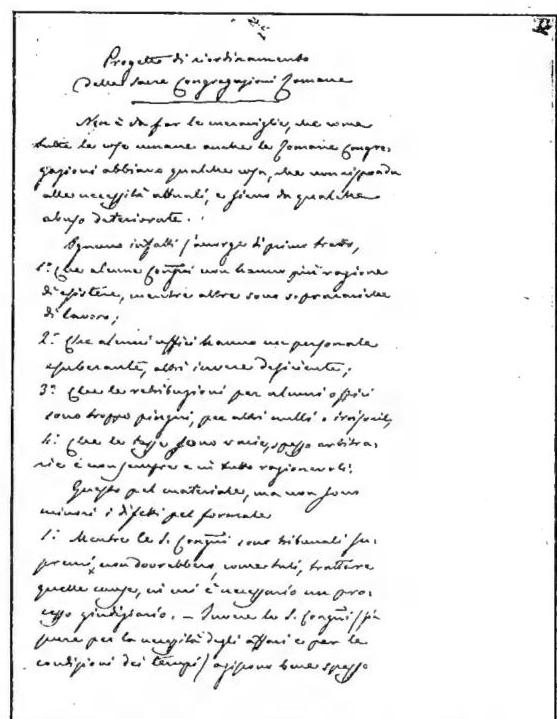
PIO X, pope, blessed — The first page of the autograph of Bl. Pius X on the plan for reorganizing the Roman Sacred Congregations. Vatican City, Archive of the Sacred Congregation of the Consistory.
IV. PIUS X AND THE APOSTOLATE OF THE LAITY
As bishop and patriarch, he had always favoured the action of militant laity, participating in conventions and congresses and defending their leaders when unjustly attacked. Yet he could not fail to perceive that the Opera dei Congressi and the Catholic Committees were suffering from the wear of time. Among the older members, clinging to the positions of yesterday, and the young, eager to open the way to tomorrow, mutual understanding had broken down. The excesses of the democratic youth group led by Romolo Murri at the Congress of Bologna (November 1903) hastened the end. In July 1904 the Pope dissolved the Opera dei Congressi, leaving in existence the Second Section, that of Popular Christian Action, and the Society of Catholic Youth. The small band loyal to Murri rebelled and was condemned. Meanwhile the majority was organised into the Popular Union, the Electoral Union, and the Economic-Social Union; to these Pius X added in 1910 the Catholic Women’s Union. The encyclical Il fermo proposito of 11 June 1905, on the feast of Pentecost, remains the Magna Charta of the lay apostolate until its reorganisation under Benedict XV.V. MODERNISM. — Prepared by the intellectual and cultural conditions at the beginning of the 20th century, Modernism (v.), a child of Kantian subjectivism and the pseudo-religious emotionalism of Schleiermacher, found in the evolutionary symbolism of Sabatier, applied to Revelation, a suggestive and convenient principle to smuggle in the philosophy of immanence and rationalist criticism as genuine science; and it began with biblical studies. In 1902 A. Loisy (v.) published L'Evangile et l'Eglise, attempting to make an apology for the Church by denying its divine origin. It was the beginning of a ruinous and ever-widening collapse in France (Loisy), in England (Tyrrell), in Italy (Buonaiuti); with ease, the movement moved from the exegetical field to the dogmatic, moral, juridical, social, and literary fields. Sensational defections, subtle maneuvers, shrewd and multifaceted propaganda. The poison was injected with alarming speed, penetrating even into seminaries, monasteries, and the ranks of the militant clergy and laity. Described as “a synthesis of all heresies,” “a path to atheism,” “an axe at the root of faith,” Modernism threatened the purity of faith, the firmness of discipline, and the holiness of the Church. The intervention appeared from the outset severe, strong, decisive, and providential. The decree of the Holy Office Lamentabili sane exitu of 3 July 1907, which condemned 65 erroneous propositions (mostly drawn from the works of Loisy), foreshadowed the masterly encyclical Pascendi Dominici gregis (v.) of 8 September 1907. The papal document is divided into two parts: the first offers a thorough and lucid exposition of Modernism; the second presents a rigorous and devastating critique that exposes its falsity and denounces its ruinous consequences for faith, for the Church, and for the world. The encyclical met with violent and virulent resistance: the struggle continued for years and brought moments of anguish and tears for Pius X, who at times felt misunderstood and even ill-treated even in circles close to him. In this long ordeal, there were not lacking the excesses of the overzealous and the malice of hypocrites; not always and not all combatants were able to remain free from partisan passions and intemperate language. Yet it is now a matter of historical record that “even in the most difficult, harshest, and most grave periods of responsibility, Pius X gave proof of that enlightened prudence which never fails in the saints” (Pius XII).
VI. PIUS X AS LEGISLATOR
Since the time of Sixtus V (const. Immensu, 22 Jan. 1587), the dicasteries of the Roman Curia had undergone only partial adjustments. The events, especially after 1870, made a complete and general revision necessary. Welcoming with goodwill the desire of many bishops, mindful of the experiences he had gained as bishop and patriarch, Pius X himself laid down the guiding principles of the reform, entrusting it to the wisdom of a cardinal commission composed of experienced jurists. On 29 June 1908 he published the constitution Sapienti consilio, together with general and special norms for the functioning of the Sacred Congregations, tribunals, and offices. To the matrimonial institute, foundation of the Christian family, Pius X devoted special care: the constitution Provida (18 Jan. 1906) on the validity of mixed marriages, and the celebrated decree Ne tenere of the Sacred Congregation of the Council (8 Aug. 1907) on the juridical form of betrothal and marriage. These were partial measures awaiting broader and more universal work. The need to gather into a single text the countless prescriptions scattered through the decretals had long been felt, especially by those who had to apply the law to pastoral care. Pius X, recognizing it as “too necessary,” would delay it no longer. On 19 March 1904 the motu proprio Arduum sane: de Ecclesiae legibus in unum redigendis established the commission for study and compilation. He followed the immense labour, one might say, day by day: advising, exhorting, encouraging, deciding. Bishops, theologians, and jurists were consulted. Centuries-old questions were addressed, obstacles of various kinds were overcome, and the strict demands of the law were reconciled with the manifold practices of life. Although this most daring work saw the light of day only on 27 May 1917, under Benedict XV, it remains “the masterpiece of the pontificate of Pius X” (Pius XII), and “he alone must be regarded as the author of this code” (Benedict XV). He had moreover begun with two constitutions of historic importance: the Commissum nobis of 20 Jan. 1904, which decreed the greater excommunication against anyone who dared to present a veto in the conclave even in the form of a simple desire, and the Vacante Sede Apostolica (25 Dec. 1904), which regulated the proceedings of the conclave.VII. HOLINESS
It emanated from him constantly. His gaze, his word, his very personality expressed goodness, firmness, and faith. The audiences “were a true and holy mission.” And yet he longed only to be sovereign over himself. From this mastery of self, the fruit of long years of struggle against his ardent temperament, there sprang a gentleness of heart that made him simple, serene, and kind even in the most tempestuous hours, amid the bitterest criticism and the most venomous calumnies, in the bitterest solitude. Among his virtues humility stood preeminent: he would recall, when occasion arose, his modest origins, shunned praise, recoiled from applause and compliments, accepted others’ opinions with amiability, and indeed solicited the judgment of cardinals, bishops, and collaborators; he spared others even the slightest annoyance, and showed countless attentions even to servants. Generous in forgiving and forgetting, indulgent toward those who strayed but were not obstinate in error, inexorable toward equivocation and compromise, utterly detached from every earthly good and from every form—even an apparent one—of favoritism, he lived and died poor, leaving to the charity of his successor the care of his sisters, whom he wished to remain in the obscurity of their modest station.From a great heart flowed deeds of industrious, passionate, heroic charity, especially as pope toward the poor, orphans, the fallen, and above all toward the victims of the Sicilian-Calabrian earthquake of 1908. A man of intense prayer, even in his lifetime he enjoyed extraordinary gifts and supernatural powers. His blessing effected cures—sometimes at a distance—that seemed beyond hope, even miraculous; cures that he humbly attributed “to the power of the keys.” There was a widespread conviction that he could read with certainty into the depths of souls and foresee the future with a light surpassing human intelligence.
VIII. DEATH AND GLORY
On 2 June 1914 Pius X entered his eightieth year. His constitution, which had always been robust despite the heart trouble he had felt even during his Venetian years, now showed signs of weariness. Political clouds were gathering on the horizon, portending a storm. The Pope referred to the coming conflict as the “big war,” as he told intimates. The assassination at Sarajevo of Archduke Ferdinand, heir to the Austrian throne, was the spark that set it off. The Pontiff tried in vain to avert the war. Taken to bed with a slight bronchitis on the afternoon of 15 August, his condition suddenly worsened on the 19th, and at one-fifteen on the 20th his soul entered eternal peace. He had reigned for eleven years and sixteen days. The world, deeply moved, bowed in reverence before the Pontiff’s remains: “History will make him a great Pope; the Church will make him a great Saint,” was said even then. In the silence of the Vatican Grottoes, his tomb became a constant goal for pilgrims and the faithful at prayer. By unanimous vote of all twenty-two cardinals resident in Rome, in February 1923 the Cause of Beatification and Canonization was introduced. After the ordinary processes on the fame of his holiness were completed, the Cause was formally opened on 12 February 1943. Following the apostolic processes, discussion turned to the heroicity of his virtues, which was proclaimed by decree on 3 September 1950. After the Church’s authority sanctioned the two miracles required by canon law, on 4 March 1951 Pius XII issued the decree tuto procedi posse. On 3 June 1951, on the steps of St Peter’s Basilica, Pius X was proclaimed Blessed. Extraordinary graces led to the swift resumption of the Cause (13 November 1951) for the supreme honor of the altar. The Blessed’s remains rest beneath the mensa of the altar of the Presentation, the first altar on the left as one enters St Peter’s Basilica. Also in the Basilica, above the door called “of the mosaics,” Pier Enrico Astorri of Piacenza carved in marble the Pope in the majesty of the Triregnum, his arms outstretched in supreme self-offering; the monument was inaugurated in 1923. — See pl. CIV.Giovanni Urbani
(photo: Felici)