
MERRY DEL VAL, RAFAEL. — Cardinal of Spanish family, b. in London on 10 Oct. 1865, d. in Rome on 26 Feb. 1930. He completed his first studies in England and Belgium; at the age of eighteen, having decided to embrace the ecclesiastical state, he entered Ushaw College (England), and then, in 1885, moved to Rome to the Pontifical Scots College. Leo XIII, however, decided that he should instead enter the Pontifical Academy of Ecclesiastical Nobles, where he was ordained on 30 Dec. 1888.
Even before his ordination, the Pontiff attached him to three different special missions to the courts of London, Berlin, and Vienna, so that he was awarded the title of monsignor while he was still only a subdeacon. On 1 Jan. 1892 Leo XIII called him to his side as a participating secret chamberlain, and then sent him—at the age of thirty-two and not yet a bishop—as extraordinary apostolic delegate to Canada. The tact with which the very young prelate fulfilled this difficult mission earned him, after his return, consecration as titular archbishop of Nicaea and appointment as president of the Academy of Ecclesiastical Nobles (1900).
Secretary of the Conclave from which Pius X emerged, he was immediately entrusted by the latter with the duties of pro-secretary of State, and a few weeks later (9 Nov.) Pius X raised him, as his “first creature,” to the sacred purple and made him his di-
rect collaborator. M. del V. was thus, throughout the pontificate of Pope Sarto, his secretary of State, linking his own name to the complex religious and political activity of the Pontiff of Riese. The eleven years during which M. del V., sustained by the most affectionate confidence of Pius X, to which he responded with filial devotion, directed the most important office of the Roman Curia, are equally bound up with the biography of the cardinal and with the history of the Church. A most faithful interpreter of the papal will, he led the arduous struggle against modernism to its victorious conclusion; gave the greatest impetus to Catholic Action and carried out a radical reform of the dicasteries of the Apostolic See.
In the more strictly political sphere, he progressively mitigated the intransigence of Leo XIII and of Cardinal Rampolla toward the Italian State, going so far as to abolish, if not formally at least in practice, the non expedit, thereby opening the way for Catholics to enter Parliament through the so-called Gentiloni Pact. The rapprochement between the Vatican and most of the Powers was also due to his consummate diplomatic skill, and on 24 June 1914 he succeeded in concluding a concordat with Serbia.
An open rupture, on the other hand, occurred with France, following President Loubet’s visit to the Quirinal, undertaken despite the pontifical prohibition against the coming of Catholic heads of state to Rome. This was followed by denunciation of the Concordat and complete separation between the Church and the French State, aggravated by violent anti-Catholic persecution. M. del V. confronted this extremely grave situation with resolute energy—although this meant the complete abandonment of his predecessor’s pro-French policy—and obtained from Pius X that, on 25 Feb. 1906, he personally consecrate in St Peter’s the first fourteen French bishops elected after the separation. Alongside his duties as secretary of State, he held, with equal zeal, other highly important offices, including those of administrator of the Holy See’s property, prefect of the Sacred Apostolic Palaces, and archpriest of the Vatican Basilica.
At the Conclave of 1914 many cardinals gathered their votes around his name, but Cardinal Della Chiesa was elected, having already been his collaborator in the Secretariat of State. The new pontiff, Benedict XV, conferred upon him the dignity of secretary of the Holy Office; while this naturally served to reduce his influence in the political sphere, it assured him a prominent role in the government of the Church. He nevertheless returned to the political stage in 1926, when, as Pius XI’s legate to the celebrations of the Franciscan centenary at Assisi, he exchanged significant speeches there with the Italian minister of Public Instruction, Pietro Fedele, who represented the government; these speeches appeared, as they in fact were, to be the prelude to the forthcoming reconciliation.
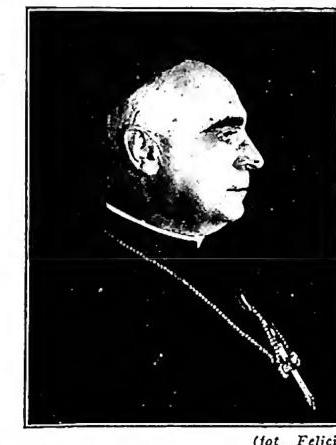
(phot. Felici)
MERRY DEL VAL, RAFAEL – Portrait.
He died almost suddenly; his remains lie in the Vatican Grottoes.