Machine translation of the 1948–1954 Italian original. The original text is authoritative.
MEROVINGICA SCRITTURA e MINIATURA. — The name m. was given by Mabillon to the script that developed in the Frankish Kingdom up to the age of Charlemagne, and was used both for documentary and for book scripts. Today the term is given a more restricted meaning, referring to the script derived in Frankish territory during the course of the 6th century from cursive minuscule, used especially in the Chancery of the Merovingians and the early Carolingians, and only rarely adapted to book forms (semi-cursive m.); in the script of codices, on the other hand, various types of pre-Carolingian script are recognized (v. CAROLINA SCRITTURA), with influences of m. that are sometimes more and sometimes less pronounced. Among the national scripts, it is the one of shortest duration: in the 9th century it survives, alongside Caroline, in a number of royal and imperial diplomas of particularly elaborate execution; in the 10th century only sporadic traces of it are found.
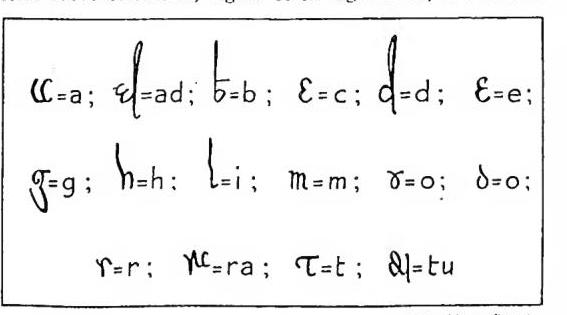
In the formation of m., the chancery element plays a predominant role: the papyrus fragment of the Homilies of s. Avito (Bibliothèque nationale de Paris, MS lat. 8913, fol. 15; first half of the 6th century), in which palaeographers recognize the oldest example of this script, reveals a type of evolving cursive minuscule, in which the Merovingian elements are suggested more as a tendency than fixed in their characteristic form. This standardization of the Merovingian elements, on the other hand, took place within the royal Chancery, with a marked tendency toward artificial forms, a strong development of long strokes, especially ascenders, an abundance of sometimes highly complex ligatures, a leftward inclination of the vertical strokes, and wavy or even broken penwork. The letters are very narrow, closely spaced, and uneven in size. Particularly characteristic (v. table) are: the open a, with the two rigid strokes at the top; in ligature it is often written above the line and in smaller dimensions; the b, which often has a horizontal stroke above the bowl, by means of which it joins the following letter; the c, which, alongside the common minuscule form, has a special form resembling two superimposed semicircles; the d, almost always in minuscule form, with the ascender descending below the line: the bowl remains open at the top when the letter is joined to the preceding one; the e, resembling a Greek e, which rises above the other short letters and joins on the right by means of a small tongue; the g, of semi-uncial type, with the tail open and the head sometimes wavy, sometimes bent into a loop toward the left; the h, with the ascender strongly inclined to the left; the i, often elongated, upward at the beginning of a word and downward in ligature; the m and n, with their legs very close together and the last one often folded back; the u, however, frequently retains its majuscule form; the o, which has two strokes, in continuation of the curved line describing the loop, from left to right, derived from the cursive minuscule form in ligature both with the preceding and with the following letter: in the 8th century, the extension of the right-hand curve tends to rise above the other, so that the o assumes the form of a δ or an uncial d; the r, with the upper element curved when isolated and rigid in ligature; the t, with the horizontal stroke bending back toward the left and inward, at times forming a true loop: in ligature, the vertical stroke bends, describing an ellipse from top to bottom and from left to right, while the upper stroke curves in the same direction but from bottom to top; the result is a sort of e whose curves are closed by the vertical stroke of the letter with which the t is joined; the u, sometimes in the position of a superscript letter.
(from Mallon-Perrat-Marleha), L'écriture latine de la capitale romaine à la minuscule, Paris 1939, (savo. fr. 3)
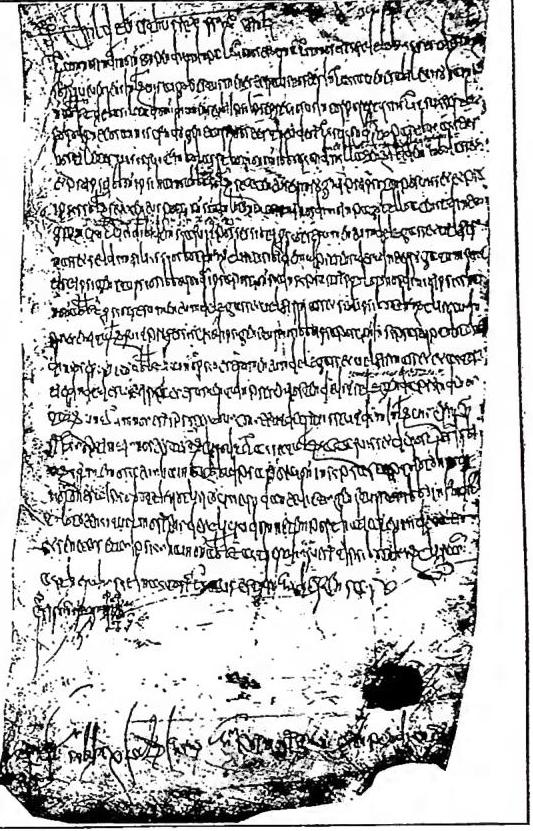
MEROVINGICA SCRITTURA e MINIATURA — Diploma of Childelbert III, dated at Compiègne, 23 December 695 — Paris, Archives nationales, K. 3, no. 9.
In the diplomas of the Carolingians, under the influence of Caroline minuscule, the Merovingian elements gradually become less pronounced. In private documents, m. generally displays freer forms; toward the end of the 8th century, however, a more careful execution is achieved, which becomes more pronounced at the beginning of the 9th century, until here too m. completely yields the field to Caroline.
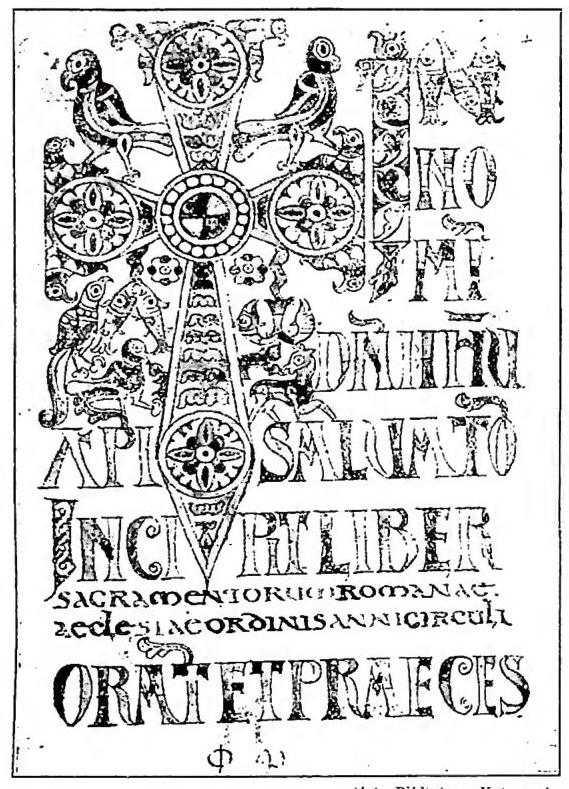
MINIATURE. - Given the chancery-like character of this script, one cannot strictly speak of Merovingian miniature. Nevertheless, it is customary to use this term to designate the ornamentation of Frankish codices from the 7th and 8th centuries, that is, the pre-Caroline miniature of France. This ornamentation is, moreover, limited to decorative drawings around initials, achieved sometimes with simple borders, sometimes with fantastical elements (especially birds and fish), in which the insular influence is evident, particularly for certain centers. In general, the ornamentation stands out for its vivid colors and whimsical architectures, but it always insists on the same motifs, treated moreover with a rather crude technique. Figurative plates do not appear in Frankish codices before the Carolingian era.
(fot. Enc. Catt.)
MEROVINGIAN SCRIPT AND MINIATURE - Characteristic letters and ligatures of Merovingian script. (fot. Biblioteca Vaticana) MEROVINGIAN SCRIPT AND MINIATURE - Incipit of the ancient Gelasian Sacramentary - Vatican Library, cod. Reg. lat. 316, f. 4° (ca. 730).
BIBL.: Ph. Lauer - A. Samaran, Les diplômes originaux des Mérovingiens, with a preface by M. Prou, Paris 1908; L. Schiaparelli, Intorno all'origine e ai caratteri della s. m., in Archivio storico italiano, 7th series, 16 (1932), pp. 169-90; F. Lot - Ph. Lauer - G. Tessier, Diplomata Karolinorum, 5 vols., Toulouse and Paris 1936-38; G. Tessier, Diplomata Karolinorum: comparaisons d'écritures, in Bibliothèque Ecole d. Chartes, 98 (1937), pp. 5-12; E. A. Moè, Les manuscrits sous les Capétiens, in Arts et métiers graphiques, 1937, pp. 23-44. For miniature: E. H. Zimmermann, Vorhardingische Miniaturen, Berlin 1916, pls. 38-149. Alessandro Pratesi
Cite this article
“MEROVINGICA SCRITTURA E MINIATURA.” Enciclopedia Cattolica, vol. VIII (1952), p. 447. Azione Romana digital edition, https://azioneromana.com/article/merovingica-scrittura-e-miniatura.