
AVITO, ALCIMO ECDICIO, saint. — Bishop of Vienne in the Dauphiné, born around 450, died shortly after 517. He belonged to a family of senatorial bishops, and the emperor Avitus was perhaps his relative. His father, too, had preceded him in the see of Vienne.
As bishop, he was one of the pillars of the Gallic episcopate of his time: the conversion of the kingdom of Burgundy to the Catholic faith was due to him. With the authority of his learning and his refinement of manner, he succeeded in winning the favor of King Gundobad and subsequently in converting his son Sigismund. For this purpose he addressed many letters to both of them, a good number of which have survived, on various biblical and doctrinal questions. Several of his other writings, moreover, are directed against the Arianism of the invading peoples and related doctrines; one is expressly directed against the semi-Pelagianism of Faustus of Riez. The Council of Epaone in 517, which he presided over, completed the work of the conversion of Burgundy through prudent measures.
A. had written many Epigrams, scattered amid the turmoil of the siege of Vienne in 500. Shortly before 507, he himself prepared an edition of his other writings, which consist of two poems, 86 letters, three complete homilies, and many fragments. The principal poem, De spiritualis historiae gestis, recounts in its first three books the events of Genesis up to the Fall, and in two others the Flood and the Exodus: its subject, therefore, is that of paradise lost and regained, and Books IV and V essentially develop the symbols of redemption. Unlike his numerous predecessors, A. was not content with a paraphrase of the biblical text, but treated the subject with great freedom and an original poetic conception, new in this genre of poem and foreshadowing Milton. The language is the correct language of his time, and the style that of a good imitator of the classics; yet here too the tastes of his age do not make him immune to mannerism. The same merits and defects are also found in the De consolatoria laude castitatis ad Fuscinam sororem Deo virginem sacratam.
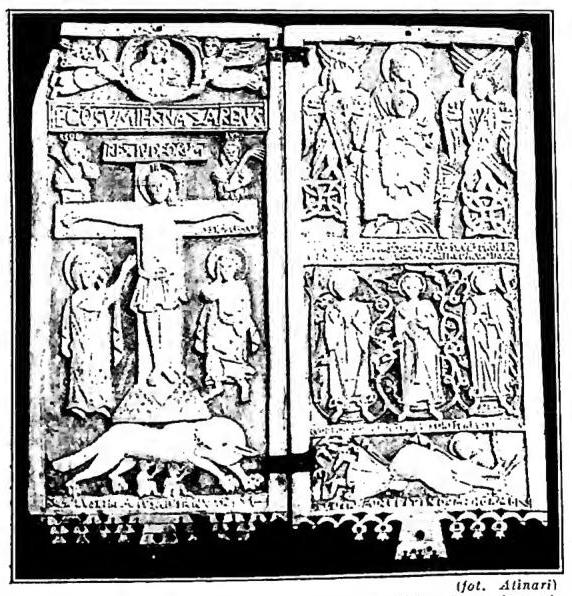
(Alinari photograph)
AVORIO — Diptych from the Abbey of Rambona (10th century). Sacred Museum of the Vatican Library.
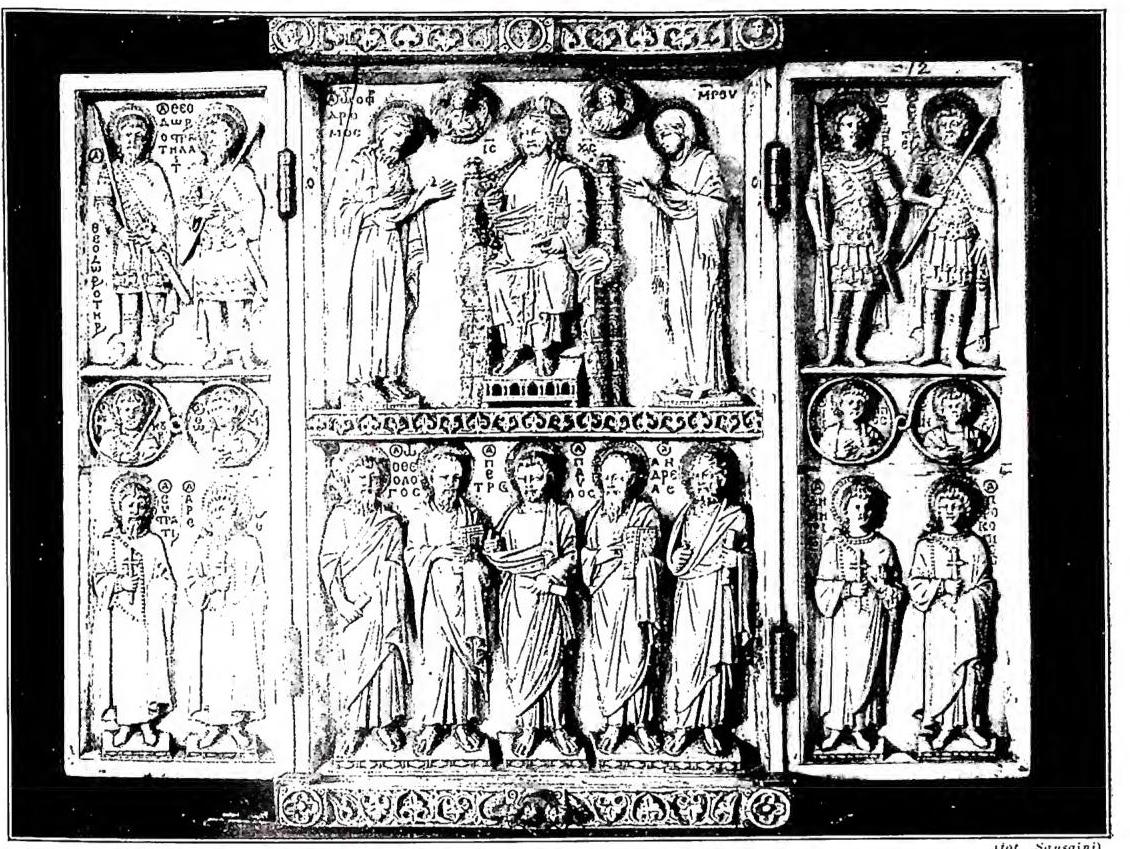
(phot. Sansoni)