
GENESIS. — Name of the book with which the series of the Old Testament begins. It is derived from the Greek γένεσις and passed into Christian usage through the Septuagint version. The Jews call it by the word with which the book begins in Hebrew: Bērā'ith =
ria of the human race from its origins to Abraham (chs. 1–12); the history of the origins of the chosen people in the lives of Abraham, Isaac, Jacob, and the latter’s sons (especially Joseph), up to the descent of Jacob and his sons into Egypt (chs. 12–50).
According to its outward form, the narrative unfolds in 10 tōlāhēt. This word means “generations”; then, by extension, the result of generation—“the men who have been generated.” Thus, “generations of Adam” is equivalent to the history of Adam’s descendants.
II. THE AUTHOR AND THE LITERARY QUESTION
The solution to this important problem must be treated in depth together with the other books attributed to Moses (v. PENTATEUCO).Here the question may be briefly summarized:
1) Internal arguments, but above all the very ancient tradition, both of the Synagogue and of the Church, state that the author is Moses himself, the great lawgiver.
2) Once highly detailed literary criticism of the sacred text had begun, and certain postulates of Hegelian philosophy concerning the evolution of religious sentiment had been adopted, the theory of the Protestant J. WELLHAUSEN, JULIUS (v.) was reached. It maintains that the work attributed to Moses by tradition is in fact the result of several documentary sources, originating in periods distant from one another, reworked and united into a single body—the present text of ours—by one or more redactors. Thus the essential authorship of this book by Moses is denied.
3) Leaving aside the erroneous philosophical presuppositions, it must be said that literary criticism has raised extremely serious problems, which the Catholic must not ignore. It is now certain that the history of the text of Gen., together
with that of the other books of the Pentateuch, is extremely obscure and troubled. Particular indications show that the possibility of considerable reworking of the original text must be carefully studied.
Some of these indications are the following:
a) Different usage of the name of God: passages in which only Yahweh appears, others in which only 'Elöhim appears, and others in which Yahweh-'Elöhim appears.
b) Differences in language and style: for example, the stylistic distinction between the first chapter and those that follow is clear: the appearance of long lists of names amid fresh popular narratives.
c) The so-called duplicates (= events allegedly narrated twice and even three times in scarcely different forms). For example, two accounts of the creation; two dangers to Sara’s honor (Gen. 12 and 20); two flights of Agar (Gen. 16 and 21), etc.
III. PARTICULAR PROBLEMS
The first eleven chapters are those that present the greatest difficulties of interpretation. They must be interpreted with great caution. In this regard, the following observations should be kept in mind:1) The sacred author’s purpose is to lead us through genealogies from Adam, who received the first messianic promise, to Abraham, Isaac, and Jacob, who were to give rise to the chosen people. Therefore:
a) The period from Adam to Abraham (and also after Abraham, cf. the story of Esau and Jacob) has the distinctive character of elimination; that is, as he proceeds in his narrative, the author gradually excludes from the account those members and peoples who have no influence on the history of restoration.
b) The narrative therefore, leaving aside the affairs of the collateral branches, focuses on Seth and on his descendants Noah, Shem, Arphaxad, Thare, and Abraham.
c) From this point of view, the opinion that the account of the Flood may be restricted solely to the line among whom Noah lived should not be condemned.
2) Chronology always remains a problem. It is evident that here we have only some of the links in the chain. Otherwise, one would have to place the creation of man only a few millennia before Christ, which is absolutely false. The omission of intermediate members, and the attribution of the term son or similar terms to grandsons and great-grandsons, accords with the Semitic conception (cf. Mt. 1, 8).
3) The figures indicating the extraordinary longevity of the ancient patriarchs should probably be viewed in the light of a literary genre restored to us by numerical documents. That is: in Mesopotamia, a king could have a twofold chronology, one real (at such an age—for example, 30 years—he begot x.; after so many years—for example, 50—he died), and another official one, in which the years of reign or life of the kings he had subjugated were added together. This enormous sum of years was attributed to the conquering king, as though he embodied in himself the glories of the vanquished kings. This system of reckoning the years may, in some way, suggest the path to be followed in resolving this biblical problem.
IV. L'INSEGNAMENTO TEOLOGICO
Per l'insegnamento teologico contenuto nel 1° capo V. ESAMERONE. Per il resto bastino le osservazioni seguenti:1) La fondamentale dottrina dell'elevazione dell'uomo all'ordine soprannaturale, del peccato originale e della promessa della redenzione è contenuta sia nell'espressione sia nell'ispirazione del racconto di Gen. 2-3. Questi capi rappresentano il perno su cui gravitano i seguenti racconti genesiaci.
2) La caratteristica dell'eliminazione ricorda il paolino « non volentis, neque currentis, sed miserentis est Dei » (Rom. 9, 16). Certi doni di Dio - qui l'essere depositari delle promesse messianiche - sono completamente gratuiti. L'eliminazione ne è una prova. Non importa per sé colpa da parte dell'uomo. In questa luce va visto il testo riportato ancora da s. Paolo: « Dio ha amato Giacobbe, ma odiato (= non ha eletto) Esaù » (ibid. 9, 13).
3) Il Gen. insegna come erano concepite nel Vecchio Testamento le relazioni tra la Divinità e l'uomo: cioè sotto l'idea di patto o alleanza. Il patto sacro è in genere una liberale concessione con cui Dio stringe a sé l'uomo per mezzo di leggi e di promesse.
Nel Gen. si hanno probabilmente tre, certo due di questi patti sacri:
a) con Adamo (nel testo ci sono gli elementi, non il nome di patto) = concessione del Paradiso terrestre = promessa della restaurazione;
b) con Noè: espressamente due volte: promessa della preservazione dal diluvio (6, 18); promessa di non mandare più il diluvio (9, 9).
4) Il più celebre con Abramo. Questo patto è il culmine e l'ultima ratio della 2ª parte del Gen. Abramo, soprattutto nel cap. 15, riceve la promessa della posterità in funzione delle benedizioni messianiche fatte a lui e a tutti i popoli « in semine tuo » (cf. pure cap. 12, 1-4).
Questo patto è quello che ha più eco nel Nuovo Testamento, specie in s. Paolo (cf. Gal. 3, 6-18) in quanto, a differenza del patto smaitico e davidico, conteneva espressamente la promessa delle benedizioni messianiche (= redenzione) a tutti i discendenti di Abramo. S. Paolo poi spiega « questa discendenza non va intensa per via carnale, ma per via di fede » (cf. ibid. 3, 6).
Per le singole questioni, V. ADAMO; ASSIRI; BABILONESI; DILUVIO; ESAMERONE; PATRIARCHI; PENTATEUCO; PROTOVANGELO.
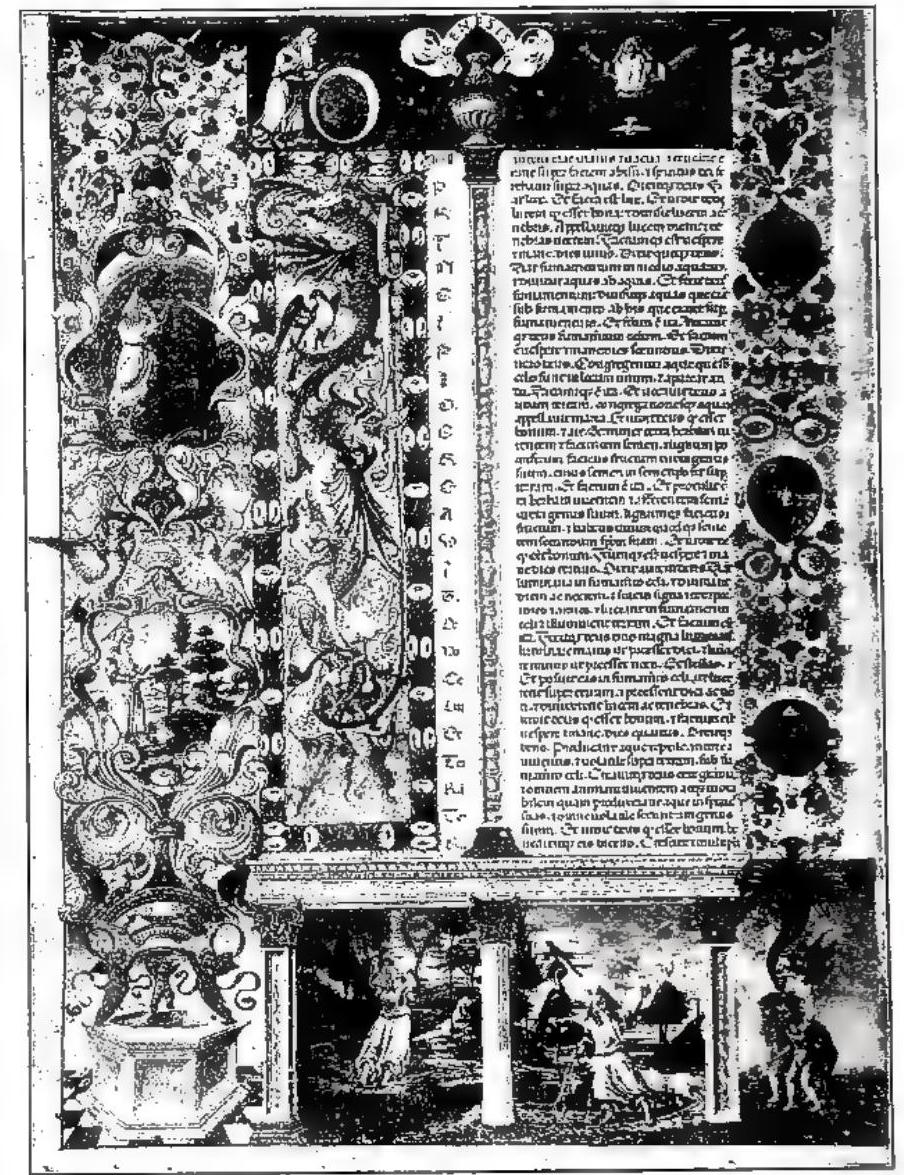
ART. — Concerning the oldest and most important texts, from the artistic point of view, in which the events of Gen. are narrated, V. BIBBIA.
Here it will suffice to recall that among the most distinguished and ancient monuments of this kind must be placed the remains of the Cotton Gen., now preserved in the British Museum in London; the Vienna Gen., which is likewise a fragmentary manuscript, probably dating from the 5th century; and the Pentateuch of Ashburnham and of s. Galliano of Tours, which belongs to the 7th century.
GENESI (PICCOLA), APOCRIFO: V. GIUBILEO, LIBRO dei.