
FLOOD. – Cataclysm that struck humanity in the time of Noah.
I. BIBLICAL ACCOUNT (Gen. 6:1–9:19). – God saw that human wickedness had spread and «repented of having made man».
The «sons of God», that is, the sons of Seth, so called because they were created by God and bound to him by a special bond of love (Gen. 4:26–5:32; cf. Ex. 4:24; Deut. 14:1, etc.), seduced by the beauty of the «daughters of men», belonging to the lineage of Cain, were led astray by sensuality: «they are flesh». In his indignation God decided: «I will destroy man whom I have created from the face of the earth: and with man also the beasts» (Gen. 6:7), granting them, however, 120 years in which to repent. Noah found favor, for himself and his family; God ordered him to build an ark capable of containing, in addition to the 8 members of the family, representatives of all the animals together with everything necessary for their subsistence. Of the clean animals, 7 pairs entered, because their flesh was to be offered in sacrifice (ibid., 6:20) and also eaten; of the unclean, one pair. God’s covenant (ibid., 6:18) with Noah consisted in the promise to save him and his from destruction, in order to establish with them a new, faithful, and holy humanity.
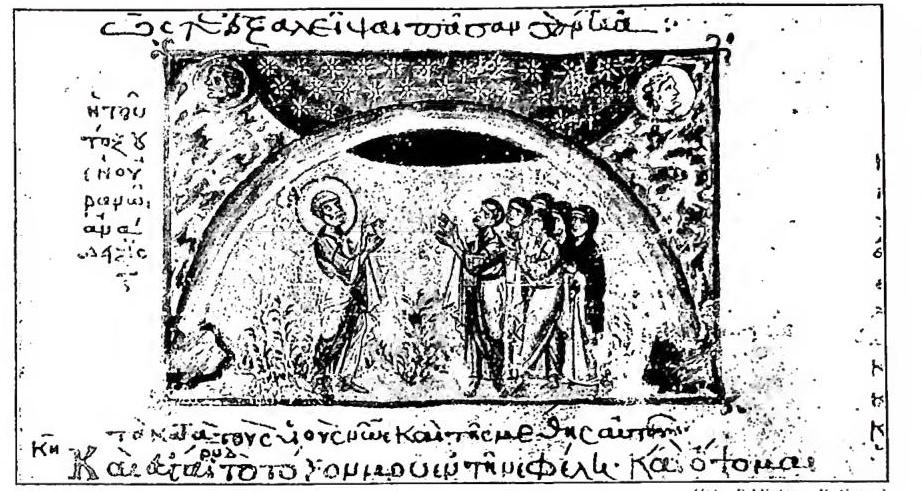
DILUVIO - God establishes the covenant with Noè after the d. (Gen. 9, 8-17). Miniature from the Octateuch contained in cod. Vat. gr. 746, fol. 57v (12th century) - Vatican Library.
The water rose fifteen cubits above the highest mountains (approximately 7.50 m), and «thus every living thing that was upon the face of the earth was annihilated, both man and cattle... they disappeared from the earth: only Noè remained, and those who were with him in the ark» (Gen. 7, 23). For 40 days and 40 nights, the rains and the waves battered the earth; the waters continued to rise and then remained stationary for 110 days; thereafter they began to recede (ibid., 8, 3); after another 175 days they had completely withdrawn (ibid., 8, 13), and after 57 days the dried-out earth was once again habitable (ibid., 8, 16): it was the 27th day of the 2nd month of the 601st year of Noè’s life. To make certain, Noè had sent a raven out of the ark, which went back and forth until the waters had dried up (ibid., 8, 7: the Clementine Vulgate erroneously reads: non revertebatur), and then a dove three times; the first time it immediately returned, finding nowhere to set its foot; the second time it returned carrying «a freshly plucked olive leaf»; the third time it did not return.
The moment had come to leave the ark: God gave the order (ibid., 8, 15 ff.). Noè set foot again upon the desolate earth, which had become a cemetery for so many creatures. To thank the Lord, «he built an altar to Jahweh, and, taking animals of every kind that were clean and birds that were clean, he offered them as a burnt offering». In return, God dispelled the men’s fear at the thought of another d.: «I will never again curse the earth». Human frailty itself moves God to mercy, after the d. had revealed his omnipotence, holiness, and justice. God blessed Noè and his sons: «Be fruitful and multiply and fill the earth»; he restored to man dominion over the animals and added the prohibition against eating «flesh with its blood», the vehicle of life (Lev. 17, 14). God made the shedding of blood a sacrificial rite, while opposing the shedding of human blood. As a guarantee of the covenant, he established the rainbow as a sign of his greatness and love.
II. HISTORICAL CHARACTER OF THE ACCOUNT
Modern criticism attributes the story of the d. to a redactor who is supposed to have drawn on two conflicting sources: J and P (v. PENTATEUCO); the contradictions are said to be found chiefly in the numbers. But these are less true contradictions than expressions that complement one another: in general, it is said that the animals are to be brought in pairs (Gen. 6, 19), and then their number is indicated (ibid., 7, 2); the entry into the ark cannot be said to have been narrated twice merely because 7, 13 resumes 7, 7; 7, 12 speaks of the waters rising for 40 days, and 7, 24 says that they “prevailed over the earth for 150.” There is no solid reason to suppose two distinct sources. If one compares it with the Babylonian account of Gigalmeš, one encounters the same elements used by critics to establish the J and P sources. Nor did the redactor— if there was one — see any contradiction among the various data he brought together, just as he did not see one in the supposed partial sources.
The d. is recalled in the Old and New Testaments: Sap. 10, 4; 16, 6 sg.; Eccli. 16, 7; 44, 17-19; Is. 54, 9; Mt. 24, 37-39; Lc. 17, 26 sg.; I Pt. 3, 20 sg.; II Pt. 2, 5; Hebr. 11, 7. These passages affirm the historicity not only of the event, but also of the circumstances narrated in Genesis. This terrible punishment inflicted by God on sinful humanity, compared by Jesus with the universal judgment (Mt. 24, 37-39), was the work of divine omnipotence, which made use of natural causes: waters issuing from the ocean depths and violent downpours (Gen. 7, 11 sg.). It was once thought that geology confirmed the account, and a century ago marine shells and sands, cave bones, and erratic boulders were cited as proof of the universality of the biblical d. Equally mistakenly, the biblical d. was identified with the geological d. of the Quaternary era. Whereas the biblical d. lasted a little more than a year, the geological one required a very long period, nor did it occur simultaneously over the whole earth. One must not, however, exclude a priori the possibility that the biblical d. may have points of contact with certain phenomena of the glacial period.
The sandy layer discovered by C. L. Woolley at Ur of Chaldea during the excavations of 1927–29 cannot, it seems, be regarded as the remnant of the universal inundation of Mesopotamia (Babylonian d.).
III. UNIVERSALITY OF THE FLOOD
The biblical account describes a “universal” Flood. What kind of universality does the hagiographer intend to speak of?1. Absolute geographical universality was the common opinion among the Fathers and ancient Doctors; but today it has been abandoned. The progress of the sciences made it possible to observe that the species of mammals alone number 7,000 living and 4,500 fossil species; physics is unable to find an explanation for all the water that would have been necessary to cover, indeed to exceed by approx. 7.50 m., or 15 cubits, the highest mountains. If Scripture speaks of the inundation of the “earth” (Gen. 6, 7, 10; 7, 4, 18, 19; 8, 9), it does not necessarily follow that this was geographically universal, because “idioma est s. Scripturae” (as s. Girolamo observes, In Is. 13, 5; PL 24, 456) “ut omnem terram illius significet provinciae de qua sermo est”. Having examined Gen. 41, 54 ff.; Deut. 2, 25; II Par. 20, 29; Act. 2, 5, one will readily admit that a relative geographical universality is intended. And thus “all the highest mountains” (Gen. 7, 19) means all the mountains of that region known to the author.
2. Relative anthropological universality. Once relative geographical universality is admitted, for the same reasons one accepts relative anthropological universality, advocated by A. L. Motais, A. Scholz, Aem. Schöpfer, J. Schuster-B. Holzammer, or regarded as a legitimate interpretation by F. Hummelauer, Schanz, H. Zschokke-G. Döller, H. Lesêtre, P. Heinisch, etc. But whereas an inundation of the whole earth is never explicitly mentioned, we do find: “the end of all mortal beings has come before me...” (ibid. 6, 13-17 and cf. 6, 6 ff.).
3. Anthropological universality therefore appears more probable. Jesus affirms that in the Flood all (Mt. 24, 39; Lc. 17, 29) perished; and the epistles of Pietro likewise teach that:
in the time of Noè (II Pt. 2, 5; 3, 6) “a few, that is, eight persons, were saved through water” (I Pt. 3, 20). This anthropological universality is presented by the Fathers neither as a dogma of faith nor as a merely private opinion, but as connected with the faith of the Church, since they see prefigured in it the doctrine of faith: “extra Ecclesiam nulla salus” (cf. s. Fulgenzio, De remissione peccatorum, I, 20; s. Girolamo, Adv. Iovinianum, 1, 17; s. Cipriano, De unitate Ecclesiae, 6). The “sensus Ecclesiae” supports this universality (cf. the catechism of the Council of Trent, I, 10, 19). Ethnology provides confirmation. There are 60 traditions of an inundation that destroys human beings, of which no fewer than 40 are independent of the Babylonian-Hebrew form. Once the universal cataclysm is admitted, it is readily explained how the “primitive tradition” passed to the various peoples and emigrated with them to the different parts of the world.
BIBLI: J. Brucker, Déluge, in DFC, I, coll. 911-16; G. Fillion, Le déluge dans la Bible et les inscriptions sumér. et accad., Paris 1925; J. Schuster-B. Holzammer, Handbuch zur biblischen Geschichte, 8ª ed., I, Freiburg im Br. 1925, Italian translation, Turin 1942, pp. 186-209; A. Deimel, Der biblische Sintflutbericht und die Keilinschriften, in Orientalia, 20 (1926), pp. 69-79; A. Bea, Institutiones Biblicae, II, 1, De Pentateuchos, 2ª ed., Rome 1933, pp. 168-180; R. Köppel, Ultime investigations de aetate generis humani, in Miscell. Biblica, I, Rome 1934, pp. 299-316; H. Simon-J. Prado, Praelectiones biblicae; Vetus Testamentum, 4ª ed., I, Turin 1941, pp. 77-91. Vincenzo M. Iacono
IV. IN NON-CHRISTIAN RELIGIONS
Belief in a flood, occurring in times more or less remote, which is said to have destroyed humanity, is common among many extinct and living peoples. In addition to the Jews, it is found, for example, among the Babylonians, among the Greeks (the myth of Ogyges and the myth of Deucalion and Pyrrha); among a very large number of indigenous American peoples, from the extreme north of the continent (the Eskimos) to the extreme south (the Yagan and Ona of Tierra del Fuego), both among peoples of very low culture, such as the two just mentioned, and among peoples of a higher civilization, such as the Maya of Yucatan and the ancient Peruvians; among populations of Australia, Polynesia, Micronesia, Melanesia, and Indonesia; in India and China, among the Andamanese, and in northern Asia. On the African continent, however, accounts of the flood are not very widespread: belief in it is found among the Masai, the Tim of Togo, the Konso of southern Ethiopia, some peoples of the Gold Coast, and a few others.F. H. Woods, connecting the various elements found in the different accounts of the flood, established a general outline of the myth itself, to which, with the necessary variations, almost all the particular forms found among individual peoples may be reduced. It is as follows:
a) one or more divinities are angry with the antediluvians; b) generally for a specific reason; c) they consequently decide to destroy humanity with a flood, d) while saving one or more human beings. e) The chosen ones, following divine counsel, build a vessel or ark, or avail themselves of another means of salvation. f) They take with them a specimen of the animals necessary for the preservation of the species, as well as seeds and provisions. g) Shortly thereafter, h) through rain or some other cause, i) the flood comes. j) When it has ceased, k) the survivors disembark upon some mountain or island, l) and sometimes offer a sacrifice. m) The future descendants of human beings (and often of the animals as well) reproduce themselves in a miraculous manner. n) The person who was saved from the flood, or one of the most worthy among them, is taken up to heaven.
As has already been mentioned, the narrative does not appear among any people in the typological form described above, but varies to a greater or lesser degree. For example, sometimes the cause of the flood is not the deity’s anger against human beings, but simply the wickedness of a hostile and evil higher being. In some versions, moreover, there is the episode of an animal (often a bird) that is sent from the ark or from the summit of the mountain where the survivors have taken refuge to investigate whether the waters have receded. Noteworthy is the fact that certain episodes of the myth, of a highly distinctive character, are found among peoples distant from one another in space and time. Such is the belief that, in order to bring the human race back to life after the flood, the surviving progenitors performed the act of throwing something behind their backs (for example, stones, as in the Greek legend of Deucalion and Pyrrha and in that of the Macusi of the Orinoco [Amazon]).
The problem concerning the process by which the myth was formed and its dissemination is of interest. Various hypotheses have been put forward in this regard. One might posit a shared memory of a universal flood, but historians of religions have not dwelt on this hypothesis. Alternatively, one might seek the psychological reason for its formation in a possible influence of the biblical account, or in the memory of local floods of greater or lesser magnitude, or in the tendency to give a pseudo-scientific explanation of natural phenomena. Since it has been observed that flood legends are found more frequently in riverine and coastal regions, which are exposed to inundation, some scholars admit the possibility that cataclysms of this kind may have appeared to the consciousness of local populations as a worldwide catastrophe, connected in turn, in various ways, with the destiny of the world and of humanity.
In order to assess more accurately the meaning of the accounts of the flood in relation to their origin, it is appropriate to note that this cataclysm is often regarded as a means—like others, such as fire, earthquakes, and famine—by which the supreme Being punishes humanity. R. Pettazzoni, in examining the characteristics of the celestial Being in the beliefs of primitive peoples, emphasizes that one of its attributes is also that of being the master of excessive and torrential rains—and therefore of floods and inundations—which it causes to break forth in order to punish human beings for evil actions. D. G. Brinton further maintains that, since the flood is often inserted into a com-
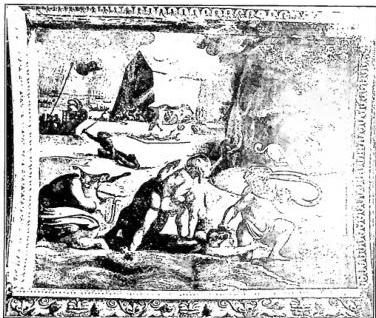
For the d., a fresco by Giulio Romano in the Logge of Raphael (ca. 1516) - Vatican.
With regard to the accounts of the d. among certain peoples, it seems possible to speak of direct Christian influences, both through the teachings of missionaries and through the narratives of merchants, who reached certain regions even before the missionaries themselves (for example, in the countries of the Gold Coast in Africa). The myths of the Masai (Mount Kenya [Africa]) in fact reveal Christian influence, attributable either to the work of missionaries or to contacts with the Christian Galla (Copts) or with Muslim Somalis, if not actually with the Judaized Falasha of Abyssinia.
The problem of the diffusion of the account of the d. was recently studied by Pia Laviosa Zambotti, who approached the question in relation to that of the diffusion of agricultural civilization throughout the world, to which she devoted particular attention.