
ARK (OF NOAH). — A large floating wooden receptacle, which Noah built before the Flood (v.) at God’s command, as a refuge for himself, his family, and all the animal species (Gen. 6:13–22).
The Hebrew téblah (which also occurs in Ex. 2:3, 5: “box” or “basket” in which Moses was saved) is translated in the ancient versions also as “ship, coffin, kneading trough.” The Latin arca corresponds to “a chest, place, or instrument intended for the safekeeping of something”; cf. Cicero, Pro Milone,
22: a secret and dark place fitted with oak planks in which criminals or slaves were confined; Vitruvius, 5, 12: a structure of planks, like a vast bottomless box, for laying the foundations of harbor wharves.
According to the command he had received, Noah made it of resinous wood (Gen. 6:14 Hebr.), perhaps cypress, which was used for containers intended for contact with moisture (ships, coffins), and coated it with bitumen. Its dimensions (Gen. 6:15)—300 cubits in length, 50 in width, and 30 in height—if the smaller Babylonian cubit is intended (0.45 m), correspond to approximately 135 × 22.5 × 13.5 m (St Peter’s Basilica measures 187 × 25 × 45 m).
Because of its overall box-like shape, the ark was suited more to floating than to sailing, and had a capacity greater than that of a ship of similar dimensions, in view of the purpose it was to serve.
It had features not customary in a ship: a door in the side (Gen. 6:16 b; for its use cf. Gen. 6:18; 7:1, 7; 8:18), which God closed before sending the waters (Gen. 7:16); and the roof or cover (cf. Gen. 8:13), to provide protection from the water. A third peculiarity was the ṣōhar (the Vulgate and other ancient versions: “window”), an opening at the top of the sides, for lighting and ventilation during the winter, one cubit high and “made completely” (Gen. 6:16), that is, extending all around, naturally with interruptions where the roof supports were located. That the ark also had a window—with a device for closing it—appears from Gen. 8:6, where hallōn is used. But since it appears (Gen. 8:6–11) that Noah could not see the external conditions without removing the cover (Gen. 8:13), ṣōhar has been explained in other ways (a dormer in the roof, the roof itself, or the hull), with a correction of the obscure and doubtful phrase in Gen. 6:16 a. Perhaps the process by which the text concerning the Flood was composed can better explain this and other contradictions.
The interior was divided into three levels, each approximately 5 m high, so that it could accommodate even large animals (the statement that they entered “all” must be understood according to the solution adopted for the problem concerning the extent of the Flood). The ark’s subsequent movements then follow the course of the Flood.
In the Babylonian narrative (v. GILGAMES), alongside certain similarities concerning the ark—built at divine command, according to given measurements, and later coming to rest on a mountain—important differences can be discerned: in Babylonia the ark is conceived as a ship, with a pilot; it takes on board many people and is much larger.
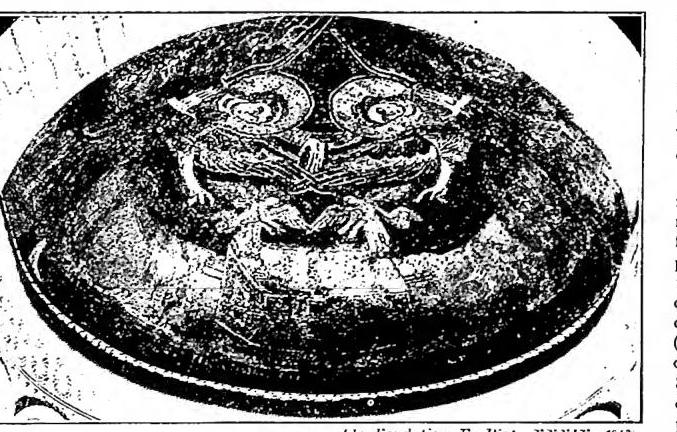
(from Fondation E. Piot, XXXIX, 1955)
ARCA DELL'ALLEANZA – Apse mosaic in the church of Germigny-des-Près (9th century).