
ARCOBALENO. – 1. A. IN THE BIBLE. – The phenomenon—called simply “bow” in the Hebrew text—is mentioned for the first time after the Flood (Gen. 9:12–17). It is not said that it did not exist before; but at that time it was taken up by God, since it is pleasant to behold and a harbinger of fair weather, as a special “sign” of his mercy in the “covenant” by which he pledges not to send the Flood again.
Of the rainbow, Ecclesiasticus invites us to contemplate the beauties, blessing him who created it (43:12–13), and uses it as a simile to celebrate the high priest Simon the Just (50:8). Ezekiel describes the reflections of the divine throne as a shining rainbow (1:23): a vision taken up by the Apocalypse, which gives the rainbow the Greek name “iris” (4:3; 10:1). Dante seems to have been inspired by this when he explains that the Son proceeds from the Father “as rainbow from rainbow” (Par., XXXIII, 118–19). Giuseppe Priero
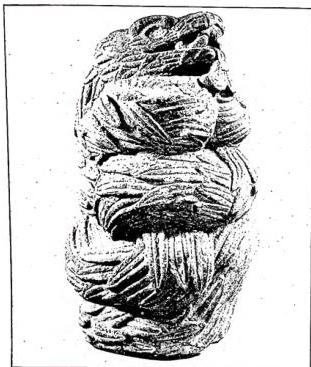
(phot. Ene. Catt.)
RAINBOW — A. in the form of a serpent. Aztec, pre-Columbian sculpture, Mexico — Rome, Lateran Missionary Ethnological Museum.
an evil demon, heralding misfortunes and therefore to be appeased with appropriate sacrifices.
The objectification of the r. occurs among all those peoples who recognize and venerate a Supreme Being, that is, first and foremost among the ethnologically most ancient peoples, with very rare exceptions. Some see in it the garment of the Supreme Being (Yuki and Kato in central California), others the hem of his mantle (Samoyeds in Siberia), still others one of his shining ornaments (Kulin and Wiradyuri in southeastern Australia), or an evident sign of his presence (Pygmies of central Africa), or a bridge thrown between the earth and the Supreme Being (Andamanese), or even a clear sign of his benevolence and love (Senapé Indians of North America and Pygmies of Gabon in West Africa). Along the same lines are peoples of a more specialized culture, still venerating a Supreme Being and accustomed to regard the r. as his belt (Galla in Abyssinia), or his bow (Bantu), or a gift of the divinity (Nilotic peoples and Negroes of Nigeria). The Negroes of the Congo believe that it constitutes the road by which the Supreme Being descends to earth; the Negroes of the Slave Coast and of the Ivory and Gold Coasts, on the other hand, believe that it served for the descent of the first men, while the Tlinkit Indians of North America and the aborigines of Hawai are convinced that it carries the souls of the elect toward paradise. And all of them interpret its appearance as a happy omen, which for some, such as the Masai and the inhabitants of Samoa, even becomes an expression of God’s satisfaction with human beings. For this group of peoples, the r. is not an object of worship, although it sometimes enters into the complex of ceremonies, as among the Yuki and Kato and among the Pygmies of Gabon, who are accustomed to take it as a clear manifestation of the venerated Supreme Being.
The personification and divinization of the r. occurs among peoples of an even more recent culture. They sometimes conceive of it as a man dwelling in the ground who, emerging during a storm, makes his way toward the sky (Aranda of central Australia); at times as the soul of an ancestor (Indians of Peru); but most prefer to think of it as a python (Kikuyu, Ewe, Haussa, Yoruba, etc. in Africa, many tribes of South America, the Caribs, etc.), which they believe dwells underground or in termite mounds, or, better still, in the water. It is conceived as a vengeful and evil demon, accustomed, in South America, to strike women; to spread diseases among the Caribs; and to absorb, during the dry season, all moisture in order to ruin human beings (East Africa). In the myths of Australia, moreover, the great serpent of the r. is often an adversary of the Supreme Being. It is generally an object of worship, so much so that the Aranda strive to appease it through choreographic ceremonies, while the Haussa offer it a black bull.
For a long time, this latter conception of the r. among primitive peoples was presented as typically unique and original. But the first attitude described by us is now richly documented, and it must be accorded full chronological priority, since we find it clearly expressed, and expressed exclusively, precisely in the ethnologically most ancient cultures. The fact remains that the few exceptions (Semang of Malacca, certain Pygmies of central Africa) are characterized as foreign elements imported from surrounding, more specialized cultures.
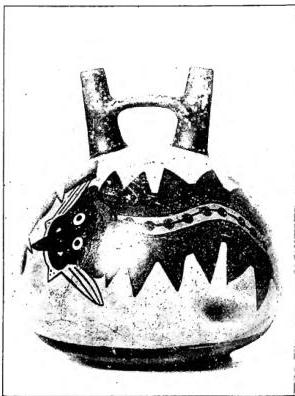
(phot. Enc. Catt.)
ARCOBALENO - A. in the form of a serpent. Peruvian pottery, pre-Columbian naxa culture - Rome, Museum of Ethnological Missions, Institute.
Sagen und Märchen des Arandastammes in Zentral-Australien, 5 vols., Frankfurt 1907–20; P. Ehrenreich, Die allgemeine Mythologie und ihre ethnologischen Grundlagen, Leipzig 1910, pp. 141, 162; J. Hastings, Encyclopaedia of Religion and Ethics, X, Edinburgh 1918, p. 371; Chantepie de la Saussaye, Lehrbuch der Religionsgeschichte, 4th ed., Tübingen 1925; R. Karsten, The Civilization of the South American Indians, London 1926; P. A. Talbot, The People of Southern Nigeria, III, Oxford 1926, p. 963, 963; W. Schmidt, Der Ursprung der Gottesidee, VI, Münster 1935; VII, there 1940; H. Baumann, Schöpfung und Urzeit des Menschen im Mythos der afrikanischen Völker, Berlin 1936; P. E. Worms, Religiöse Vorstellungen und Kultur einiger nordwestdeutschischen Stämme in fünfzig Legenden, in Annali Lateranensi, 4 (1940), pp. 213–82. Michèle Schulien