Machine translation of the 1948–1954 Italian original. The original text is authoritative.
ABORIGINES. – Indigenous inhabitants of the place in which they live (autochthonous). In the ethnological sense, the term is applied to those inhabitants of a land whose civilization proves to be the oldest among all those flourishing around II.
They are: in Africa, the Pygmies of the Ituri, and certain groups of the same people farther to the west, as well as the Pignandi Batwa (Belgian Congo and Ruanda), and finally the Bushmen in the Kalahari Desert; in North America, certain Joshua and Selish tribes in the northwest, the Algonquins (Lenâpe, Winnebago, Sauks, Foxes, Arapaho, Cheyenne, etc.), and certain tribes of central California (Maidu, Pomo, Wintu, etc.); in South America, the Gè (Brazil) and then the Fuegians (Tierra del Fuego); in Asia, certain Arctic peoples such as the Samoyeds, certain Koryaks, the Tungus, the Eskimos, and also the Ainu in Japan, the Andamanese of the archipelago of the same name, the Semang of the Malay Peninsula, and the Negritos of the Philippines; in Australia, certain tribes of the southeastern region of the continent (Kurnai, Kulin, Kamilaroi, etc.).
All these peoples, then, inhabit secluded places, often at the margins of the continents, on islands, in dark forests, among mountains difficult to access, in desert regions, far from the great and obligatory routes of traffic, almost as though forcibly driven into natural refuges by the impetus of successive waves of migration. Their cultures generally differ from the more advanced civilizations through the absence of pottery, weaving, and metalworking, and through the fact that they practice neither agriculture nor pastoralism. The men provide animal food through simple individual hunting; the women gather herbs, roots, and wild fruits. In short, these are the types of cultures designated as Simple Hunters and Gatherers. They have a pronounced sense of the family, predominantly monogamous, with the girl enjoying free choice. The abduction or purchase of the bride is unknown. Women have equal rights, or at least enjoy relative independence in the domestic sphere. The birth rate is high despite nomadism. Infanticide is absent. Few of these tribes are ruled by chiefs, owing to the great pre-eminence of the family. Respect for the individual is strong; cannibalism and slavery are unknown. The concepts of individual and family property are clear. Their belief in a supreme Being, creator, lawgiver, judge, and owner of whatever is necessary for existence is pronounced. This Being is the object of worship expressed through prayers, ceremonies, and offerings (the first fruits of the hunt and gathering). The myths dealing with
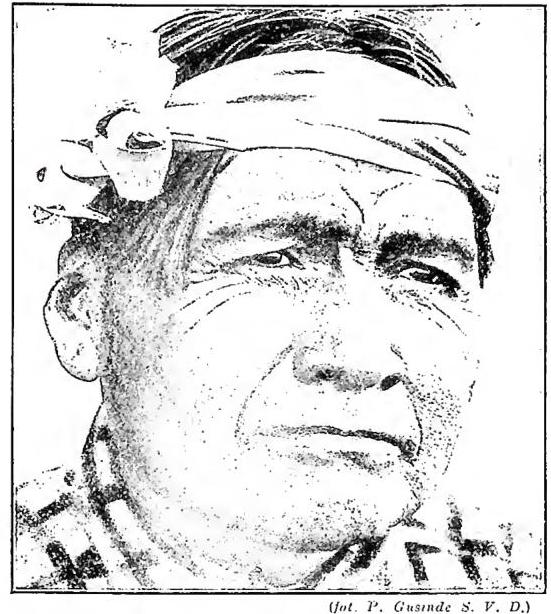
(Int. P. Gusunde S. V. D.)
ABORIGENI - Zuni Indian (North America).
him, his teachings, the creation, paradise, original sin and its corresponding sanction: death. This is the form of civilization which, through extensive comparisons, reveals itself as the most ancient, and we have confirmation of this from linguistics, which often demonstrates to us how the speech of many of these peoples constitutes an island among those surrounding it, and from anthropology, whose scholars are by now agreed on the antiquity of those peoples. It is understood, however, that in the type of civilization in question one must not see civilization in an absolutely primordial form, but only the oldest among those known, that is, the most ancient stratum of civilizations accessible to ethnological study today. - Vedi Tav. VII.
BIBL.: M. A. Czaplica, Aboriginal Siberia. A Study in Social Anthropology, Oxford 1914; J. Déniker, Les races et les peuples de la terre, 2e ed., Parigi 1926; E. von Eickstedt, Rassenkunde und Rassengeschichte der Menschheit, 1e ed., Stoccarda 1934; W. Schmidt, Die Stellung der Pyrmäenwölfer in der Entwicklungsgeschichte des Menschen, Stoccarda 1910; id., Der Ursprung der Gottesidee, I-IV, Münster in W. 1926-35; id., Das Eigentum auf den ältesten Stufen der Menschheit, Münster in W. 1937. Michele Schulien
Cite this article
“ABORIGENI.” Enciclopedia Cattolica, vol. I (1948), p. 88. Azione Romana digital edition, https://azioneromana.com/article/aborigeni.