
ABLUTION (Lat. ab-luo, Gr. ἀπο-λοίω “I carry away by washing”). — A. is a rite intended to place an individual or group in a state of ritual purity with regard to the divinity or to a person, object, or place invested with sacredness. Before contact with what is sacred, a. serves to remove the filth accumulated on the person; afterward, it serves to terminate contact with the “sacred” and to return the individual to the normal condition. purification (v.) which seeks to cleanse a physical or moral miasma, and from lustration, which has a collective expiatory character.
1. IN NON-CHRISTIAN RELIGIONS
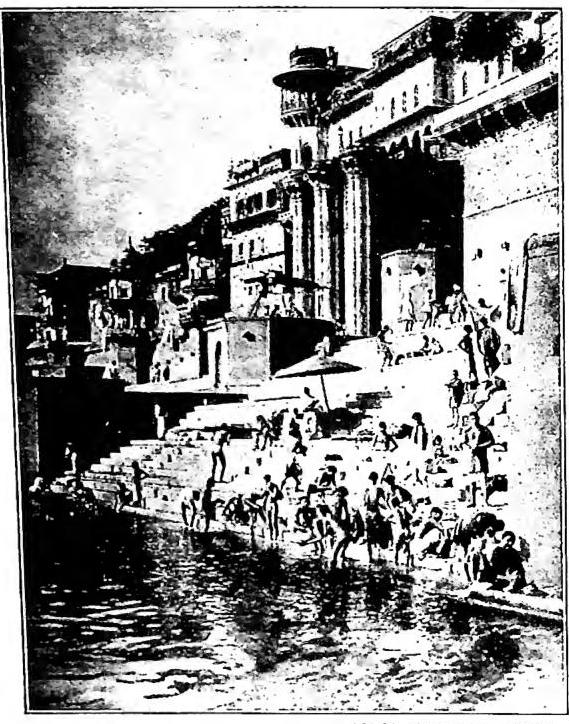
A. is performed especially with water, either by immersion or by pouring, as is documented by the ritual of all religions. Running water, especially that of rivers, is particularly suited to removing impurities. Hence the very frequent a. of the Hindus in the Ganges and their concern to die in its waters or on its banks, or at least with their thoughts turned toward the sacred river; in Shinto, the washing of the hands and mouth before entering the temple to pray; in Islam, a. before prayer, reading the Qur’an, or before touching a copy of it, in order to free oneself from impurities arising from the normal functioning of the body. Other means, however, are not excluded, such as desert sand for Muslims who are far from a spring (Qur’an 4:46; 5:9), and ox urine for the ancient Persians and modern Hindus.A., therefore, as a religious rite, does not have a hygienic purpose in the modern sense; it is intended to cleanse dirt insofar as this almost impairs and disfigures the condition of the person or thing, which emerges from washing regenerated into new life, and is considered a possible receptacle of miasmas that must be removed. This is evident from the practice of the Greeks (Aeschylus, Coeph. 95) of turning their eyes away when throwing out the receptacle of refuse, and from the practice of the Roman Vestals of throwing the rubbish from the temple of Vesta from the Capitoline slope (Varro, De lingua lat., VI, 32), or into the Tiber (Ovid, Fast., VI, 228, 713).
BIRL.: Van den Leeuw, Einführung in die Phänomenologie der Religion, Tübingen 1933, p. 320 ff. Nicola Turchi
2. ETHNOLOGY
A. with a religious, or at least ritual, background are found among primitive peoples and among advanced peoples in various forms, with different substances, and under different meanings. It is rare, however, to find them among the most culturally ancient peoples, some of whom recite their morning prayers to the Creator while washing their faces: in this case a. has no religious character, but constitutes merely a preparation for prayer. A certain ritual aspect is present, on the other hand, in the washings that other peoples at the same cultural level practice at the first manifestation of puberty and that are accompanied by ethical instruction, often joined to appeals to the will of the Creator; here, therefore, we are in the presence of a religious substratum.In more recent cultures, still among primitive peoples, religious, or at least ritual, a. appear with various meanings. A., certainly ritual in character, in the sea or in rivers, are observed in almost all initiation ceremonies for the young; but their purpose remains obscure. A particular type of a. is that which appears almost exclusively in the initiation of young women, when the mother pours beer (Africa) or “chicha” (America) over her daughter’s body as a wish for every happiness and perhaps also for numerous offspring.
Other a. are performed with medicines or blood in order to cure illnesses or to ward off every kind of baleful influence. The same purpose is pursued through anointings, aspersions, and the like. Finally, there are a. intended to remove impurities, whether material, moral, or imaginary, arising spontaneously from important states or phases of existence, such as puberty, marriage, childbirth, widowhood, remarriage, etc., or contracted through contact with impure things (corpses), or deriving from evil occult forces or from moral responsibility.
BIRL.: P. D. Chantepie de la Saussaye, Lehrbuch der Religionsgeschichte, 4th ed., Tübingen 1925; R. H. Codrington, The Melanesians, Oxford 1891; J. A. Dubois, Mœurs, institutions et cérémonies des Peuples de l’Inde, new ed., Pondicherry 1921; H. A. Junod, The Life of a South-African Tribe, 2nd ed., London 1927; W. Schmidt, Der Ursprung der Gottesidee, 6 vols., Münster 1926–40; L. von Schroeder, Arische Religion, Leipzig 1923; G. Wobbermin, Das Wesen der Religion, Leipzig 1925. For the Church’s position regarding superstitious a. in India, cf. the decree of Benedict XIV of 12 Sept. 1744, Dubio 14, in Collectanea S. Congreg. de Propaganda Fide, Rome 1907.
Michele Schulien
3. IN THE LITURGY
In many regions of the West, during the Middle Ages, it was customary to wash the head during the Palm Sunday service (Capitilavium), perhaps as the last remnant of the bath that catechumens took before baptism during Holy Week. Following the example of pagans and Jews, the first Christians too washed their hands in the fountain (cantharus) located in the atrium before entering the church, because they were to receive the Eucharist in their hands and then communicate themselves. The priests did likewise. The final vestige of this practice has remained in the washing of the hands or fingers that priests perform, while reciting an appropriate prayer, before putting on the sacred vestments, and, for the faithful, in the holy water at the entrance to the church. Another washing of the hands during Mass, at the Offertory, arose from the priest’s need to wash his hands after receiving the offering of bread and wine from the faithful, or also because, when dismissing the catechumens, he had laid his hands upon them.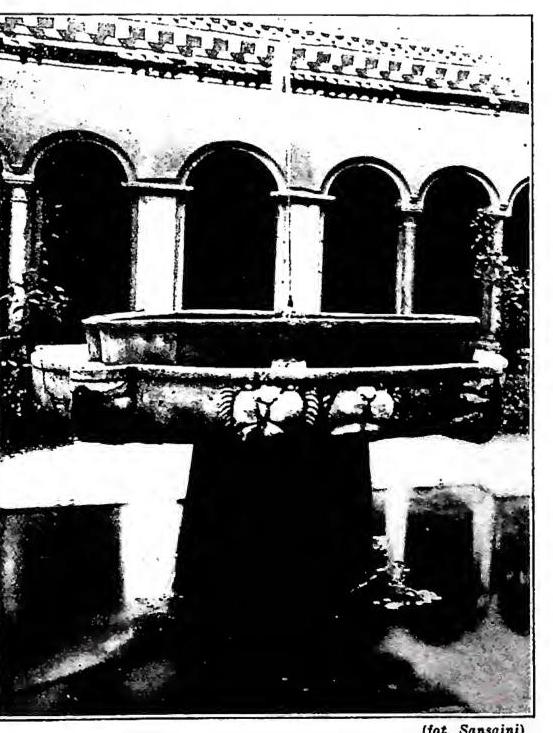
(photo Sassanini)
ABLUZIONE — Ewer for ablution (12th century) — Rome, Cloister of the Basilica of the SS. Quattro Coronati.
Until the 16th century, the manner of performing the a. varied according to place and time. Generally, the chalice was purified once with wine alone; the fingers, on the other hand, with wine alone or with water alone. In time, the practice of performing the a. first with wine and then with wine and water finally became established. These liquids were then poured into the piscina or another suitable place; sometimes, however, they were requested with great devotion by the faithful, in order to use or drink them as a kind of sacramental, from which they expected heavenly favors for body and soul. The second a., where it was customary, was performed not at the altar but in the sacristy or near the piscina. In many places the a. was not accompanied by prayers; in others, by one, two, or even three. The present rite was established by Pius V in 1570. Bishops, abbots, and all who possess the privilege of pontificals wash their hands even after the a. of the chalice and fingers, as all priests were accustomed to do in the 11th century.