
BAPTISM. - One of the seven Sacraments instituted by Jesus Christ, the first that can be received and which makes it possible to receive all the others: "Sacramentorum ianua et fundamentum" (CIC, can. 737).
I. DOCTRINE OF BAPTISM
OUTLINE:
I. Name and definition
II. Institution
III. Meaning and effects
IV. Constituents and conditions
V. Necessity
VI. Children and adults who die without B
VII. Christian baptism and non-Christian baptism
VIII. Conclusion.I. NAME AND DEFINITION
Baptism (from the Greek βαπτίζω, frequentative of βάπτω = I immerse) means immersion, ablution. The term “baptism” in Holy Scripture is not reserved exclusively to the Sacrament instituted by Jesus Christ (cf. Mt 3:7; Mk 7:4, 8; Lk 3:3) nor is it the only word chosen to designate it (Eph 5:26; Tit 3:5; F. Prat, I, p. 551; Oepke, pp. 527–28, 543).Among the holy Fathers, Christian Baptism is indicated and described by various names and circumlocutions. St Gregory Nazianzen summarizes the varied terminology when he says: “We call it gift, grace, Baptism, anointing, illumination, robe of incorruptibility, washing of regeneration, seal and every other most excellent name. It is called gift because it is given to those who previously gave nothing; grace because it is granted to one who was previously a debtor; Baptism because sin is buried in the water; anointing because it is sacred and royal… illumination because it is a radiance; robe because it covers our ignominy; washing because it purifies; seal because it preserves and is a sign of dominion” (In S. Baptisma, oratio 40, 4; PG 36, 362–63; cf. St Cyril of Jerusalem, Procathechesis, 16; PG 33, 360–61; Pseudo‑Basil, Hom. 13, 5; PG 31, 434; St John Chrysostom, Catech. I ad illuminandos, 2; PG 49, 225–26). Among these appellations, those of illumination, seal and character are particularly noteworthy for the theological thought they imply and the developments to which they give rise; they are already found in the early Fathers (e.g., Justin, I Apol. 61 [testimony to the spread of the term: F. Prat, I, p. 507, note 1]; Shepherd of Hermas, Simil. 8, 2, 4; 9, 16–17 [F. X. Funk, Patres Apostolici, I, Tübingen 1901, pp. 559, 561, 609, 611]; Abercius, Epitaph, V. 9; St Ephrem, Hymni de oleo et oliva, 4 [ed. T. J. Lamy, 4 vols., Malines 1882–90, II, pp. 805 ff.] etc. Cf. J. Coppens, pp. 313–14).
As the centuries passed, the meaning of the terms gradually crystallized, and although a great variety of expressions continued in use, the classical and technical term for the Sacrament instituted by Jesus Christ became “Baptism.” Subsequently, Scholastic theology, instead of seeking new names and circumlocutions, devoted itself to the systematic and profound study of the Sacrament in its various aspects. The fruit of this study was precise and exact definitions. According to the canons of the time, these definitions fall into two types: those that reveal especially the “visible components” of the baptismal rite (definitio physica) and those that reveal “the specific element” that differentiates it from other Sacraments (definitio metaphysica). Outside the strictly Scholastic frameworks, the authentic magisterium of the Church proposes to the faithful this definition: “Baptism is the Sacrament that makes us Christians, that is, followers of Jesus Christ, children of God and members of the Church” (Catechism of Christian Doctrine published by order of Pius X). Cardinal P. Gasparri, with a less concise definition, states: “Baptism is the Sacrament instituted by Jesus Christ, through which the baptized: 1) becomes a member of the mystical body of Jesus Christ, which is the true Church; 2) obtains the remission of original sin and of all actual sins present in the soul and of all the punishment due to them; 3) becomes capable of receiving the other Sacraments” (P. Gasparri, Catechism for Adults, 2nd ed., Brescia 1934, p. 130).
The definitions cited agree with the terminology of the holy Fathers on one essential point: Baptism is a rite of great richness of content. This richness is expressed by the Fathers through the multiplicity and variety of their terms, and by theologians through the determination and coordination of concepts.
II. INSTITUTION
It is a truth of faith that the Sacrament of Baptism was instituted in His Church by Jesus Christ. Although Holy Scripture does not state this in explicit terms, the equivalent expressions it employs leave no room for doubt.Jesus, in fact, says to Nicodemus: “Unless a man be born again of water and the Holy Ghost, he cannot enter into the kingdom of God” (Jn 3:5). Here, water is the outward and sensible rite; the intervention of the Holy Ghost indicates its sanctifying effect; their joint action opens the kingdom of heaven and produces in the soul a new life of a higher order than natural life (cf. infra, III, n. 4). The text also teaches, in universal terms, the necessity of this baptismal rite; equally universal are the terms in which the command to baptize is promulgated: “All power is given to me in heaven and in earth. Going therefore, teach ye all nations; baptizing them in the name of the Father, and of the Son, and of the Holy Ghost” (Mt 28:19); “Going into the whole world, preach the gospel to every creature. He that believeth and is baptized, shall be saved; he that believeth not shall be condemned” (Mk 16:15-16). According to these texts, Jesus has thus established, in principle, the necessity of Baptism and ordered its use in His Church.
Therefore, the Apostles administered Baptism from the very day of Pentecost (Acts 2:41). The deacon Philip administers it to the converts of Samaria, and, on the road to Gaza, to a high official of Ethiopia (Acts 8:36-38). Peter, in answer to the question of his hearers: “What shall we do?”, replies: “Do penance, and be baptized every one of you in the name of Jesus Christ, for the remission of your sins” (Acts 2:38). Baptism is also given to persons sent by God in a miraculous way, e.g., to the centurion Cornelius (Acts 10:47) and to Paul (Acts 9:15). Now the Apostles could not have administered Baptism in so universal, determined, and formal a manner, “in the name of Jesus,” unless they had received from Him both the command and the doctrine. St Paul further develops this doctrine in its most profound and mystical meanings: there is one Baptism, as there is one Christ (Eph 4:5); Baptism imprints the seal of the Holy Ghost (2 Cor 1:21-22); it clothes us in Christ (Gal 3:27); it mystically causes us to share in the death and resurrection of Jesus (Rom 6:3-4); etc. (cf. infra, III). Baptism thus appears immediately in the teaching and practice of the Apostles as a rite accompanied by doctrine on its efficacy.
The dogma of the institution of Baptism was defined by the Council of Trent where it declares, under pain of anathema, that all the Sacraments of the New Law were instituted by Jesus Christ (Sess. VII, can. 1; Denz-U, no. 844). Against the theory of liberal theology and modernism, which would derive Christian Baptism from the purification rites in use among various peoples, and even among the Jews, the Church condemned in the decree Lamentabili this proposition: “It was the Christian community that introduced the necessity of Baptism, adopting it as a necessary rite and attaching to it the obligations of the Christian profession” (Denz-U, no. 2042; cf. no. 2088).
The moment of the institution of Baptism is not indicated by Scripture; and the Fathers and theologians adhere to different opinions. Some think that Jesus instituted it at the moment when He Himself was baptized in the Jordan (Mt 3:13); the water, then, would have received a purifying power (St Ambrose, In Lc., II, 83; PL 15, 1665; St John Chrysostom, In Mt. hom. 12, 3; PG 57, 206; St Thomas, Sum. theol., III, q. 66, a. 2; Roman Catechism, pt. 2, ch. 20, no. 19). Others, instead, choose the moment of Jesus’ discourse with Nicodemus (Jn 3:1-21); still others, the moment when Jesus, before ascending into heaven, gave the Apostles the command to baptize (Mt 28:19). Combining the three points of view, one may say with St Albert the Great (In IV Sent., dist. III, a. 3) that the Baptism in the Jordan determined the matter of the Sacrament, the command given to the Apostles to baptize expressed its form, the discourse with Nicodemus indicated its end; the blood and water flowing from the side of Jesus on the Cross conferred its power and efficacy (cf. also St Bonaventure, In IV Sent., dist. III, pt. 2, p. 1, a. 1).
### III. SIGNIFICANCE AND EFFECTS
Baptism presupposes and cannot disregard the Catholic doctrine concerning the condition of man in a state of sin, on redemption, and on the manner in which redemption is applied to individuals.
According to Catholic doctrine, Adam was created in a state of justice and holiness, free from evil inclinations and immortal. He sinned and brought ruin upon all his descendants. Now, men are born sinners (original sin), subject to the violence of passions to which they cannot resist (Rom 7:14-25). They fall and increasingly forge their own chains. Sin holds them under its power as slaves (Rom 6:17, 20; Jn 8:34; 2 Pt 2:19); to the devil they are subject as subjects to their head (Jn 12:31; 14:30). The devil is the god (θεός) “of this age” (2 Cor 4:4; 1 Cor 2:6; Gal 2:15).
The power of Satan was shattered by Jesus Christ the Redeemer. But the defeated devil has not abandoned the world. He continues to wage war (1 Pt 5:8). His attempt will not cease until the end of the world. Jesus Christ has His apostles; He also has “antichrists,” “who are many” (1 Jn 2:18), who zealously support the effort of their head, who seeks to supplant God, take His place, and be worshipped (1 Jn 2:18-22; 2 Thess 2:3-12. Cf. A. Charue, in L. Pirot, La Sainte Bible, XII, Paris 1946, pp. 179-85, 530-32; P. De Ambroggi, Le Epistole cattoliche, in S. Garofalo, La Sacra Bibbia, XIV, 1, Turin 1947, pp. 217-19; H. Rahner, pp. 239-73).
This is the situation in which every man finds himself: a sinner because descended from Adam, and, if an adult, a sinner also through personal sins; salvation, purification from his guilt, and liberation from the dominion of Satan he can find only in Jesus Christ (Acts 4:12). He must choose between Jesus Christ and Satan. He cannot remain neutral: he is either with Christ or against Christ (Lk 11:23). Through baptism, the transition from Satan to God is marked.
1. Approach to the Cross of Christ. — The central moment of the life of Jesus Christ is the moment of His death. There redemption was accomplished. Jesus Christ saved the world by dying for II. But St. Paul warns us that Jesus Christ did not die alone. To the Corinthians he writes: “The love of Christ impels us, thinking that one died for all [ὕπερ πάντων], and therefore all have died” (2 Cor 5:14) ideally and mystically in Him and with Him. All have died, that is, they have become sinners “in Adam” by the very act of his disobedience, and they become sinners “in fact” at the moment of their natural generation, because then they become actual members of the sinful human family. In a similar way, all are justified “ideally and by right” on Calvary, by the death of Jesus Christ, “in fact and really” at the moment when they come into contact with the death of Jesus Christ (J. Cools, p. 305; F. Prat, pp. 243-44).
Contact with the death of Christ occurs in baptism. It is the application of the sanctifying power of the Passion to every Christian (C. Spicq, p. 384). Here are two fundamental texts of St. Paul: “Do you not know that all of us who have been baptized into Christ Jesus (εἰς Χριστὸν Ἰησοῦν) have been baptized into His death? Therefore we have been buried with Him through baptism into death, so that as Christ was raised from the dead through the glory of the Father, so we too might walk in newness of life” (Rom 6:3-4). “In Him [Christ Jesus] you were also circumcised with a circumcision made without hands, in the removal of the body of the flesh by the circumcision of Christ; having been buried with Him in baptism, in which you were also raised up with Him through faith in the working of God, who raised Him from the dead. When you were dead in your transgressions and the uncircumcision of your flesh, He made you alive together with Him (συνεξωποίησεν), having forgiven us all our transgressions” (Col 2:11-13).
The content of these dense verses can be organized into three concepts: 1) through baptism, the Christian is incorporated into Christ; 2) purified from every fault; 3) regenerated.
2. Incorporation into Christ Jesus. — The doctrine expounded in the cited verses is not new in the Pauline epistles.

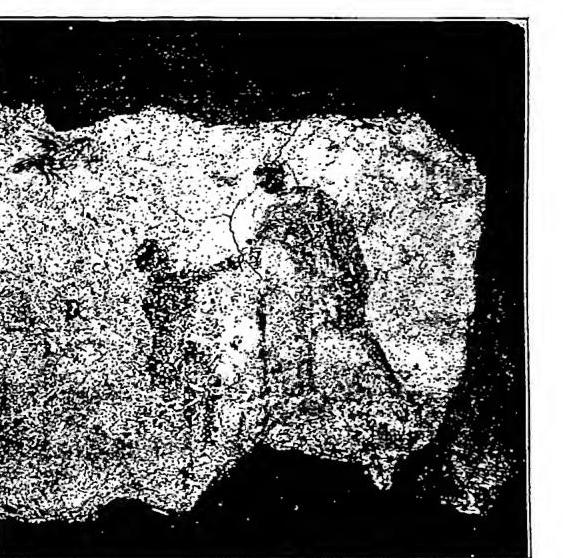
(from Wilpert, Pitture, tav. 39, 5)
BAPTISM — Baptism of the faithful (end of 2nd century).
Rome, cemetery of St Callistus.
is one only, “so also is Christ. For in one Spirit we were all baptized into one body, whether Jews or Greeks, whether slaves or free; and in one Spirit we were all made to drink” (1 Cor 12:12–13, 27; cf. J. Huby, Première Épître aux Corinthiens [Verbum Salutis, 13] Paris 1946, pp. 288–89). To the Galatians he said that by being baptized into Christ they put on Christ and every distinction arising from race, civil status or sex falls away: “you are all one in Christ Jesus” (Gal 3:28). Whether the preposition εἰς in Gal 3:27, Rom 6:3 and 1 Cor 12:13 is interpreted in a quasi-local sense, as though Christ were the element or medium in which baptism immerses us (F. Prat, I, pp. 552–53; J. Bover, Teología de s. Pablo, Madrid 1946, pp. 64–65), or more simply as indicating a mystical relation of belonging (J. Coppens, s.V. in DBs, I, col. 897), it remains true that baptism truly unites us with Christ. This assertion is confirmed by many other expressions in St Paul and the New Testament at large that describe the Christian life as beginning and unfolding in union with Jesus (cf. Eph 2:5–7; Col 2:20; 3:3; 1 Pt 3:21; Phil 3:10, etc.). Particularly noteworthy is the very frequent Pauline expression “in Christ Jesus” (cf. F. Prat, p. 478; M. R. Weijra, In Christo Iesu, in Revue Thomiste, 55 [1947], pp. 499–517; J. Bonsirven, L’Évangile de Paul, Paris 1948, pp. 241–42) and the group of compound words formed with the preposition σύν, coined and used to indicate how the facts of the Christian life unfold in contact with the facts of Jesus’ life (e.g., συναποθνήσκειν = to die together [with Christ], συνθάπτεσθαι = to be buried together [with Christ], συζωοποιεῖν = to vivify in [Christ], σύμμορφος = of the same form [as Christ], etc. List in F. Prat, I, p. 21; J. Bonsirven, ibid.).
The body of Christ is the Church (Eph 1:23). Baptism incorporates one into II. For the Church the Saviour “gave himself up to death to sanctify her, having cleansed her by the washing of water with the word” (Eph 5:26; cf. A. Médebielle, in L. Pirot, op. cit., p. 67). According to Huby, St Paul here teaches that, in the divine intention, the Church as a society comes before the faithful. The Christian adheres to Christ and becomes an heir of God because he enters the Christian community, which cannot fail in the purpose for which it was founded; individual Christians may fail and render Christ’s Passion unfruitful, but the Church as a unity cannot. (J. Huby, Mystiques Paulinienne et Johannique, Paris 1946, pp. 30–31.) Baptism is therefore shown to be a sacrament of profound social significance. On receiving it, relations with other Christians cease to be merely human relations: they become relations between members of the same body. Rightly, schism, which breaks the unity of the body of Christ, has always inspired horror in Christians and has been condemned as heresy (cf. H. de Lubac, Catholicisme, 4th ed., Paris 1947, pp. 51–52).
By entering the mystical body of Christ one receives the gift of the Holy Spirit. The Holy Spirit is the Spirit of Christ, and whoever does not possess him is not a Christian (Rom 8:9). The Holy Spirit teaches us to invoke God as Father (Rom 8:15–17; Gal 4:6), to judge spiritual and supernatural things (1 Cor 2:10, 16) and, in general, to think and judge as Jesus Christ thought and judged (Phil 2:5; F. Mura, Le Corps Mystique du Christ, 2nd ed., I, Paris 1936, pp. 198–201; J. Duperray, Il Cristo nella vita cristiana secondo s. Paolo, trans. G. Montali, Riccione 1934, p. 70; L. Cerfaux, La théologie de l’Église suivant s. Paul, 2nd ed., Paris 1948, pp. 182–99).
3. Remission of sins
By incorporation into Christ the divine plan for the salvation of mankind is realized. God’s eternal plan is to bring all things to salvation through Jesus Christ. He created men to be holy and blameless before him in love; he predestined them to become his adopted children through Jesus Christ, in whom they find redemption and forgiveness of sins; he willed that all things be united in Christ so that in Christ they might be brought to God (Eph 1:4–6, 10; J. Huby, Les Épîtres de la captivité [Verbum Salutis, 8], Paris 1935, pp. 153–61). This divine plan of salvation embraces all, even pagans, who, no less than Jews, are destined to be fellow heirs, members of the same body, partakers of the promise in Christ Jesus through the gospel (Eph 3:4–6). This is the great mystery that Paul must proclaim to the world (D. Deden, Le « Mystère » paulinien, in Ephemerides Theologicae Lovanienses, 13 [1936], pp. 20–22; C. Spicq, p. 116 ff.).The unity in Christ, which is part of the divine design, becomes a reality in baptism. Baptism must therefore render men immaculate and holy, removing the sins that make union with Christ impossible and would nullify the divine plan of salvation. In fact, baptism is the tomb of sin. Not merely in the sense of a legal fiction by which God considers just what is not so in reality, nor in the sense of a simple conversion of heart that no longer wishes to sin again, but in the sense of the true and complete destruction of sins committed. The texts of St Paul do not say “die to sin” but “you have died to sin,” buried as Christ was buried in his tomb; the body of sin was crucified together with him (Rom 6:3–6). In Rom 5:12–21 it is affirmed that liberation from sin, effected by Jesus Christ, is as real as the sin that men contract in Adam; indeed, if Adam’s sin was great and effective, Christ’s work is even greater and more effective, because where sin abounded, grace overflowed all the more (vv. 1, 6, 17, 20). Before descending into the baptismal font one might have been a fornicator, idolater, adulterer, effeminate, thief, drunkard, etc.; in baptism all this falls away, one becomes clean, holy, just (1 Cor 6:9–11). “There is therefore now no condemnation for those who are in Christ Jesus” (Rom 8:1). Sin is dead—original sin and actual sin. St Paul makes no restriction or limitation: everything that is sin in the true sense of the word is dead.
The Fathers of the Church extol the purifying virtue of baptism both in their frequent direct statements (cf. C. Pesch, n. 399) and in saying that the water of baptism is the tomb of earthly life and the maternal womb of the new celestial life. (Clement of Alexandria, Stromata, IV, 25, 160; Cyril of Jerusalem, Catecheses, Mystagogical 3, 2-4; PG 33, 1078-80; Pseudo-Dionysius, De caelesti hierarchia, II, 2, 7; PG 3, 396; Augustine, Sermon 119, 4; PL 38, 674; Pseudo-Augustine, De Symbolo ad catechumenos: PL 40, 659, etc.). Or else, taking their cue from St Paul (1 Cor 10:2-5, 11), they like to draw a parallel between the historical fact of the Hebrews’ departure from Egypt and the crossing of the Red Sea, and the spiritual event of departure from the state of sin through the pool of baptismal water. The historical event that happened to the Hebrews is an image of what happens to the Christian in the pool of baptism: God works for him what He worked for the Hebrews in the crossing of the Red Sea. “Whoever therefore claims that baptism does not totally remit sins, let him say that the Egyptians did not truly die in the Red Sea. But if he admits that the Egyptians truly died, then he must also admit the full remission of sins in baptism.” (St Gregory the Great, Epist., XI, 45; PL 77, 1162; cf. J. Daniélou, pp. 402-30). Or again they say that the cross of Christ sanctifies the water and, from common water, makes it sanctifying water (e.g. St Ambrose, De Mysteriis, 4, 20; PL 16, 394; St Augustine, Contra Iulianum, VI, 19, 62; PL 44, 861; id., De Catechizandis rudibus, 20; PL 40, 425, etc.). The same thought of the cross of Christ sanctifying the water is expressed by ancient writers and artists in representing or speaking of the cross planted in the midst of the Jordan to sanctify the water that generates Christians (H. Rahner, Griechische Mythen, pp. 114-17). The Roman liturgy of the consecration of the baptismal font symbolically conveys the same concept by making the priest, who blesses the font, stand on the water in the form of a Greek V (the V indicates the tree of life, the cross that fertilises the waters), and by immersing a lighted candle in the font as the antiphon is sung: “May the fullness of the Holy Spirit descend into this water,” the candle being a symbol of Jesus Crucified descending into the water and granting it the powerful light of the Spirit and of life (cf. H. Rahner, ibid.; for the concept of Jesus Christ as light, M.-J. Lagrange, Evangelium selon s. Jean, Paris 1925, pp. CLXI-CLXII; F. J. Dölger, Sol Salutis, Münster in V. 1925).
On this matter the Church had already expressed herself directly and explicitly at the Council of Florence. The Decree for the Armenians affirms as an effect of baptism “the forgiveness of all original and actual guilt and also of all the punishment due for them. Therefore no penance is to be imposed on the baptised for sins committed, and if they die before sinning again, they go straight to paradise” (Denz-U, 696). And she had pronounced herself indirectly much earlier by including among the articles of faith necessary for every Christian to believe that baptism is “for the remission of sins” (Nicene-Constantinopolitan Creed, Denz-U, 86), “of all sins, both original sin which is contracted and those which are committed voluntarily” (Innocent III, profession of faith prescribed for the Waldensians [Denz-U, 424]; cf. Council of Lyons [Denz-U, 464]; the constitution Benedictus Deus of Benedict XII [Denz-U, 539]).
Since this constant teaching had not been sufficient to restrain the Protestants, the Church formulated her thought anew at the Council of Trent. Canon 5 of Session V lays down that everything that is sin in the true sense is truly “taken away” by baptism and not merely “not imputed.” In those regenerated in baptism there is no longer anything that is an object
BAPTISM — Baptism of Jesus Christ (late 2nd century).
Rome, cemetery of St Callistus.
of hatred on God’s part. They have become pure, innocent, immaculate, without fault, and pleasing to God. Nothing prevents their entry into paradise. The Church knows that even in the baptised there remains concupiscence, that is, the tendency to evil, but she teaches that it is a trial for man and does not harm those who do not consent to its inclinations and vigorously resist them (Denz-U, 792). It is true that in the discussions preceding the definition of this canon there were some voices not far removed from the religious innovators who proposed almost treating as inexact the words “in the regenerated God hates nothing” (nihil odit Deus), but the conciliar Fathers did not yield. The Church’s official and infallible teaching once again sanctioned that with Baptism sin is entirely removed (cf. Concilium Tridentinum, ed. Societas Goerresiana, V: Actorum pars altera, ed. S. Ehses, Freiburg in Br. 1911, pp. 105-256 and passim).
In Baptism the past is buried with Jesus Christ and dies. A new life is born. Death and life are total terms. In death all activity ceases; in Baptism sin dies and with it dies all that is its work, including the obligation of punishment. A new life begins which feels the past only inasmuch as it enlivens and deploys its activity through a nature that was once an instrument of sin by which it was ruined and made prone to evil.
4. Regeneration
The great text of Rom 6:3ff presents Baptism under the double aspect of union with Christ’s death, which destroys sin, and union with Christ’s resurrection, which introducesinto a new life. The immersion of the rite symbolises death and burial; the emergence, resurrection and life. For Jesus Christ, death, burial and resurrection were real. Likewise for the Christian, there is real death and burial of sin, and there is real resurrection to new life.
The new life of the baptised is not constituted by the resolve to change conduct. The Christian as such is the effect not of an evolution in his conduct but of a creation (2 Cor 5:17; Eph 2:10, 13 [ἐκτίζω], Gal 6:15), of a regeneration: “(God) saved us through the bath of regeneration and renewal of the Holy Spirit, which he poured out upon us richly through Jesus Christ our Saviour, so that, justified by his grace, we might become heirs in hope of eternal life” (Tit 3:5-7). Thus Paul, at the end of his life, summarises his teaching in a few words. St John, alluding to the result of this regeneration which makes us children of God, will say: “See what love the Father has given us, that we should be called children of God; and so we are” (καὶ ἑωθέν: 1 Jn 3:1). That we are called children of God is not a mere title or a legal fiction; it is due to our real state (cf. P. De Ambroggi, in S. Garofalo, La Sacra Bibbia, XIV, 1, Turin 1947, p. 223). The Jewish people boasted of being the predilected people par excellence, and is in fact called by St Paul an “adopted” people (Rom 9:4); but in comparison with Christians it can no longer be called “son.” Only in Christ are we truly adopted as sons (Gal 4:5; F. Amiot, Epître aux Galates [Verbum Salutis, 14], Paris 1946, pp. 190-91; E. Mersch, La Théologie du Corps Mystique, II, ibid. 1946, pp. 16-49). In comparison with Christians the Jewish people is in the condition in which, in ancient society, the son of a slave stood before the son of a free woman (Gal 4:21-31; F. Amiot, op. cit., pp. 200-206; L. Cerfaux, La théologie de l'Église suivant s. Paul, 2nd ed., Paris 1948, pp. 127-29). The reason for this difference lies in the fact that the regeneration of Christians proceeds from a heavenly and divine principle which does not limit its action to an external and legal recognition but penetrates to the inmost being and there causes to sprout the life for which the title “child of God” is a just one. Nicodemus marvels to hear Jesus say that one who is not born ἀνωθέν (anew, or from above) cannot enter the kingdom of God, and asks Jesus how it is possible for one to be born when he has already grown old; can he indeed enter his mother’s womb again? Jesus answers him: “Truly, truly, I say to you, unless one is born of water and the Spirit, he cannot enter the kingdom of God” (Jn 3:5). Whether ἄνωθεν in V. 3 means “anew” as many exegetes hold, or “from above” as many others maintain (cf. J. Coppens, in DBs, I, cols. 865-66), or whether John, in writing this word, had both senses in mind, as some still hold (J. Huby, Mystique Paulinienne et Johannique, Paris 1946, p. 156), it is certain that Jesus speaks of a true rebirth. This is shown by the terms used and by Nicodemus’s reaction and words (v. GIACOMO, La Παλιγγελεσία, pp. 376-80). The principle of this new life, together with water, is a heavenly and divine principle, the Spirit (πνεῦμα; J. Coppens, ibid.). With an even stronger term, St John in his First Letter calls Christians “born of God,” having within themselves a seed of him (στέψα αὐτοῦ: 1 Jn 3:9; cf. ibid., 2:29; 3:13; 4:7 and P. De Ambroggi, op. cit., p. 227).
With this rebirth one begins to live that life which, in its fullness, is possessed by the Father, is transmitted by the Father to the Son in its fullness, and from the Father and the Son to the Holy Spirit (Jn 5:26). This life, which is the dominant theme of the entire Gospel of St John (J. B. Frey, Le concept de «vie» dans l'évangile de s. Jean, in Biblica, 1 [1920], pp. 37-58; 211-39), Jesus has the mission to bring to all men, and for this he came into the world (Jn 10:10). And indeed, all who accept him and his teaching are vivified by him (Jn 1:12-13) and made “partakers of the divine nature” (2 Pt 1:4).
The intimate nature of this life that God gives us remains for us, who on earth know spiritual and heavenly things only by reflection (1 Cor 13:12), a mystery. It is partly revealed through the life and more-than-human experiences of the saints, but its intimate essence and inner value elude us. They will be fully disclosed in heaven (1 Jn 3:1-4).
The process that culminates in regeneration in the sense indicated is due to the heavenly Father, from whom the initiative of redemption has come (F. Prat, I, p. 91 ff.; P. Bonnetain, Grâce, in DBs, III, col. 1008 ff.). St Paul expressly says that God “saved us through the bath of regeneration and renewal of the Holy Spirit, which he poured out upon us richly through Jesus Christ our Saviour” (Tit 3:5). Baptism is the point of convergence of the action of the divine Persons. The Father applies to individuals through Baptism the merits of Christ’s passion, sanctifying them by the intervention of the Holy Spirit who gives life and inwardly renews the neophyte.
In the fact that Baptism effects a rebirth, theologians have always seen the intimate reason why Baptism remits every sin and every penalty due for sin (cf. St John Chrysostom, Catechesis I ad illuminandos, 3; PG 49, 226-27; Sum. Theol., 3ª, q. 69, aa. 1-2). St Paul adds that the rebirth effected by Baptism is a beginning and starting-point, not a definitive arrival. The Christian is a new being but also a being who is continually renewed (2 Cor 4:16). The life received increasingly invades the activity of man, develops and grows every day, until it reaches adulthood, to be a “mature” man in Christian life, as was Jesus Christ (Eph 4:12-16; C. Spicq, loc. cit.).
5. Character
God the Father has predestined Christians to be conformed to His Son (Rom. 8:29). Baptism answers this divine desire by incorporating the faithful into Christ and making them partakers of the supernatural life which in Jesus is found in its fullness. It is a first way of becoming “conformable” to Jesus. It is not the only way. Revelation knows of another.Revelation teaches: a) Baptism is the sacrament received first in order of time. It is “the door of the spiritual life” (Decretum ad Armenos, Denz.-U., 696). Without Baptism no other sacrament can be received. A non-baptized person, even if he knows Christian doctrine, believes it, and is repentant of his sins, cannot be absolved in confession; that is, not only must he not be absolved, but if a priest were to absolve him, the absolution would be as if it had not been given. Two Christians who marry, even if they are in a state of sin for which they are not repentant, commit sacrilege, yet they truly receive and administer the sacrament of Matrimony. Two unbaptized persons, however, even if they have a more living faith than the two Christians just mentioned and are in the state of grace, if they marry, neither receive nor administer the sacrament of Matrimony.
These differences indicate that Baptism impresses on the soul something which remains even when sanctifying grace has already been lost.
b) Baptism is received only once. This doctrine was one of the mainstays on which the defenders of the validity of sacraments administered by heretics relied.
c) Along with the two preceding affirmations there is the doctrine of the sacrifice of the Mass as the sacrifice of the Church and of the priesthood of the faithful (cf. 1 Pt. 2:9; Pius XII, encyclical Mystici Corporis of 29 June 1943, in AAS, 35 [1943], pp. 232-33).
d) Finally, there are the numerous statements of the Fathers speaking of a seal (in the passive sense of an impressed image), of a distinctive mark received in Baptism, indelible, which renders the Christian discernible from one who is not a Christian and makes him capable of receiving the other sacraments. Some Fathers see an indication of this distinctive mark in three texts of St. Paul (Eph. 1:13; 4:30; 1 Cor. 1:21-22) which speak of a σφραγίς (= seal) impressed by the Holy Spirit upon Christians and the Apostles (e.g., St. Cyril of Jerusalem, Catechesis 17, 35; PG 33, 1010; St. Athanasius, Epist. I ad Serapionem, 23; PG 26, 583; St. Basil, Homilia in S. Baptisma; PG 31, 431; St. Ambrose, De Spiritu Sancto, I, 6, 78; PL 16, 723; St. John Chrysostom, In II Cor. homily 4, 7; In Eph. homily 2, 1; PG 61, 418; 62, 18). St. Basil calls it the distinctive mark which makes known those who belong to God. He who does not have this mark will not be spared, just as the houses marked with blood were not spared when the destroying angel passed by (Homilia in S. Baptisma 1; PG 31, 431).
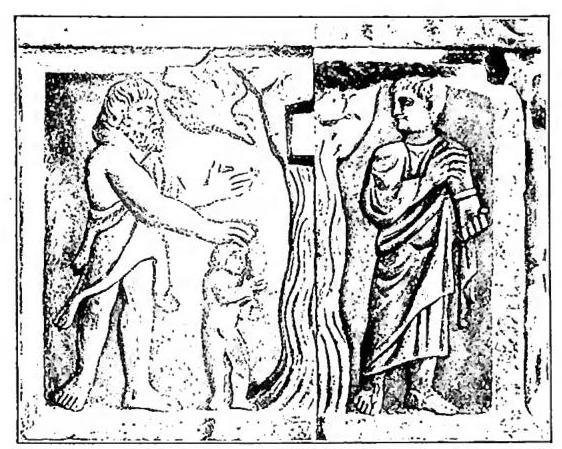
(from Wilpert, Sarcofagi, tav. II, 2)
BAPTISM – Christian sarcophagus with B. of Jesus Christ (late 4th cent.) – Arles.
A passage by Theodotus, preserved by Clement of Alexandria, speaks of the image of Christ that is impressed upon Christians as the image of the emperor was impressed upon the coin presented to Christ by the tempting Pharisees (Clement of Alexandria, Excerpta ex scriptis Theodoti, nn. 83, 86, ed. F. Sagnard [Sources Chrétiennes, 23], Paris 1948, pp. 206-209, 210, 235). St Ephrem compares it to the imprint left by a ring on wax (in G. S. Assemani, Biblioth. Orient., I, 94). Others describe it as a sign that puts demons to flight and points out to the angels the souls to be received (St Cyril of Jerusalem, Catechesis 17, 36; PG 33, 1010; St Gregory Nazianzen, In S. Baptisma, orat. 40, 15; PG 36, 378; St Gregory of Nyssa, Oratio adversus eos qui Baptismum differunt; PG 46, 423). Still others insist on the distinctive notes of this seal, calling it holy, spiritual, salutary, impressed on the soul, on the heart, indelible, inalienable, remaining even in deserters who have passed over to Satan’s camp (Tertullian, De Baptismo, 6; De resurrectione carnis, 8; De pudicitia, 9; St Cyprian, Epist., 73, 9; St John Chrysostom, In II Cor. homil. 4, 7; PG 61, 418; etc. Cf. J. B. Franzelin, De Sacramentis, 4th ed., Rome 1888, p. 154 ff.). St Augustine, in his controversy with the Donatists, often bases his arguments on the existence of an effect of Baptism produced by the Holy Spirit, independent and separable from the grace of justification and not lacking in any valid Baptism (De Baptismo, III, 16, 21; V, 24, 34; PL 43, 148-49, 193). This effect, distinct and separable from sacramental grace, is a distinguishing mark, a character of Christians, possessed by all the baptized, even heretics (Epist., 173, 3; 185, 23; PL 33, 754, 803); it is a “royal sign,” a “royal character,” the character imperatoris mei (Serm., 8, 2; Contra ep. Parmen., 12, 29; Sermo ad plebem Caes., 2, 4; PL 46, 839; 43, 71, 691-92). The reason why heretics, in baptizing, impress this sign of Christ is that Baptism is Christ’s work more than man’s. It is Christ who baptizes in His apostles. The Baptism administered by John the Baptist was repeated, whereas the Baptism administered by Judas was not repeated: John indeed baptized in his own person, whereas in Judas it was Christ who baptized (St Augustine, In Io. tract. 5, 18; 6, 7; PL 35, 1424-28).
In the following centuries all these data were carefully examined and the doctrine of the “character” (as this particular effect of Baptism was called) was developed in its various aspects. A solemn document was issued at the Council of Trent. It was defined that the three sacraments of Baptism, Confirmation and Holy Orders impress on the soul a character, that is, a spiritual and indelible sign, and therefore cannot be repeated (Sess. VII, can. 9; Denz-U, 852). A similar declaration had already been made at the Council of Florence (1439) (Decretum ad Armenos; Denz-U, 695).
These two documents state what the character is (a spiritual, indelible sign impressed on the soul) but do not specify its function. Other documents are more explicit. Pius XII, in the encyclicals Mystici Corporis of 29 June 1943 and Mediator Dei of 20 Nov. 1947, says that the faithful in the Holy Mass “offer” the divine victim together with the celebrating priest (NAS, 35 [1943] pp. 232-33; 39 [1947], pp. 532-55). Only the priest consecrates and performs the unbloody immolation; “by placing the divine victim on the altar, the priest presents it to God the Father as an oblation to the glory of the Most Holy Trinity and for the good of all souls. To this oblation properly speaking the faithful participate in the manner proper to them and for a twofold reason: namely, because they offer the sacrifice not only through the hands of the priest, but, in a certain sense, also together with him, and by this participation the offering made by the people is also directed to the liturgical worship” (encyclical Mediator Dei, ibid.; S. Tromp, Quo sensu in sacrificio Missae offerat Ecclesia, offerant fideles, in Periodica de re morali et canonica, 30 [1941], pp. 265-73). The power to participate, together with the priest, in the offering of the divine victim the faithful have from Baptism: “For by the washing of Baptism, Christians become, in common title, members of the Mystical Body of Christ the Priest, and, by means of the ‘character’ impressed on their souls, they are deputed to divine worship, thus participating, in a manner suited to their state, in the priesthood of Christ” (encyclical Mediator Dei, ibid.). If therefore we observe that in Jesus Christ we may consider His personal state and His office of priest of the New Law, it must be said: Baptism, inasmuch as it gives the life of grace, makes us like Jesus considered rather according to His state: Jesus is life, we are vivified by Him. Instead, inasmuch as it impresses the character, it makes us like Jesus Christ considered rather according to His office (H. Hurter, Theologiae Dogmaticae Compendium, III, Innsbruck 1903, n. 276).
In other words, Jesus Christ is the supreme Head of worship and the principal priest of the Holy Mass, which is the one sacrifice of the New Law. He is also the supreme Head of the Mystical Body in the order of grace, distributing it to all the members. With grace one is in contact with Christ, Head of the order of grace; with the character one is in contact with Christ, supreme High Priest. By the character impressed in Baptism, one participates in His priesthood so as to be able to receive the other sacraments, administer the sacrament of Matrimony, and offer with the celebrating priest the divine victim in the Holy Mass (cf. Ch. Journet, p. 69; E. Mersch, Morale et Corps Mystique, Louvain 1937, p. 145).
By the hypostatic union the human nature of Jesus Christ was assumed by the divine Word, set apart exclusively for the worship of God, excluded from every profane use, that is, from everything not referring to God and His honour and worship. By Baptism, in receiving the character, the Christian is “sanctified by a certain consecration, inasmuch as he is deputed to divine worship, just as inanimate things are said to be consecrated when they are deputed to divine worship” (Sum. Theol., III, q. 63, a. 6 ad II).
Grace and character, although distinct, are intimately united.
It is obvious that divine worship cannot be exercised fittingly unless one is a friend of God, in His grace, and whoever is destined for worship, that is, to procure honour for God, must not offend Him and must be His friend. It is therefore easy to understand why the Fathers say that the character is a title for obtaining the custody of the angels: the custody of the Christian is the custody of one who owes honour to God so that he may not fail in his purpose.
IV. CONSTITUTIVE ELEMENTS AND CONDITIONS
Liturgical history documents that Baptism has not always been administered in the same way.The interpretation of this fact is governed by two principles: 1) The Church has the power to determine the conditions and manner to be followed in administering the Sacraments, but it has no power over their “substance” (Council of Trent, sess. XXI, cap. 2: Denz-U, n. 931). 2) The Church has always preserved the “substance” of the Sacraments intact, because the infallible assistance of the Holy Spirit preserves it from any error in matters of faith and morals. Consequently, the variations in rite documented by history have always left intact the essential core of the Sacrament. Indeed, these variations are an excellent means of discerning what constitutes the “substance” of each Sacrament.
6. Matter of the Sacrament
The essential core of Baptism includes an ablution performed with natural water (the matter of the Sacrament), accompanied by words that express the action of baptizing and contain an invocation of the Most Holy Trinity (the form of the Sacrament).The New Testament knows only one Christian Baptism: that performed with water. Thus the servant of the queen Candace is baptized. The account in Acts 8:36-37 is significant: the apostle Philip and this servant of the queen come to a place where there is water, “and the eunuch said, ‘See, here is water! What prevents me from being baptized?’ And Philip said, ‘If you believe with all your heart, you may.’ And he replied, ‘I believe that Jesus Christ is the Son of God.’ And they both went down into the water, Philip and the eunuch, and he baptized him.” In the minds of both, Baptism requires an ablution with water. The same assertion is found in Acts 10:47. The apostle Peter sees a figure of Baptism in the Old Testament: it is the water that lifted up Noah’s ark (1 Pt 3:21). St. Paul points to another figure: it is the passage through the Red Sea and the cloud, a figure of the Holy Spirit (1 Cor 10:2, 6; cf. J. Huby, Première Épître aux Corinthiens [Verbum Salutis, 13], Paris 1946, pp. 216-18). Jesus Christ Himself speaks of rebirth “from water and the Spirit” (Jn 3:5).
The fire spoken of by John the Baptist in Mt 3:11 and Lk 3:16 does not refer to the matter of Baptism. There, fire characterizes the action of the Holy Spirit, highlighting its supreme efficacy. Just as fire burns and consumes, so the Holy Spirit, in whom Christ will baptize, will consume all impurities and sanctify souls. John, however, baptizes only with water for repentance. He does not purify souls but disposes them to purification by arousing compunction and contrition (D. Buzy in L. Pirot, La Sainte Bible, IX, Paris 1946, p. 30). According to P. Van Imschoot, “to baptize with the Holy Spirit and fire” designates the judgment that will be carried out by the terrible justicer upon whom the Spirit of God rests, who will burn obstinate sinners with fire and bring the elect to their final perfection in sanctification (cf. P. Van Imschoot, Baptême d’eau et Baptême d’Esprit Saint, in Ephemerides Theologicae Lovanienses, 13 [1936], pp. 653-66). The Didachē states: “Baptize in the name of the Father, and of the Son, and of the Holy Spirit, in running water. If you do not have running water, baptize with other water; if you cannot use cold, [baptize] with warm; if you have neither, [for immersion] pour water three times over the head in the name of the Father, and of the Son, and of the Holy Spirit” (Didachē, 7; P. X. Funk, Patres Apostolici, I, Tübingen 1901, p. 16). The nature of the treatise and the assurance with which it speaks presuppose an accepted and fixed usage (cf. G. Van Noort, De Sacramentis, 4th ed., Hilversum 1927, n. 175).
In the early Church, some heretics of Gnostic or Manichaean tendency refused to accept Baptism with water (cf. Irenaeus, Adversus haereses, I, 21, 4; PG 7, 666; St. Augustine, De haeresibus, 46; PL 42, 38). The responses given to such doctrines by Tertullian and St. Augustine became famous. Tertullian takes as his starting point the word ἰχθύς. He writes against a supporter of the heresy of Gaius, previously called a most venomous viper, and observes that vipers, asps, and regoli love arid places, “but we, little fishes according to our fish Jesus Christ, are born in water. That most monstrous woman, even if not heretical, would have had no right to teach, knew perfectly well how to kill little fishes by taking them out of the water” (De Baptismo, 1). St. Augustine replies with the classic words: “What is Baptism? An ablution of water with the word [sacramental form]. Remove the water. It is no longer Baptism” (In Io. tr. 15, 4; PL 35, 1512). Among the official documents of the Church, the decrees of Innocent III (Denz-U, 412), Gregory IX (Denz-U, 447), Innocent IV (Denz-U, 449), the Council of Florence in the Decretum pro Armenis (Denz-U, 696), and the Council of Trent (Sess. VII, de Sacr. Baptismi, can. 2: Denz-U, 858) are of particular importance.
7. Manner of Baptizing
Baptism is a λουτρόν (= washing; Eph 5:26; Tit 3:5). The water must therefore touch the body and flow over II. Otherwise, there would be no ablution and hence no Baptism.The ablution can be performed by immersing the baptismal candidate in water (Baptism by immersion), by pouring water over him (Baptism by infusion), or by sprinkling him with water (Baptism by aspersion).
The rite of immersion was common in antiquity (cf. Hippolytus, La Tradition apostolique, 21, ed. B. Botte [Sources Chrétiennes, 11], Paris 1946, pp. 49-51; A. Rücker, Ritus Baptismi et Missae quem descripsit Theodorus ep. Mopsuestenus in sermonibus catecheticis [Opuscula et Textus, Series liturgica, 2], Münster 1933, pp. 17-18). The Baptism of the eunuch of the queen Candace was certainly by immersion (Acts 8:38). The Baptism referred to in the Didachē, 7, by Tertullian, De Baptismo, 4, and in the Recognitiones of the Pseudo-Clement, 32; PG 1, 1329—that is, Baptism performed in running water, in the sea, or in a river—must have been by immersion. Baptism administered in the “baptisteries” built for this purpose was also by immersion (cf. Leclercq, Baptistère, in DACL, I, cols. 382-90). This manner of baptizing very aptly symbolizes the death, burial, and resurrection of which St. Paul speaks in Rom 6:3 ff.
Baptism by immersion was not the only manner of baptizing even in antiquity. It is difficult to imagine that the approximately 1,000 people baptized at the first Pentecost in Jerusalem were all baptized by immersion. It is even less likely that the Baptism conferred by Paul in prison on the jailer of Philippi and his whole household was by immersion (Acts 16:33). The Didachē explicitly testifies that Baptism can be administered by pouring water three times over the head (Didachē, 7). The Baptism of the sick could only have been by aspersion or infusion (cf. St. Cyprian, Epist., 69, 12, ed. L. Bayard [Les Belles Lettres], II, Paris 1925, pp. 247-49); Cornelius the Pope, in Eusebius, Historia ecclesiastica, VI, 43; PG 20, 621; Responsa Stephani papae: PG 89, 1027). In theory, there is no difference in validity between Baptism conferred by infusion and that conferred by aspersion. In practice, aspersion is dangerous and not used because it is difficult to be certain that a true ablution has taken place. The Latin Church now baptizes by infusion with a triple ablution. However, for validity a single ablution is sufficient (St. Gregory the Great, Epist. I, 43: PL 77, 498). In the East, Baptism by immersion is still in use (cf. M. Jugie, Theologia dogmatica orientalium, III, Paris 1930, pp. 68-80).
3. Form of Baptism. — In the Latin Church, the minister of baptism says, as he pours water over the head of the baptized: “I baptize thee in the name of the Father, and of the Son, and of the Holy Ghost.” In the Greek Church the formula is: “βαπτίζεται ὁ δούλος κ.τ.λ.” The form clearly refers to Mt. 28:19: “Go therefore and teach all nations, baptizing them in the name of the Father, and of the Son, and of the Holy Ghost.” If βαπτίζειν εἰς means to consecrate, through baptism, believers to the Most Holy Trinity (F. Zorell, Lexicon graecum N. T., 2nd ed., Paris 1931, cols. 209–11; βαπτίζειν; M. Zerwick, Graecitatis biblicae cognitio quid ad S. Scripturam interpretandam conferat, Rome 1944, p. 18; cf. however D. Buzy, in Pirot, op. cit., IX, pp. 386–87; J. Coppens, in DBs, I, cols. 867–68; 873–74; Oepke, p. 537), the words of Jesus would not in themselves contain an explicit command to baptize while expressly naming each divine Person. It is nonetheless evident that the Most Holy Trinity is invoked in the sacred rite performed by divine authority, which purifies and sanctifies souls, consecrating them to the worship of God and making them His children, and that it is efficacious solely because the Most Holy Trinity works in it and through II. In fact, Christian usage understood the words βαπτίζειν εἰς as imposing the precept to baptize while explicitly invoking these three sacred names (Didachē, 7; St Justin, First Apology, 61, etc.).
The necessity of using these three names gave rise to doubts about many baptisms administered by heretics. Whoever did not believe that the Son or the Holy Ghost is God, or that they are distinct Persons, was naturally inclined to alter the form of baptism and thus to invalidate or render doubtful the sacrament. A difficult problem thus arose for Catholic bishops, who, when confronted with a heretic seeking conversion, had to ascertain how he had been baptized in order to know whether they should rebaptize him or not (cf. the decisions of Damasus I [Denz-U. 82], Innocent I [Denz-U. 97], Pelagius I [Denz-U. 229], Gregory the Great [Denz-U. 249], Zachary [Denz-U. 297a]. Conciliar decisions were issued at Rome in 1215, at Vienne in 1311–12, at Florence in 1439 [*Decretum ad Armenos*], and at Trent in 1547 [Denz-U. nn. 430, 482, 696, 860]).
The Acts of the Apostles sometimes speak of Christians as “baptized in the name of Jesus Christ” (Acts 2:38 [ἐπὶ τῷ ὀνόματι]; 10:48 [ἐν τῷ ὀνόματι]; 8:16; 19:5 [εἰς τὸ ὄνομα]). Moreover, there exists the text of a reply by Pope Nicholas I (866) in which he would admit the validity of baptism conferred in the name of Jesus Christ. A passage from St Ambrose (De Spiritu Sancto, I, 3: PL 16, 713) and a synod “ad ripas Danubii” of 796 are cited in the same sense (cf. C. Le Clerc, A propos de la formule de Baptême «in nomine Iesu», in Collectanea Mechlinensia, 5 [1931], pp. 313–18 and Recherches de Théologie ancienne et médiévale, 4 [1932], Bulletin, no. 1013). Many theologians believed they could conclude that in apostolic times baptism was administered not only with the trinitarian form, but also with the name of Christ alone. Others extended the validity of baptism conferred with such a form even to post-apostolic times. Most, however, did not admit the validity of such baptism at any time (cf. Summa Theologiae, III, q. 66, a. 6; J. B. Sasse, Institutiones Theologicae de Sacramentis Ecclesiae, I, Freiburg in Br. 1897, p. 206).
Present-day theologians observe: a) liturgical documents always contain the trinitarian form, and none is known that has only the form “in nomine Iesu.” b) The Popes have been explicit in requiring the invocation of the Most Holy Trinity. The only text that presents difficulty—that of Nicholas I—is not of clear interpretation. c) Similarly, among the Fathers, the meaning of the passage from St Ambrose is debated (cf. O. Faller, Die Taufe in Namen Jesu bei Ambrosius, in 75 Jahre Stella Matutina, 1 [1931], pp. 139–50; B. Marchetta, La materia e la forma del B. nella Chiesa di S. Ambrogio, Rome 1940, pp. 141 ff.; A. d’Ales, De Baptismo et confirmatione, Paris 1927, pp. 54–58; C. Pesch, no. 338). The texts in Acts that speak of Christians baptized “in the name of Jesus” are not regarded by exegetes as demonstrative of the existence of a baptism conferred with the form “in nomine Iesu” (J. Coppens, in DBs, I, col. 873; cf. however M. De Jonghe, pp. 647–53). K. Prümmer observes that the baptismal form “in nomine Iesu” can only be a way of indicating Christian baptism. It cannot be supposed that the first Christians had to express the entire rite or report the essential form every time they wished to speak of the baptism instituted by Jesus Christ. There must have been a brief expression that identified Christian baptism, distinguishing it from non-Christian baptisms, especially that of John. It would precisely be the expression “baptism in the name of Jesus.” The adjective “Christian,” which serves us so well, is not found in St Paul. It was applied to the disciples of Jesus Christ in Antioch by non-Christians. According to E. Peterson, it came from Roman authorities. The title would have had a political flavor, like those of “Caesarians” or “Herodians” (K. Prümmer, Christiantum, pp. 161–62; Oepke, p. 537; A. Ferrua, Christianus sum, in La Civiltà Cattolica, 1933, II, pp. 552–53; E. Peterson, Christianus, in Miscellanea G. Mercati, I [Studi e Testi, 121], Rome 1946, pp. 355–72). It is therefore highly problematic whether the Apostles baptized using only the words “in nomine Iesu.” For post-apostolic times, A. d’Ales (op. cit.) does not admit that a valid baptism was ever conferred with the sole form “in nomine Iesu.” In view of the repeated and clear declarations of the Church, it is beyond doubt that the invocation of the Trinity is now required for the validity of the sacrament (A. De Smet, nos. 828–30).
A group of early scholastic theologians entertained doubts about the necessity of using the words “I baptize thee.” They believed that the sacrament would not be invalidated by saying only: “in the name of the Father, etc.” (A. Landgraf, Die Ansicht der Frühscholastik von der Zugehörigkeit des Baptists zur Taufform, in Scholastik, 17 [1942], pp. 412–27, 531–55). This doubt ceased to exist from the 13th century onward. Since then, theologians have agreed on the necessity of the words that indicate the action of baptizing [“I baptize thee”] (cf. Decretum ad Armenos: Denz-U, 696). In the 17th century, F. Farvacques sought to argue as probable that at one time baptism conferred with only the words “in the name of the Father, and of the Son, and of the Holy Ghost” was valid. His opinion was rejected by Alexander VIII (Decree of the Holy Office of 7 Dec. 1690: Denz-U, 1347).
4. Minister of Baptism. — The minister of baptism is the priest, to whom the administration of baptism pertains by office. In case of necessity, however, a layperson or a woman, even a heretic or a pagan, may baptize, provided that they observe the Church’s form and intend to do what the Church does (Decretum ad Armenos: Denz-U, 696). St Thomas gives as the reason for this generous dispensation the supreme necessity of baptism. Since without baptism no one can enter Heaven, the Lord, who wills all to be saved, has granted to all human beings the power to baptize (Summa Theologiae, III, q. 67, aa. 3–4).
In the 3rd century, baptism conferred by heretics (V. Baptism of Heretics) gave rise to particular difficulties.
5. Subject of Baptism. — Every unbaptized person is capable of receiving baptism. Since Jesus Christ came to earth to save every human being, and baptism is the means of realizing the divine plan of salvation, no one may be excluded from this sacrament.
Baptism must be received freely. Whoever is forced by violence to receive it, if inwardly, despite the pressure, he does not accept it, is not baptized (cf. Innocent III, epistle Maiores Ecclesiae causas of 1201; Denz-U, 411).
An adult who goes to receive baptism must be repentant of his sins and must believe. Faith always appears intimately united with baptism, and the Church has never admitted anyone to baptism without a prior profession of faith (F. Prat, II, pp. 312-15; J. Bonsirven, L'Evangile de Paul, Paris 1948, pp. 189-91; J. de Ghellinck, Patristique et Moyen Age, I, ibid. 1946, p. 224). If someone, for any reason, were to ask for baptism and receive it without faith, he would be validly baptized, but his sins would not be forgiven. They would be remitted to him when he repents.
A doubt may arise regarding children, who, lacking the use of reason and freedom, do not seem capable of receiving the sacrament that binds them to Christianity.
In fact, the capacity and liceity of baptizing children was denied for various reasons. By the Pelagians, because they did not admit original sin. Once original sin was denied and it was affirmed that the child is born in the condition of Adam before sin, there was no longer any reason why the child should receive baptism. It was an error about baptism that depended on an error about original sin and grace. It was condemned at the Council of Carthage in 418 (Denz-U, 102). In the 12th century, Peter of Bruys rejected the baptism of children because, he said, salvation requires faith and baptism. Children cannot believe precisely because they are children, and therefore they cannot be saved. Then it is useless to baptize them. It is better to wait until they become adults. The strongest opposition to the baptism of children occurred in the 16th century at the hands of the Anabaptists. They rebaptized those who had been baptized as children. The Anabaptists were not approved by Calvin (Institution de la religion chrétienne, ed. J. Pannier, III, Paris 1938, pp. 224 ff.) nor by the Lutherans of the Augsburg Confession (Confessio Augustana, art. 9, ed. M. Bendiscioli, Como 1943, p. 60). The Church has always opposed all these doctrines (Councils of Lateran II, IV, Vienne, Trent: Denz-U, 367, 430, 482, 868-70; Decretum Lamentabili, prop. 43: Denz-U, 2013). It is a fundamental principle of Christianity that God wills all to be saved, and that the redemption of Christ extends to all. If the child, because he is a child, cannot be baptized, there exists a great mass of human beings who are sinful because they descend from Adam and are excluded from the benefit of redemption. St. Paul, however, teaches that the benefits brought by Christ to the human race are greater than the harm done by original sin (Rom 5:12, 21).
The case of children, when it was proposed by Peter of Bruys, had already been repeatedly considered and resolved by the Fathers of the Church (cf. Hippolytus, The Apostolic Tradition, loc. cit.; Irenaeus, Adversus haereses, II, 22, 4: PG 7, 784; Origen, Commentary on Romans, 5, 9 [Ecclesia ab apostolis traditionem suscepit etiam parvolis Baptismum dare]; PG 14, 1047; St. Augustine, Epist. 166, 23: PL 33, 731). The practice of the Church of baptizing children was one of the principal arguments of St. Augustine for proving the existence of original sin (cf. De civ. Dei, XXI, 14: 16: PL 41, 728, 730; In Io. tr. 41, 5; 80, 3: PL 34, 1068, 1840). It is true that even in antiquity there were examples of different kinds of baptism until the ardor of passions had cooled (Tertullian, De Baptismo, 18; St. Augustine, Confessions, I, 11), but this practice did not deny either the possibility or the liceity of the baptism of children, and it was not accepted by the Church. St. Cyprian writes to Fidus—who thought that children should not be baptized until eight days after birth—that those present at the Council of Carthage in 253 were unanimous in disapproving of the delay and in approving the contrary practice (Epist., 64, 2, ed. L. Bayard, II, Paris 1925, p. 214). St. Augustine cites this passage from St. Cyprian and approves it as conforming to the “firmest faith of the Church” (Epist., 166, 7: PL 33, 730-31).
The Church, however, does not baptize the children of non-Christians if their parents do not consent. The baptism would be valid even if given against the parents’ will, but since natural law places children under the guardianship of their parents, the Church respects their right and, when they do not consent, does not baptize their children. The Church baptizes the children of non-Christians even against the parents’ will when they are in danger of death. Then the child’s right to eternal life prevails over the contrary will of the parents (C. Pesch, nn. 456-61).
V. NECESSITY
Jesus Christ said: «Unless one is born of water and the Spirit, he cannot enter the kingdom of God» (Jn 3:5). Baptism is the path to spiritual rebirth and is as necessary as rebirth itself. Jesus uses a universal negative proposition, ἐὰν μὴ τις, so that no case may be excluded. Sending the Apostles into the world, Jesus says: «He who believes and is baptized will be saved; he who does not believe will be condemned» (Mk 16:16).Baptism is the normal outcome of apostolic preaching (Acts 8:38). On the day of Pentecost, when the people ask St Peter: «What must we do to be saved?», St Peter answers: «Repent and be baptized» (Acts 2:38). When converts mistakenly receive only John’s baptism, they are rebaptized with the baptism of Jesus Christ (Acts 18:25; 19:5; cf. 10:48; 16:12-15; 22:11-16). In the minds of the early Christians the necessity of baptism was so deeply rooted that the Shepherd of Hermas extended it even to the righteous of the Old Testament, who were said to have been baptized in limbo in order to be admitted into the kingdom of heaven (Simil. 9, 16: F. X. Funk, Patres apostolici, I, 2nd ed., Tübingen 1901, p. 608).
Throughout the centuries, the doctrine of the necessity of baptism has been linked with the doctrine of original sin. The two periods of greatest tension were in the 5th century with the Pelagian heresy, and in the 16th century with the teaching of the Reformers. In these two periods the Church’s most explicit and solemn interventions also occurred (Council of Carthage of 418 and Council of Trent: Denz-U, 102, 861).
Theologians note that the Council of Trent states the necessity of baptism «after the promulgation of the Gospel» (Sess. VI, cap. 4: Denz-U, 796). The law of baptism, before coming into force, had to be lawfully intimated, like any other law. The solemn and official promulgation was certainly complete by Pentecost, yet no document compels us to admit that Jesus’ proclamation in sending the Apostles into the world and the events of Pentecost notified the law of baptism to all men to the extent necessary for it to become immediately effective for individuals throughout the world, or for the means of salvation that scattered peoples might have to lose their efficacy automatically. It is not easy to determine when the promulgation became sufficient for all. The Church has not explicitly fixed any date. It is commonly held that sufficient promulgation for all was already achieved several centuries ago. Some theologians are more lenient and delay it (cf. G. Van Noort, loc. cit., n. 207; L. Lercher, Institutiones Theologiae Dogmaticae, IV, 3rd ed., Innsbruck 1934, n. 279; A. Michel, Sacraments préchrétiens, in DThC, XIV, cols. 652-53).
VI. Children and Adults Dying Without Baptism — Some theologians have attempted to mitigate the law of Baptism in favour of
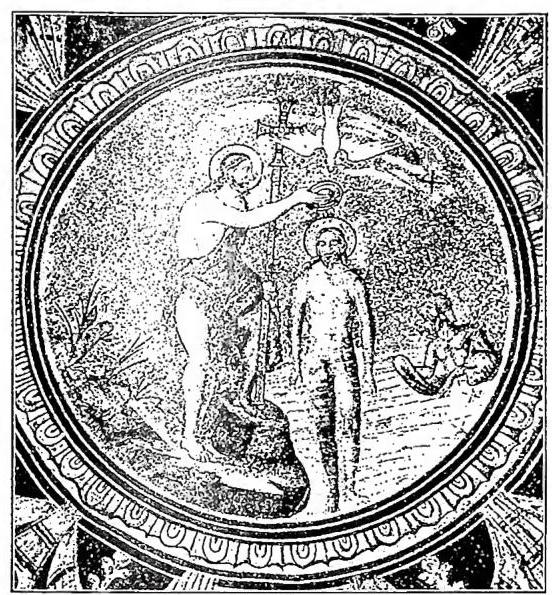
BAPTISM — Baptism of Jesus Christ. Mosaic from the vault of the baptistery of the Cathedral (mid-5th century) — Ravenna.
Some theologians have attempted to mitigate the law of Baptism in favor of children who cannot be baptized. They resorted to the desire of the parents, which could substitute for Baptism in cases of impossibility, at least occasionally; they proposed to consider the death of children as a kind of martyrdom of blood; they supposed that at the moment of death, they acquire knowledge, understand their state, and can, if they wish, make an act of perfect love and be saved. These are pious suppositions, for which there is no proof to justify them. Revelation never alludes to them. Indeed, Revelation does not seem favorable to them. If such exceptions existed, they should be known in some way by the Church, and the tone of Revelation and the Church in affirming the necessity of Baptism would be less forceful. Moreover, to claim that death is a martyrdom is contrary to the obvious meaning of the word; and to assert that God intervenes by miraculously granting knowledge to those who naturally would not have it has no foundation whatsoever.
On children dying without Baptism, see LIMBO.
It is certain, however, that the Baptism of water (Baptismus fluminis) can be supplied by the Baptism of blood (Baptismus sanguinis) and by that of desire (Baptismus flaminis).
Baptism of blood is martyrdom. Martyrdom is the suffering of a mortal violence inflicted out of hatred for God or Christian virtue and endured patiently. Martyrdom supplies Baptism when it cannot be received because Jesus Christ has promised salvation of the soul to those who lose their life for Him (Lk. 9:24; Mt. 10:39; Jn. 12:25). Repentance for sins is necessary, for without repentance no sin can be forgiven.
Baptism of desire is an act of perfect charity or love of God for His own sake above all things, and of neighbor for the love of God. This act of charity implies the desire for Baptism. Whoever truly loves God above all things wishes to do everything that God commands and desires to receive the Baptism that God requires of all. In the case of ignorance of the law or the existence of Baptism, by desiring all that God wills, one implicitly desires Baptism as well.
The act of perfect charity supplies Baptism because Jesus Christ said: “Whoever loves me will be loved by my Father, and I will love him and reveal myself to him” (Jn. 14:21 ff.). Whoever is loved by God in this way is certainly among His friends and cannot be lost. Perfect charity cannot be separated from the grace of God (cf. Council of Trent, Session VI, chap. 4 [Denz.-U., 796], and propositions 31, 32, 33 of M. Baius [Denz.-U., nn. 1031–33]).
Martyrdom and Baptism of desire do not imprint the character. By revealing that, in cases of impossibility of receiving Baptism, an adult can be saved through an act of perfect charity, God makes us understand that the salvation or damnation of every adult is always connected with his good or bad will. Grace to love God and, in case of necessity, to make an act of perfect charity, God grants to all. Whoever does not heed it and is damned must blame only himself for his ruin.
VII. B. CHRISTIAN AND B. NON-CHRISTIAN. — The doctrine expounded above is of fundamental importance in the investigation of the origin of Christian baptism.
All peoples have felt the need to “purify” themselves inwardly. To represent this “purification” by a sensible religious rite, the most obvious image, suggested even by human psychology, is that of a washing. That Christian baptism, considered in the materiality of its rite, may have analogies with ceremonies in use among the Jews or even among pagans, is therefore not strange. But the similarity, in so obvious a symbol, does not in itself prove dependence. A caution is necessary in noting external similarities: one must, that is, be vigilant so as not to project one’s own mentality onto the rites and distort them by interpreting them in a false light.
Internal purification can be conceived in various, different, even opposite ways. In inquiring whether Christian baptism can derive from similar rites of other religions, it is necessary to investigate what “type” of purification it symbolizes, and what historical information we have about its origin. Christian baptism is a sensible rite, an ablution that remits sins, brings one into communion with Christ, and confers upon the baptized the divine life of which Jesus possesses the fullness.
The sin that is presupposed and destroyed by this rite is the sin as conceived by those who admit a personal God, offended by sinful action. Whoever does not admit a personal God, who is personally offended by sin, cannot have an idea of what Christian baptism is and cannot invent II.
Baptism instituted by Jesus Christ is efficacious because God acts in it, not because the water has the power to cleanse from sins. This is explicitly excluded. Doctrines with a Gnostic or Manichaean background, which consider matter evil and distance it as much as possible from God, cannot have given rise to a baptism like the Christian one, in which God acts through a material element. And if magic is the art of dominating the occult forces of nature and life, Christian baptism, in which God is the principal agent in a rite instituted by Him, has nothing of magic (cf. E. Hocedez, Sacraments et magie, in Nouvelle Revue Théologique, 58 [1931], pp. 481-506; N. Turchi, Magia, in Enc. Ital., XXI [1934], p. 893).
In Christian baptism there occurs a true rebirth. Not in the sense that it releases the spark of divine life that lay hidden and imprisoned in man, nor in the sense of a merely moral renewal. The interior principle of divine life granted in baptism is given to one who did not have it in any way, had no right to it, and was altogether unworthy of II. It is not the release of what lies chained within man; it is the gift of what man does not possess and never would have possessed without the infinite liberality of God.
In the doctrine to which baptism belongs, it is explicitly admitted that man is by nature the image of God. Baptism is not the enhancement of this natural likeness: it elevates to an order of likeness and sonship that has no term of comparison except in the sonship of the Second Person of the Most Holy Trinity. Whoever thinks only of a spark of divine life imprisoned in man, whoever lacks the concept of the supernatural in the sense indicated, and has no idea of the mystery of the Most Holy Trinity, cannot conceive of Christian baptism nor understand II. Christian baptism refers to the death of Christ. The same sources that speak to us of baptism tell us that Jesus Christ is God. Doctrines that reject as repugnant the idea of a God who dies, and cannot conceive of a God who suffers and dies for men, have not even been able to think of Christian baptism. Which is not preached as the application and contact with a mythical event, lost in the darkness of the ages, but has a precise and very recent reference: the life of a being who disappeared from earth less than 20 years before. Many of the living knew him, and his enemies were full of strength and vigor. This very recent personage preached a new doctrine and morality: baptism presupposes and synthesizes them. It stands or falls with them. How the surrounding pagan world and Judaism regarded Christian doctrines is shown by two verses of St. Paul: “We preach Christ crucified, a stumbling block to Jews and folly to Gentiles” (1 Cor 1:23). This stumbling block and folly the Christians relive in themselves. It is not without significance that all paganism made common cause against the religion of the crucified Christ. They felt that Christianity was not “one of them.” It is likewise symptomatic that modern research is tending to admit that in the New Testament the profane vocabulary is Greek, but the religious vocabulary has nothing to do with Hellenism (cf. St. Lyonnet, Hellenisme et christianisme, in Biblica, 26 [1945], p. 116 [reviewing G. Kittel’s Theologisches Wörterbuch]). The Apostles were men of their time in all things except in religion (cf. J. Lebreton, Histoire du dogme de la Trinité, I, 7th ed., Paris 1927, pp. 540-47; V. GIACOMO, Il Battesimo; J. Coppens, in DBs, I, cols. 887-906; K. Prüm, Christentum; M.-J. Lagrange, Les Mystères: L'Orphisme, Paris 1937; A. J. Festugière, La Révélation d'Hermès Trismégiste, I, Paris 1944; all of which contain abundant bibliography).
VIII. CONCLUSION
In the years when the Apostles were preaching the theology of Baptism that we have set forth, the cult of the emperor acclaimed as κύριος was raging in the provinces of the East and spreading into the West.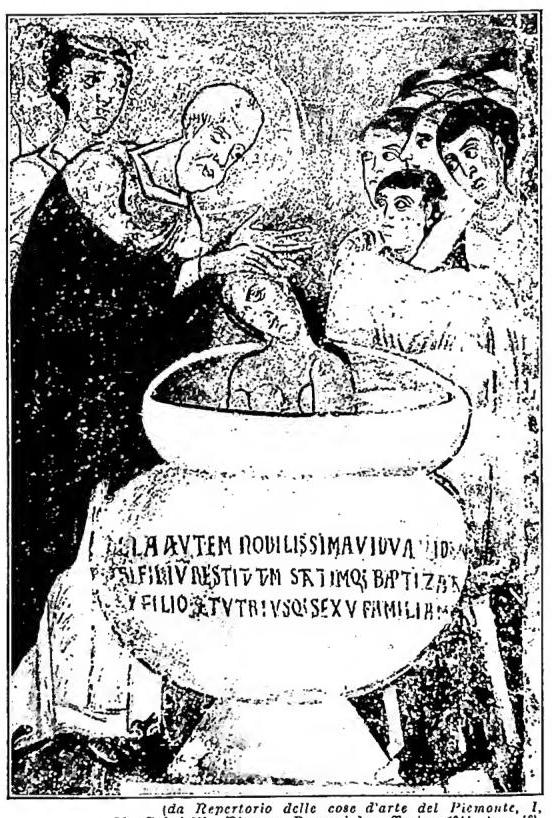
By becoming Christ’s, one renounces the devil and all that belongs to the devil and enters the sphere of his action. The liturgy summed up this renunciation in the formula: renunciation “of the pomp of the devil.” The pomp of the devil was the triumphal procession of Satan with all its trappings (cf. H. Rahner, Pompa diaboli, p. 246 ff.). The Christian renounced entering into this procession and all that adorns II. It was a renunciation fraught with struggle, for the devil, prince of this world, contends with God for dominion over private life and public manifestations of society. Baptism marked the passage from the ranks of Satan to those of God. The devil is the prince of death (Hebr. 2:14; Rom. 6:23). Jesus Christ is the prince and author of life (Act. 3:15; Hebr. 2:10). In passing to Christ, man “is born again.” A new life arises and develops, making him holy. The Christian is ἄγιος [= holy] because united to Jesus Christ. His is a life of intimacy with God and estranged from the world to a degree and in ways hitherto quite unknown (cf. A. J. Festugière, La Sainteté, Paris 1942; H. Delehaye, Sanctus, in Analecta boll., 28 [1909], pp. 145-200).
BAPTISM — St. Syrus baptizes the Veronese widow (second half of the 12th century) — Novara, Cathedral, oratory of St. Syrus.
(photo Alinari)
BAPTISM
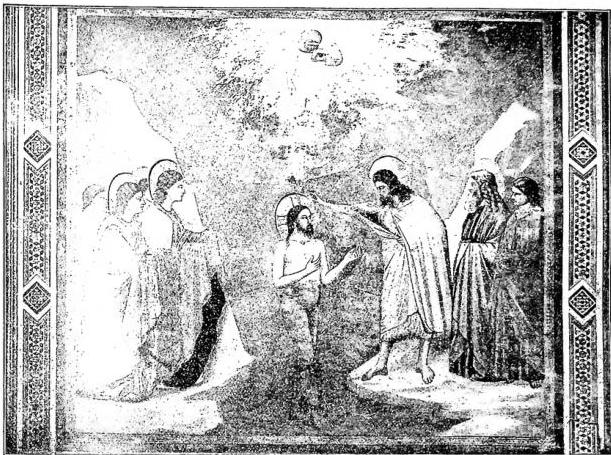
Baptism of Jesus. Fresco by Giotto (1303–1305) – Padua, Scrovegni Chapel.
The reasons that spur them to virtue and the avoidance of vice, the nobility and dignity of an untarnished life or the unworthiness of vice, are not what ultimately move them; rather, it is solely the example of the Heavenly Father and the example and teaching of Jesus Christ.
This is how things naturally stand. Whoever is no longer merely a man but is also a son of God, a brother of Jesus Christ, has his rule of conduct in his state as a son of God. Christian law, with its precepts and counsels, is precisely the expression of this higher norm. It is not a code imposed from without. It is the code that corresponds to the intimate essence of one’s own being. This code is enlivened by the consciousness of union with Christ and of the fatherhood of God who loves, assists, and aids. The Christian observes this code, gently guided by the Spirit of Christ (Rom 8:9–17).
II. DISCIPLINE REGARDING THE ADMINISTRATION OF BAPTISM
SUMMARY:
I. Matter of Baptism
II. Necessity
III. Effects
IV. Minister
V. Subject
VI. Ceremonies
VII. Name
VIII. Godparents
IX. Time and Place.I. MATTER OF BAPTISM
As has been seen, the matter of Baptism is water and water alone, whether it be from a spring, the sea, or rain, melted from snow or hail, hot or cold.If the water is mixed with some other substance, it is valid only if the compound is commonly regarded as water and is properly so called. Oil, saliva, milk, blood, grease, beer, fruit juice, and any mixture that, though containing water, is not commonly called such are not valid matter for Baptism. If Baptism must be administered in an emergency and true water cannot be obtained, even doubtful water may be used. In this case, however, if the baptized person survives, the Sacrament must be conditionally administered with true water.