
GIORDANO (Hebr. Jardēn, Arab. el-Urdunn). — The most important and perennial river of Palestine, formed by the confluence of three watercourses whose sources lie at the foot of snowy Hermon.
The most famous spring emerges from a cave, now blocked, formerly dedicated to the god Pan, whence the name of the present-day village of Banjās (329 m. above sea level), which in turn gives rise to the Nahr Banjās; the other, the most copious, is near Tell el-Qāḍī (154 m. above sea level), ancient Dan-Lais, and produces the Nahr el-Leddān; the third is at Ḥaṣbejjah (563 m. above sea level), with the river el-Ḥasbānī. The three tributaries join to form the G., which, after flowing for approximately 10 km. amid the reeds, rushes, and papyri of the marshy Ard el-Hūleh, gathers in the marshy lake of Hūleh or Semacomite. It then becomes turbulent and plunges through a narrow valley, in which, over a course of 17 km., it descends from 2 m. above sea level (the elevation of Lake Hūleh) to 208 m. below it, flowing into the Lake of Galilee. From here to the Dead Sea the straight-line distance is 109 km., but the Jordan runs so tortuously through the meanders of the valley (Gōr) that it triples the distance (320 km.), descending another 200 m. Of the numerous tributaries that feed it, the principal ones are the Jarmuk and the Jebbōs; on the left, the Nahr Galūd and the Wādī Fāsah or de tra. In the first 20 km. the Gōr, 2–3 km. wide, expands to 15–20 km. in the vicinity of Jericho. The river’s narrow valley, from 500 m. to 3 km. wide, is marked by evergreen shrubs and flooded during the months of high water; the current is 40–50 m. during the months of low water. Near the tributaries there is luxuriant tropical vegetation, and in the oases, in ancient times and
Not navigable, the G. constitutes more a barrier than a means of communication among peoples. In the Bible it is remembered above all as a frontier (Num. 34, 12; Ez. 47, 18), both of enemies who had crossed it (II Reg. 7, 15; Iud. 12, 5) and of Israelites who sought safety on the other bank (I Sam. 13, 7; II Sam. 2, 20; 17, 22).
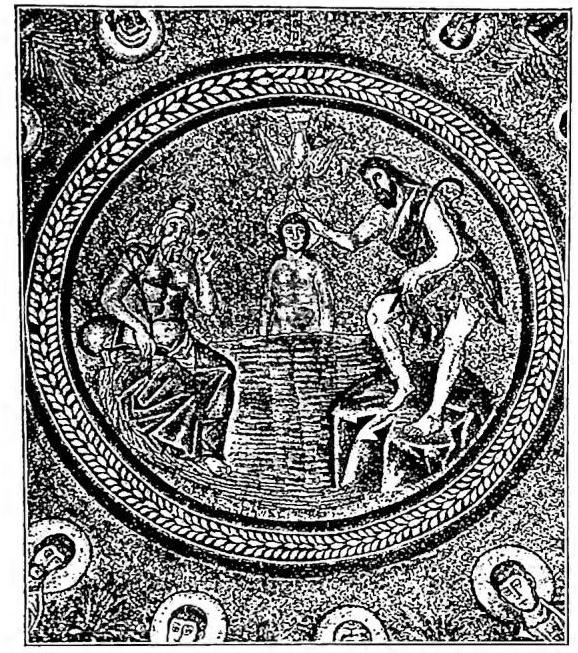
In its lower course, opposite Jericho, the G. is associated with the memory of the miraculous crossing of the Israelites (Ios. 3, 1), with the prophets Elia and Eliseo (II Reg. 2), with the ministry of St. Giovanni Battista (Io. 1, 28), and with the Baptism of Jesus. This memory caused the G. to be continually frequented and visited by the faithful, who, out of devotion, bathe in it, especially on the solemnity of the Epiphany.
seated upon a rock and furnished with the attributes of an ancient river deity. In cemetery frescoes and on sarcophagi, anthropomorphization is generally not found, but clearly defined landscape details appear. In every case the waters of the G. are visible, symbolizing the spiritual purification obtained through Baptism. With regard to the Old Testament, the personification of the G. appears in the fresco of the lunette of an arcosolium in the cemetery of Domitilla (second half of the 4th century), with the scene of Elijah’s assumption into heaven (II Reg. 2, 1 ff.; Eccl. 48, 1-13); it also appears on the Werden casket and in the «Joshua Roll», preserved in the Vatican Library, specifically in the episode of the crossing of the river by the Jewish people led by the successor of Moses (Ios. 3, 7; 4, 14, 23).