
JERICHO (Heb. Jērikō, Ar. Erikah). — Palestinian city, the first that the Israelites encountered in the land of Canaan after crossing the Jordan and, through divine intervention, conquered and destroyed (Ios. 6). It was situated, as recent excavations have demonstrated, 2 km north of the present village, on Tell es-Sultān.
Assigned by Joshua to the tribe of Benjamin (Ios. 16, 17), the oasis was repopulated under the name “city of palms” (Ios. 18, 21; Iudc. 3, 19; II Par. 28, 25). Eglon, king of Moab, made it his residence for 18 years (Iudc. 3, 13); David’s emissaries stayed there until the disgrace inflicted on them by the Ammonites had disappeared (II Sam. 10, 5). Around 800 B.C., a certain Hiel of Bethel rebuilt the walls of the ancient city, bringing upon his two sons the curse foretold by Joshua (I Reg. 16, 34). In the Israelite city there flourished a school of prophets often visited by Elijah and Elisha (II Reg. 2, 1-22). After the population was deported and the city plundered at the time of the Assyrian invasion (II Reg. 25, 5; Ier. 39, 5; 52, 8), it prospered again after the Exile, and its inhabitants contributed to the rebuilding of Jerusalem (Eid. 2, 34; Neh. 7, 35).
Because of its splendid gardens, whose balsam trees provided considerable revenue, Marco Antonio gave it as a gift to Queen Cleopatra, who sold it to Herod; he increased its magnificence by moving the city center 2 km south of the Canaanite site, in Wadi el-Qelt, with the construction of villas, a hippodrome, an amphitheater, and pools (Fl. Giuseppe, Bell. Iud., XIII, 6-8).
During the paschal feasts, G. was the gathering place of the Jews who traveled from Galilee and Perea to Jerusalem for the festivals. Jesus, too, passed through it several times; on his final journey he healed the two blind men there and accepted Zacchaeus’s invitation (Mt. 20, 29; Lc. 19, 1-5).
In 70 A.D. the city was plundered and destroyed. An episcopal see in 325, in the Byzantine period it was populated by laurae, whose monks lived under the direction of s. Euthymius and s. Sabas, and it extended southeast of Elisha’s spring. The Madaba map depicts it enclosed amid palm trees. After the earthquake of 571, Justinian had the churches of the Theotokos and S. Elisha, as well as the large hospice for pilgrims, repaired (Procopius, De aedif., V, 9).
With the advent of the Muslims, it continually declined, and in the 12th century it was a heap of ruins. The Crusaders rebuilt the city to the east of the two earlier ones, on the site of the present village, which has resumed developing and flourishing over the last twenty years.
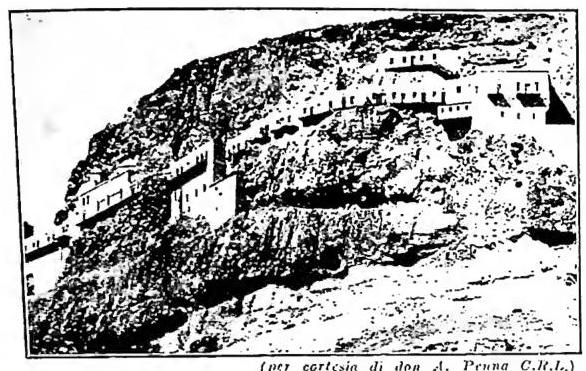
(courtesy of don A. Prune C.R.L.)
GERICO – Greek monastery halfway up the Mount of Temptation near G.
prehistoric origins (Mesolithic and Eneolithic periods). The chronology of the walls has thus been classified. The city founded in 3000 was confined by a massive wall (A) in the northern part of the Tell; from 2100 to 1900 it occupied the crest of the hill, covering approximately 2 hectares and enclosed by a wall (B) of bricks with stone foundations; from 1900 to 1600 it expanded from 2 to 5 hectares, with a powerful wall (C) reinforced by a glacis, at the foot of the hill and also enclosing the spring. This was the city’s most prosperous period, characterized by a Hyksos palace, Egyptian and Hyksos scarabs, and bronze weapons and tools. For unknown reasons, after the walls had been dismantled, the city withdrew once again to the crest, protected by a wall (D) built around 1500 and parallel to wall B but constructed using a different technique. It was destroyed by a cataclysm around 1400, according to Garstang, director of the excavations, or around 1250, according to p. Vincent. It then appears to have been repopulated in the 9th–10th century (I Reg. 16, 34) and also during the Hellenistic period.
Approximately 250 m. from the Tell, approximately 2,800 pottery specimens from all the periods corresponding to the city’s history have been collected in the metropolis.
At G. in 1910, a mosaic pavement was discovered containing the inscription of a priest and hegumen named Ciriaco, founder of the oratory of the martyr St. George and benefactor of the New Church of the Mother of God in Jerusalem, which had been dedicated by Justinian in