
ARTE CRISTIANA ANTICA. — We still know almost nothing about the origins of Christian art, understood in the twofold chronological and spatial sense of the word. It can only be presumed that its very earliest creations saw the light during the first half of the second century and, here and there, in the principal communities scattered throughout the Roman Empire. There do not seem to have been any serious obstacles, either on the part of Judaism or on that of ecclesiastical authority. The Mosaic prescriptions are to be understood in an anti-idolatrous sense, and opposition to figurative art within the Jewish communities was confined to the rigorist tendency. Their monuments (the synagogue of Dura Europa, the catacombs of Rome) demonstrate that the Jews of the Diaspora were not hostile to art. The opposition within the Christian community itself is likewise easily exaggerated, since here too it was inspired by limited rigorist tendencies or by local circumstances.
A unique example of balance, the religion of Christ, in the reflection of the mysteries of the Incarnation and the Resurrection, did not fear to make its own the taste for figured decoration so widespread in the Hellenistic world, and to employ such decoration, purifying it, as an expression and vehicle of the highest concepts. In any case, figured representations are not lacking in the most ancient monuments that have come down to us. They date from the final decades of the second century and the beginning of the third (the oldest centres of the catacombs of Priscilla, Domitilla, Callistus and Pretextatus; the Christian chapel of Dura Europa). The first sculptures on sarcophagi follow shortly thereafter.
From its very beginnings, ancient Christian art reveals its fundamentally symbolic nature, and not only, as was long believed, in the decoration of tombs, but also in that of places and furnishings of worship. It regards art as a language, as an ideographic expression, whose vocabulary and syntax are always those commonly diffused, but which it employs to formulate new phrases, at times combined into a logical and systematic discourse, at times juxtaposed like those of the ancient litanies, and often intelligible only to the initiated.
Apart from certain representations borrowed directly from profane art (Orpheus, Cupid and Psyche, etc.), and leaving aside the symbolic signs, decorative motifs, and recollections of earthly life, the repertory of this art consists of symbolic figures and historical, allegorical, and representative scenes, all oriented toward evoking and illustrating Christ the Saviour and the work of salvation prepared in the Old Testament, accomplished during Christ’s earthly life, continued after his death by the Church, and crowned in the life of blessedness. At some times more, at others less, according to the period, it
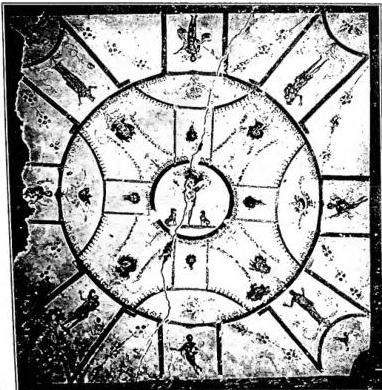
(from Wilpert, Pitture)
ANCIENT CHRISTIAN ART — Daniel, Good Shepherds, orants, the four seasons, genii, birds, and decorative motifs (second half of the 2nd century) — Rome, Cemetery of Callistus, region known as that of Lucina.
are placed in the foreground, with greater or lesser emphasis according to the period: concepts relating to death and resurrection, both spiritual and bodily; God’s intervention on behalf of the faithful of all ages; the means of salvation, among which faith, Christian initiation, and the food and drink of immortality hold pride of place; the intervention of the holy intercessors, among whom the Princes of the Apostles are the first to occupy the place of honor, followed soon by the other martyrs; and the triumphant glorification of Christ.
From the primitive Good Shepherd to the majestic figure of Christ, which in the course of time would become almost exclusive, one can discern a line of continuity passing through representations of Christ as philosopher and wonder-worker. The Orant, originally an abstract figure, intended rather to give concrete form to the state of the blessed soul, came to represent the deceased person himself, conceived in this state, and ultimately was replaced by figures of the deceased welcomed into Paradise.
Among the scenes from the Old Testament, the earliest are those in which deliverance from the danger of death through divine intervention is most clearly manifested (Noah in the ark, the sacrifice of Isaac, Daniel among the lions, the three youths in the furnace, the story of Susanna and that of Jonah, etc.); but the selection soon broadened to include scenes in which this concept, although always present, was no longer expressed with the same immediacy. Iconographic themes such as the creation of man, the fall of the first parents, and the intervention of the Lógos on their behalf are directly related to the problem of life and death already mentioned, whereas the various prophecies of the prophets are to be related to the mystery of the Incarnation.
The scenes from the New Testament are divided into various groups according to the fundamental concepts to which they refer. Besides the Christological scenes (the Annunciation, the Nativity, the Adoration of the Magi, and, later, the scenes of the Passion, etc.) and the series of miracles (healings), which have the same function as the paradigms of the Old Testament, one should note the scenes of Baptism, the resurrections, the multiplication of the loaves, and the miracle at Cana, together with their derivatives; the so-called denial of s. Peter; the conversation with the Samaritan woman, etc.
Among the allegorical scenes, the banquets should be mentioned first. One group contains evident allusions to the Eucharist, whereas a second group alludes to the refrigerium in the other life.
Even before the peace of the Church, the first reflections of monumental art entered the sphere of cemetery art, with the earliest representations of Christ the teacher among the Apostles; but this iconography spread fully only in the second half of the 4th century, especially on the fronts of sarcophagi, in compositions such as the Traditio Legis, the council in the City or in the heavenly Basilica, the acclamation or presentation of crowns, etc., while the cult of the martyrs led to their representation as intercessors for the deceased. It was in this same second half of the 4th century
and in the 5th that art also created allegorical representations in form, employing above all lambs and doves to represent Christ, the Apostles, and the faithful.
To study the repertoire of cemetery art properly, one must distinguish between paintings and sculptures, because not only did the two fields follow traditions that were more or less independent, so that the catalogue of subjects is also richer in sculpture, but the areas to be decorated and the very nature of the materials and tools employed imposed their own laws, which affected both the formal execution of the works of art and their iconographic conception and relative distribution within more extensive complexes. It does not appear, however, that the Christian religion immediately produced visible effects on style as well; the first Christian painters and sculptors employed the technique and style of their time, and it was only with the passage of time and the slow death of pagan art that one could speak of a Christian “style.” Certain innovations that appeared fairly early, such as, for example, eyes raised toward heaven, belong to questions of content rather than style.
After the peace of the Church, Christian art developed freely also in monumental compositions serving the liturgy and the education of the faithful directly. The technique of mosaic assured it a splendor lasting for centuries. Although fully conscious of its new task, it nevertheless did not renounce its fundamental primitive character and remained essentially symbolic. In the baptisteries and martyria as well as in the basilicas, its cycles of biblical scenes, apparently merely narrative, increasingly reveal that the selection and arrangement of their scenes obey symbolic or typological laws. They thus form a natural transition between the primitive symbolism of the catacombs and the true concor-
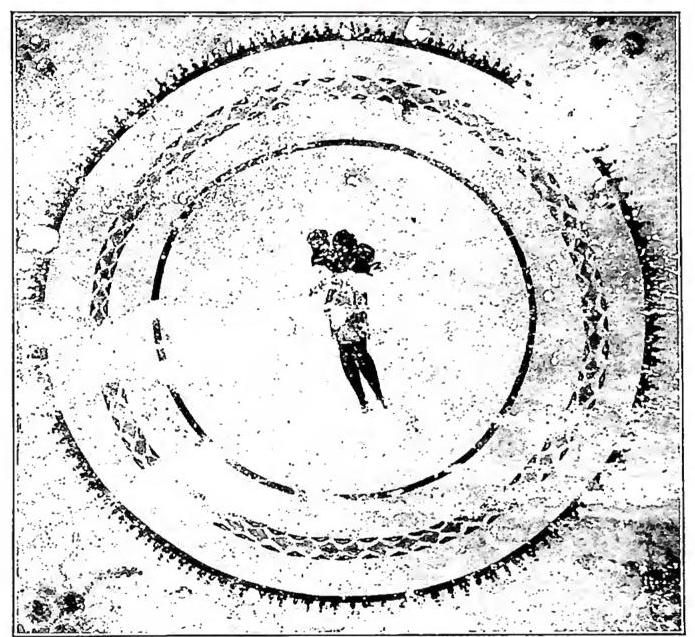
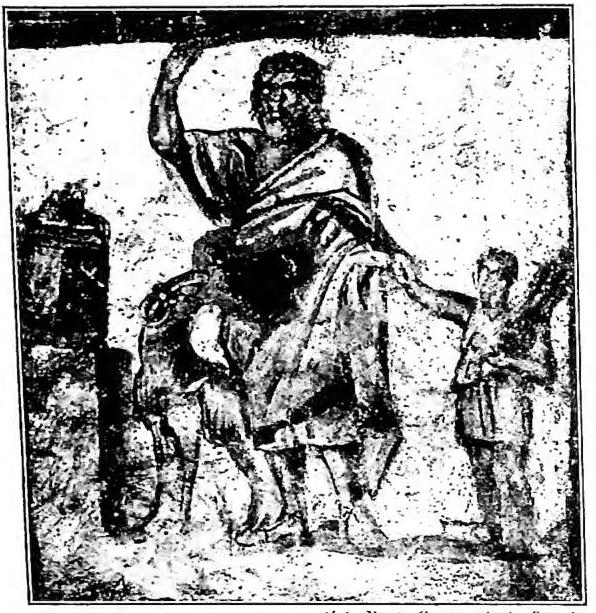
Middle Ages would come to know them.
The baptisteries, reserved for Christian initiation, likewise follow an iconography partially independent of that of the basilicas and focus above all on starry heavens in which the monogram of Christ appears, on the figure of the Good Shepherd, and on the Traditio Legis. The other scenes allude to the water of life, the resurrection, victory over death, and the Eucharist. The figures of the apostles and the symbols of the evangelists, alternating with motifs and compositions of an allegorical character, make possible highly varied ensembles. Examples: Dura Europos; S. Costanza; S. Giovanni in Fonte in Naples; the Lateran baptistery; that of Ravenna, etc.
In the basilicas, on the other hand, the various parts of the building must be distinguished. While the apse and the triumphal arch receive compositions oriented toward the glorification of the Lord and of the entire mystical body, on the side walls of the nave one or another part of the history of the chosen people unfolds, and on the inner entrance wall there appears, at least as far as we know from a couple of examples, the historical memory of the foundation of the church. The ancient examples still preserved are too few to allow the rules followed to be generalized. In the apses, the majestic figure of the Lord is surrounded by the Apostolic College and by the Princes of the Apostles, the patron saints and the founders of the church, all included within the ideal setting of the heavenly Jerusalem or Paradise. At the base of the composition, an allegorical frieze evokes the glorification of the divine Lamb. The triumphal arch, with the symbols of the Evangelists surrounding the throne or bust of Christ, with the seven candelabra, the twenty-four elders, and the two allegorical cities, is commonly inspired by the vision of the Apocalypse. A wholly particular place is occupied by the arch of S. Maria Maggiore, in memory of the proclamations of the Council of Ephesus. The historical cycles on the walls usually set a series of events from the Old Testament against one from the New. In the two
basilicas of S. Pietro and S. Paolo, they were accompanied by medallions containing portraits of the Supreme Pontiffs. And as art evolved, representations first of the martyrs and then of the other saints of both sexes would become increasingly numerous in various parts of the sacred building.
The mosaics and frescoes depicting sacred figures or narrative scenes found their logical complement in stucco decorations in the upper parts of the building and in marble incrustations in the lower ones. Unfortunately, few witnesses have come down to us. In both baptisteries and basilicas, the floor mosaics contributed to the overall decoration, and not only through geometric or purely ornamental compositions, but also through symbolic representations. Architectural sculptures, also polychromed, in friezes, capitals, and furnishings, completed the ensemble.
In the realm of the minor arts, a. c. a. pursued its activity as elsewhere, making use of the most diverse materials. Ceramic objects, engraved or gilded glass, ivories, utensils in precious metals, gems, and textiles constitute equally numerous fields in which the religion of Christ left its traces. Especially precious are the illuminated manuscripts, among which the principal examples that may be cited are the Vienna Bible, the Joshua Roll, and the Rossano Purple Codex. Finally, the carved wooden doors deserve mention, whose principal representatives are those of S. Sabina in Rome and S. Ambrogio in Milan. - Vedi Tavv. V-VII.
For the origin of the iconographic types and related questions: V. ICONOGRAFIA CRISTIANA.