
MUSAICO. – In Latin opus musivum (opere museo, in CIL, VIII, 1323), in Greek μοῦσα, μουσάκιον, μουσόμα, and at a later period metallica. It is a form of painting executed with small cubic tesserae or cubes (abaculi) of stone, glass paste, marble, or terracotta by craftsmen whom the Theodosian Code distinguishes as tessellarii and musivarii (CIL, IV, 4502 and 7044). At times the artist is called musearius (CIL, III, 1934 ff.). In the inscription of Felice IV (526–30) in S. Stefano Rotondo, one read musivo (G. B. De Rossi, Inscr. christ. Urbis Romae, II, 1, Roma 1888, p. 152, n. 32).
Later one finds the expression metalla, as in SS. Cosma e Damiano under Felice IV (526–30): aula Dei claris radiat speciosa metallis, or under Onorio I (625–38) in S. Agnese: virginis aula micat variis decorata metallis; or also metallum, as in the oratory of S. Venanzio from the time of Giovanni IV (640–42). By the expression metalla, sometimes, as in the aforementioned inscription of Felice IV at SS. Cosma e Damiano, one understands not only the gold and enamels of the gleaming mosaic, but also works in opus sectile marmoreum, or tessellatum, that is, marble panels with strips, carvings, and friezes of porphyry, serpentine, and so forth, of which notable examples survive in the chapel of SS. Rufina e Seconda in the Lateran Baptistery and in S. Sabina (G. B. De Rossi, I m. cristiani, Roma 1899, tavv. II, III, XI, XII, XV, XVIII, XXXIX).
The themes found in the apses of the Roman basilicas are as follows: in that of the ancient Vatican Basilica, Jesus Christ teaching among the princes of the Apostles; in S. Pudentiana, Christ in majesty among the Apostolic College, the heavenly city, the four creatures of the Apocalypse, the Church “ex circumcisione” and that “ex gentibus” (Wilpert, Mosaiken, pls. 42–44). At SS. Cosma e Damiano, the Lord, standing rather than seated, receives the martyrs presented by the princes of the Apostles, and Pope Felice IV (526–30), the founder, also appears; alternatively, the martyrs approach the Redeemer seated upon the globe, as in the Pelagian mosaic of S. Lorenzo and in S. Teodoro, or among the angels, as in the oratory of S. Venanzio (G. B. De Rossi, I m. cristiani, Roma 1899, pls. 15, 16, 17, 19). At S. Agnese, the martyr occupies the place of Jesus Christ, between the two Pontiffs who glorified her tomb, Simmaco and Onorio I (id., ibid., pl. 18). On the basis of the description by s. Paolino of Nola, F. Wickhoff attempted a reconstruction of the apse mosaic (Das Apismosaik in der Basilika des hl. Felix zu Nola, in Röm. Quartalschr., 3 [1889], p. 169 ff.). On the triumphal arch there is the throne with the cross, the crown, and the purple, that is, the insignia Christi, between Peter and Paul (Wilpert, op. cit., pls. 70–72), as in S. Maria Maggiore; or the bust of Jesus Christ, between the four creatures or the twenty-four elders of the Apocalypse, as at S. Paolo (G. B. De Rossi, I m. cristiani, pl. 13). Later, as at SS. Cosma e Damiano, the exaltation of the divine Lamb replaces the bust. At S. Paolo the ceiling beams were covered with gold mosaic; Prudentius attests that inside, all the light was golden as at sunrise and the arches were entirely covered with magnificent, multicoloured glass mosaics, like flowers in spring enamel the meadows (Peristephanon, XII, 50–54). It is also enough to recall, besides the mosaic cycles of the basilicas of Milan (v.), Parenzo (v.), Ravenna (v.), Constantinople (v.), those in S. Matrona
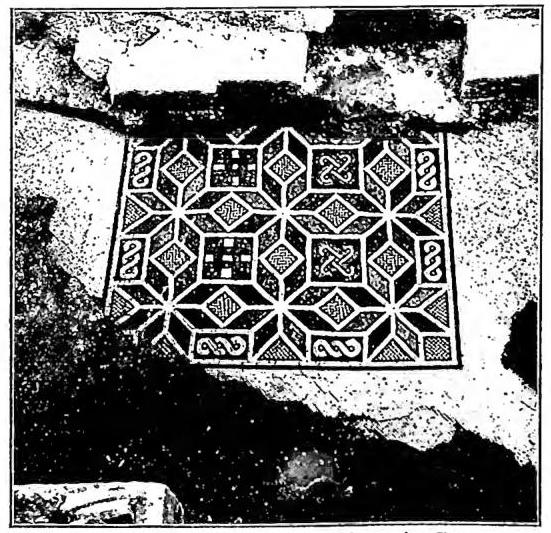
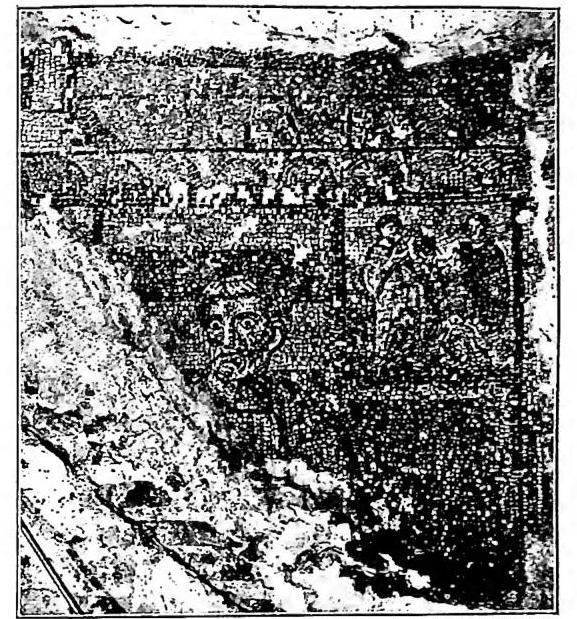
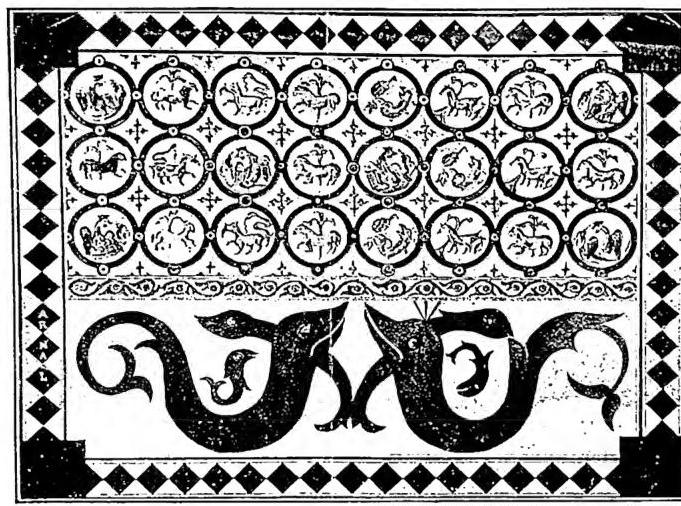
In the underground Christian cemeteries, mosaic decoration was little used; examples are found in Rome in the cemeteries of Bassilla, Callistus, Praetextatus, and Priscilla, and in that « inter duas lauros »; in Naples, in S. Gaudioso, in cubicula and arcosolia; sometimes on tiles, as with the scenes of Jonah found in a cemetery on the Via Latina, now in the Lateran Christian Museum, or in inscriptions, as in the cemetery of Pamphilus (v. MARTIRIO E MARTIRE, col. 243). Portraits of the dead were also executed in mosaic, such as those of Fl. Iulius Iulianus and Maria Simplicia Rustica, found in the cemetery of S. Lorenzo in 1656, now in the Lateran Christian Museum. Mosaic covering was widely used on freestanding tombs in North Africa and at Tarragona in Spain; one example is found near Teano (v. CALVI E TEANO), now in the Museo di S. Martino in Naples. Mosaic decoration was also employed for Christian mausoleums, such as the small Christian cell of the 3rd century in the Vatican necropolis, the mausoleums of S. Costanza and S. Elena, and that of Cencelles near Tarragona. It was then extensively used for the floors of cemetery buildings, as in the basilica of S. Felice near Nola erected by s. Paolino, and in the cemetery basilicas of Africa, Salona, Sabaria, etc. Floor mosaic (Σαββατοσπον) is called opus tessellatum at Aquileia, Brescia, Setif, Trieste, and Verona; the expression tessellavit is used. Often this polychrome covering, like a dazzling carpet, was offered by the faithful as a votive gift, as attested by the inscriptions of Aquileia, Brescia, Grado, Pola, Verona, and Vicenza in Italy, and Setif in North Africa. Floor mosaics have been dis-
covered in great numbers, besides the places mentioned above, in Bethlehem, in the Constantinian octagon and in the Grotto of the Nativity (5th century), Palestine (v.), Madaba (v.); at Ravenna in S. Vitale, at Parenzo, Orsera, Zuglio Carnico, and in S. Apollinare in Classe; throughout proconsular Africa, in Byzacena, Numidia, Mauretania, Tripolitania, Cyrenaica, and Syria. Enrico Josi
Christian mosaics from the 7th to the 13th century.
- With the introduction and predominance of Eastern forms, the classical current loses its last positions, and mosaic begins to assume new aspects. In S. Agnese and in the oratory of S. Venanzio at the Lateran, executed in the time of Giovanni IV (640-42) with the depiction of the Dalmatian martyrs, one finds the persistence of a local tradition identifiable in the characterization of the faces, as in the mosaics of the apselet of S. Stefano Rotondo and in S. Sebastiano of S. Pietro in Vincoli, a work of the mid-7th century. At the beginning of the 8th century, chiefly through the merit of the Greek Giovanni VII (705-707), a particular artistic revival is perceptible in Rome, as in the New Testament mosaic cycle of the oratory dedicated to the Virgin by that same pope, formerly in the ancient Vatican Basilica, now dispersed in various places: in S. Marco in Florence; in the cathedral of Orte and in Rome in the Vatican Grottoes and in S. Maria in Cosmedin. The new technique is characterized by an accentuation of the contours and the use of luminous harmonies marked by brown lines, which detach the figures from the gold background. This technique anticipates that characteristic of the Roman mosaics of the 9th century, whose first complete manifestation appears on the triumphal arch of the church of SS. Nereo ed Achilleo. The mosaic of Leone III, with the scenes of the Administration, the Transfiguration, and the Virgin with the Child, asserts a new manner in which white predominates over blue and shadowed areas furrow the faces, though still in a greatly attenuated form. More harmonious compositions are offered by the triumphal arch and apse of S. Maria in Domnica, the work of Pasquale I (817-824). The procession of the elders toward Christ enthroned within the luminous mandorla and the gleaming host of angels, who bow slightly before the Theophora, accentuate the contrast of light areas with the dark tones of Christ and the Virgin. In S. Prassede and S. Cecilia in Trastevere, the mosaicist kept in mind the representations in the apse of SS. Cosma e Damiano, but without that plastic vigor and that marvelous interplay of light. More intimate and harmonious is the chapel that the Pontiff erected in the same church for
(phot. Alinari)
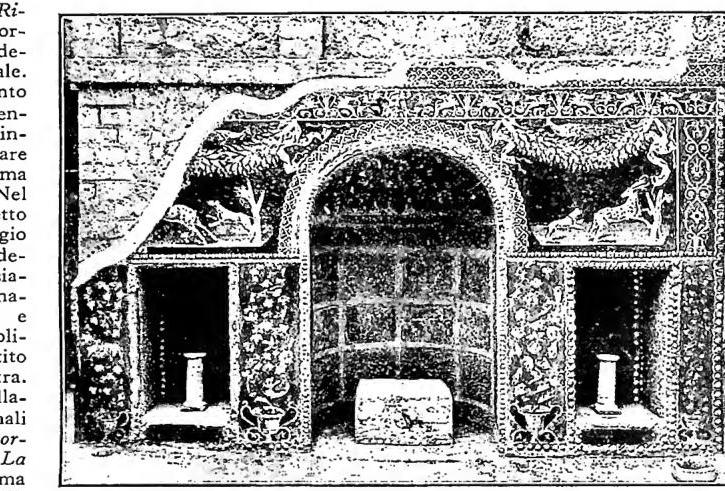
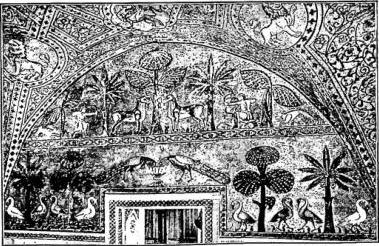
MUSAICO — Hunting scenes. Mosaic decoration of the Chamber of Ruggero (12th century) — Palermo, Royal Palace.
In the East, the second golden age of Byzantine art began in the 9th century: that of the great mosaics of S. Sofia in Thessalonica and of S. Sofia in Constantinople. Even if the forms were initially contaminated, as in S. Sofia in Thessalonica, by distortions deriving from Syrian art, already in the church of Hosios Lukas in Phocis (late 10th century) all the characteristics of the mosaics of S. Sofia in Kiev, of the Catholic at Dafni, dedicated to the Koimesis of the Virgin like the church of the same name at Nicaea, and of the Nea Mone on Chios are announced.
In the 10th and 11th centuries, new characteristics took shape, synthesizing Byzantine monumental solemnity and the tormented vision of the barbarian world. Thus in Sicily, Venice, Parenzo, and Torcello, where the two currents, Eastern and Roman, persisted with their own elements mingled with the new ones, until they merged in that marvelous crucible of forms represented by the Venetian decoration of S. Marco.
In Rome, the traditional current was reaffirmed in the apse mosaic of S. Clemente at the beginning of the 12th century, where, alongside the classical scrollwork, appear the scene of Calvary, the Eternal One, the Apostles, the saints, the Prophets, the Eucharistic Christ and the triumphant Christ, the little sheep, the holy cities, and the symbols of the Evangelists.
The apse mosaics of S. Maria in Trastevere and S. Francesca Romana, almost contemporary yet different in the artists who executed them, display the persistence of the same manner. But the dryness and hardness of the forms in S. Francesca Romana find no counterpart in the supple drapery of the figures in the Trastevere basilica. Meanwhile, in Sicily, with the support of the Norman kings, within the brief span of sixty years an immense profusion of tesserae adorned S. Maria dell’Ammiragliato (or della Martorana) PERGAMO (v.), Cefalù (v.), all datable between 1140 and 1160, CORALE (v.), from the end of the 13th century. The mosaics of S. Marco in Venice are assigned dates ranging from the 11th to the 13th century, although all agree that they are the work of different masters: some Byzantine in manner but with pronounced regional characteristics, others wholly obedient to the Oriental courtly style. To the first manner perhaps belong the Stories of Genesis narrated in the narthex and certain mosaics in the interior (the scenes from the Life of the Virgin, the Symbolic Virtues in the dome of the Ascension, and the Scenes of the Passion on the nearby great arch), which recall the magnificent Last Judgment in the cathedral of Torcello and, to a lesser degree, the Madonna in Glory with Two Angels in the apse of S. Giusto at Trieste. To the pure forms, on the other hand, belong the dome of Pentecost (somewhat less so the other lateral dome), the fine group in the inner lunette of the main portal, the scenes on the great arch toward the right arm, etc. More severe and less mannered are the Virgin in the apse of S. Maria e Donato at Murano and the Christ in Glory at Torcello, in the apse of the chapel of the Sacrament. In the 13th century, the contamination of Byzantine forms by the new Romanesque tendencies became increasingly frequent. Nor would the new wave of Byzantinism, brought to Rome by the Venetian mosaicists of Honorius III (1218), have serious consequences in this evolutionary process. This can be seen in the mosaic medallion by Jacopo and Cosma in the portico of Civita Castellana, in the Virgin on the altar of the chapel of S. Zenone in S. Prassede, in the beautiful Madonna della Clemenza in S. Maria in Trastevere (mid-13th century), and finally in the apse mosaic of the Liberian Basilica (1295), where Jacopo Turriti, in the guise of the most classical Byzantinism, heralds the new conception of Cavallini. Turriti’s mosaic, commissioned by Niccolò IV, is this master’s most complete work. In the apse basin, Christ and the Virgin are enthroned within a starry globe; around them are ranks of angels, saints,
acanthus scrollwork, and, above, a polychrome fan; on the lower surface are the Annunciation, the Nativity, the Purification, the Adoration of the Magi, and the Transit of the Virgin. In every scene and every zone he used two qualities of tesserae: splendid ones for the foliage and the garments of the figures; muted, non-reflective ones for the faces. The result is a chromatic plasticity of powerful effect. Inferior to Turriti is Filippo Rusuti, who in the mosaics on the façade of S. Maria Maggiore narrates the Stories of the Foundation of the Basilica and composes a Christ Enthroned among a Procession of Saints. His manner is nevertheless close to that of Cavallini, whose disciple he was, and in certain shadows on the faces one can already sense that the Romanesque consciousness had matured in him. Cavallini (v.) is responsible for mosaics executed by him in the lower zone of the apse of S. Maria in Trastevere: in chronological terms, these are also the last great Roman and Italian mosaic composition.
During the 14th century the art of mosaic was practiced less and less according to ancient themes (Naples, S. Restituta, mosaics by Lello da Velletri) or was used as a decorative element in architectural schemes (Andrea Orcagna, mosaics later for the most part remade, on the façade of the cathedral of Orvieto). The same occurred in the 15th century, when Mantegna and Gianbellino supplied cartoons for mosaics intended to complete the cycles of the basilica of S. Marco in Venice. For this building, during the 16th century, other mosaicists, by then mere craftsmen, copied in mosaic painted works by Tintoretto and Veronese, produced with entirely different aims from those proper to the art of mosaic. Even in the 18th century Leopoldo del Pozzo, a Roman, copied in mosaic a painting by Sebastiano Ricci depicting the arrival of the body of S. Marco, while in the 19th century Liborio Salandri copied Lattanzio Querena’s Last Judgment, which is visible at the center of the façade. Meanwhile, in Rome, in 1516 Raphael had one of his compositions translated into mosaic for the lantern of the dome of the Chigi Chapel in S. Maria del Popolo, and subsequently Baldassarre Peruzzi had his compositions translated for the vault of the chapel of S. Elena in the church of S. Croce in Gerusalemme. But these, like the later works, represent nothing more than an accurate yet mechanical reproduction, in a technique different from that in which those works of art had originated. The same can be said, in most cases, of the works produced during the 19th and 20th centuries by the school of the Vatican mosaic (the funerary chapel of Pius IX in S. Lorenzo fuori le mura, etc.). In recent times, however, certain artists have sought to restore mosaic to its original function as a decorative element whose character is clearly distinct from that of fresco painting. Such were Guido Cadorin in the mosaics of S. Giusto at Trieste and Ferruccio Ferrari in a mosaic on the façade of a house in Tivoli. — Vedi tavv. CII–CIV.