
CASARANELLO. – A locality in Apulia, in the Salento peninsula, birthplace of Pope Boniface IX (Pietro Tomacelli: 1389–1404); it later declined and was finally destroyed, being replaced by nearby Casarano.
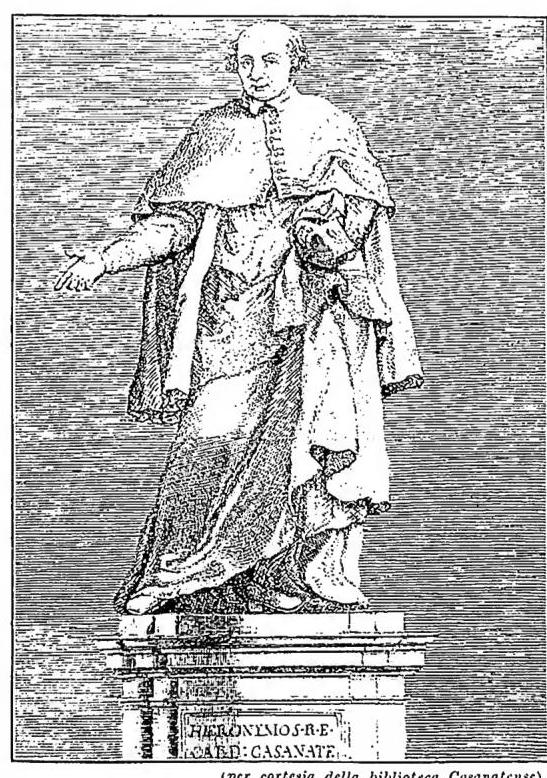
(courtesy of the Casanatense Library)
CASANATE, GIROLAMO – Statue of Cardinal C. Sculpture by P. Le Gros (early 18th century), from a contemporary copper engraving – Rome, Casanatense Library.
It is starry, in two shades of blue, at whose summit a Latin cross in yellow stone tesserae stands out; acanthus-leaf scrolls unfold on the pendentives; the arches are delimited by a festoon of leaves between two jewelled bands; only one of the barrel vaults of the arms of the cross is still decorated up to the springing line with two lateral zones, delimited by a braid and a sinuous, intertwined serpent-like motif that curves inward so as to frame round or trapezoidal fields containing animals or fruits and flowers; between these two compositions is a broad band of pine-cone scales in various colours, and the whole is enclosed by five borders of gems, braid, foreshortened beams, and running-dog motifs. At the end of this same arm, which may be called apsidal, also because the foot of the cross in the dome faces toward it, there remain fragments of a mosaic representation, including part of a celestial halo edged in red, on a blue ground flecked with dark tesserae, most probably belonging to an image of the Virgin with the Child on her lap, an echo of which perhaps survives in her effigy, placed on one of the pillars and datable to the 12th century. These mosaics, the only surviving ones in all Puglia, are not without similarities to those of Ravenna and other Italian monuments, as well as to related works from Syria and Africa—an understandable circumstance in a region that, while unable to remain entirely extraneous to the artistic movements of the peninsula, was at the same time clearly subject to the influences of the schools of the East and of the opposite shore of the Mediterranean. Like the chapel, they are to be dated to the 5th century.