
Cipro. — In terms of area (9,283 sq. km), it is the third-largest island in the Mediterranean.
SUMMARY:
I. Geography
II. History
III. Ecclesiastical History
IV. Archaeology.I. GEOGRAPHY
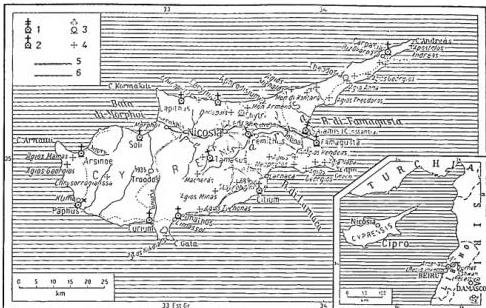
Physically a fragment of nearby Anatolia (75 km. away), it consists of an undulating plain (Messaria) enclosed between two mountain ranges: one to the N., continuing into the Karpaso peninsula (M. Akromandra, 1029 m.), and one to the S., higher (Troodos, 1953 m.) and more extensive. It has a mild climate, but with long, hot summers and scant precipitation. Agricultural (cereals, vines, olives) and industrial (owing to deposits of iron, asbestos, copper, etc.) possibilities are not lacking, but the economy has been stagnant for centuries. Of the island’s 450,000 inhabitants, slightly fewer than three-fourths are Greeks; the remainder are Muslim Turks.The island was occupied by Gran Bretagna in 1878 and detached from Turkish dependence in 1914. Since 1 May 1925 it has been a colony of the English Crown, with a Governor appointed by the king. It is divided into 6 districts; the seat of government is at Nicosia (35,000 inhabitants). Other notable population centres are Limassol (23,000 inhabitants), Larnaca (15,000), and Famagosta (2,000), although they are in serious decline.
II. HISTORY
In ancient times, the fertility and wealth of the soil are attested by classical writers (Strabo, XVI, 6, 5; Ammianus Marc., XIV, 8, 14). The origin of the Greek name Κύπρος is obscure; from it was derived the name of copper (cuprum), extracted from the island’s abundant mines since the most remote times. The utilization of this metal must have brought prosperity and importance to the country. Some Babylonian cylinders testify to its commercial relations with Mesopotamia from as early as the middle of the second millennium.It appears under the name Alashiya in the inscriptions of Tuthmosis III (1470) and in the tablets of el-‘Amāmah (letter from the Cypriot king to Amenophis IV in 1385). Later, Greek colonies penetrated the island, founding Salamis and Paphos. During the Iron Age (1700–600), further Greek and Phoenician peoples immigrated there. The Greeks gave the island the name Κύπρος, which already appears in Homer, while the Phoenicians called it Kittim (= Citium), the name adopted by the Bible (Gen. 10, 4; Num. 24, 24 [and Dan. 11, 30]; Is. 23, 1. 12; Jer. 2, 10; Ezek. 27, 6).
In the Assyrian annals of Sargon, to whom the island was vassal, as is shown by a commemorative stele erected by Citium with an image and inscription, it is called Iatnan. After the fall of the Assyrian empire (626), it briefly returned under Egyptian influence, and in 526 it was incorporated into the Persian empire, forming, together with Phoenicia, Syria, and Palestine, the fifth satrapy. In 497 it joined the anti-Persian insurrection; but the true champion of Hellenism against the Phoenician element was Evagoras, in the struggles waged from 394 to 374. The complete Hellenization of the country took place after the victory of Alexander the Great. Contested by his successors, C. ultimately remained united with the Ptolemies of Egypt. In 108–88 the Jews began to settle on the island (I Mach. 15, 23; cf. II Mach. 4, 29; 10, 13; 12, 2), and their numbers increased when, in 58 B.C., the island was annexed by the Romans to Cilicia. Augustus constituted it an imperial province, governed by a propraetor (Strabo, XIV, 6, 6; XVII, 3, 25); but, having become a senatorial province in 22 B.C., it was governed by a proconsul, also of praetorian rank (Cassius Dio, 54, 4).
After Herod had leased the copper mines from Augustus (Flavius Josephus, Antiq. Iud., XVI, 129), Jews settled in all the cities of the island. To escape the persecution raging in Jerusalem after the martyrdom of St. Stephen, many Christians dispersed throughout C. (Acts 11, 19–20). Barnabas, a Hellenistic Jew and companion of Paul, was a native of C., from a family of the tribe of Levi (Acts 4, 36). On the first missionary journey, Paul, with Barnabas and Mark, evangelized the island, traversing it in its entirety from Salamis to Paphos, where the proconsul Sergius Paulus resided—at that time C. was a senatorial province—and in whose presence St. Paul disputed with the false prophet Bar-Jesus (Acts 13, 4–12). After the Apostolic Council, at the beginning of the second missionary journey, Barnabas separated from Paul and returned to the island (Acts 15, 39). St. Paul sailed across the sea of C. on his journey from Caesarea to Rome (Acts 27, 4).
After these first pieces of information, history ceases and one is confronted with legend, which, although it may have a substratum of truth, offers no certainty: it centers chiefly on Barnabas, and also on John Mark and Heraclides, the first Cypriot bishop ordained by Paul or by Barnabas. The first historical information is found again with the persecution of Diocletian (Palestinian Christians exiled in C. [Eusebius, De martyr. Palaest.: PG 20, 1513]) and with the Council of Nicaea (325), to which three Cypriot bishops subscribed (H. Gelzer, Patrum Nicaenorum nomina, Leipzig 1898). At the beginning of the fifth century, the metropolitans of Antioch began to advance their claims concerning the election of the Cypriot metropolitan (certainly in memory of the fact that Antioch had been the capital of the imperial diocese of the East), and Pope Innocent I himself (415) inclined in favor of Antioch; but the Council of Ephesus tacitly recognized the independence (autocephaly) of the Church of C., and for the time being all was quiet. When the question arose again under the emperor Zeno, it was resolved in favor of C., thanks to the discovery by the metropolitan of Salamis, Anthemius, of the tomb of St. Barnabas. From the totality of the facts, however, it seems that this discovery, although presented as having been sought for a specific purpose, involved neither deceit nor fraud. In 645 the metropolitan Sergius, condemning the Monothelites, openly attested the Roman primacy in a letter to Pope Theodore I (Mansi, X, 913-16). C., already subject to Arab invasions since 632, was gradually conquered by them. The Byzantine reconquest began in the middle of the ninth century and ended by the middle of the tenth. C. thus came under the Comneni, whose government, good at first, degenerated into tyranny, creating favorable conditions for the Latin occupation. Indeed, in 1191 Richard the Lionheart seized the island and ceded it to the Templars; from them it passed to Guy of Lusignan.
As regards its orthodoxy, the fact that the Greek schism
did not occur all at once, but gradually and chiefly for reasons of politics and antagonism rather than doctrinal rebellion, and the further fact that the Cypriot Church always remained independent, lead one to believe that in substance it maintained Catholic orthodoxy. This was perhaps not understood by the Latin rulers, whose chief concern was to convert the Cypriots by Latinizing them. Hence that painful period of struggles which unfortunately drove the Greek Church of C. ever more decisively toward the schism of the East. In the struggle against the Greeks, the cardinal legate Pelagius, bishop of Albano, was particularly tenacious.
The Latin hierarchy, introduced on the island from the beginning of the thirteenth century, was always in conflict with the Greek hierarchy and clergy, and almost always prevailed. The condition of the Greeks improved somewhat under Innocent IV, who recognized the election of the Greek metropolitan Germanus II and attempted to temper the imprudent zeal of the Latin metropolitan Hugh of Fagiano. This work of pacification, carried out chiefly through the prudence of the cardinal legate Eu-
Francesco Saverio Pericoli Ridolfini
IV. ARCHEOLOGIA
Le varie occupazioni dell'isola da parte dei bizantini e dei musulmani causarono la rovina di gran parte degli edifici cristiani più antichi. Il richiamo alla predicazione di s. Paolo e di Barnaba, cipriota, è ancora vivo in diverse località di C. Presso la chiesa di Hagios Barnabas (Salamis) è una grotta identificata come tomba di s. Barnaba, il cui corpo, nel sec. v, sarebbe stato trasportato a Costantinopoli.Di chiese anteriori al sec. vi si hanno solo tracce; avanzi di una furono scoperti a Salamis, poi Constantia dal nome dell'imperatore Costanzo (337-61) e distrutta dagli Arabi nel 648. Contemporanei al vescovo Epifanio (368-404), o poco posteriori (sec. v?) sono i ruderi scoperti d'una basilica a cinque navate con pilastri quadrati ed abside unica ad est (m. 70 x 49); molte tessere della decorazione musiva rinvenute durante gli scavi, fanno pensare che le pareti, se non pure le volte, fossero decorate di musaici (G. Jeffery, in Journal of the Soc. of Antiquaries in London, 8 [1928], pp. 344-49; G. A. Sotiriou, in Κύπρ. Σπουδαί, 1 [1937], pp. 175-87). In un'antica cisterna, riadoperata in epoca cristiana come «haghasma» si notano pitture murali, fra cui un busto di Cristo barbato con nimbo crucigero, forse del sec. VI. Resti di pavimento a musaico del sec. vii sono a Kerynia. (Report of Dep. Ant. of Cyprus, 1935, p. 4); un battistero, annesso alla chiesa del sec. v di S. Philon sulla quale fu poi fondata quella del xiv, è a Carpasia (ibid., pp. 14-16).
Come nel periodo classico, anche i cristiani di C. scavarono tombe nella roccia, od occuparono quelle dei loro predecessori, ma non mancano tracce di cimiteri all'aperto (G. A. Sotiriou, Τὰ παλαιοχριστιανικὰ καὶ βυζαντινὰ μνημεῖα τῆς Κύπρου, in Praktikā [dell'Acc. di Atene], 6 [1931], pp. 477-90; id., in Κύπρ. Γράμματα, 2 [1936], p. 309 sg.). Da esse provengono monogrammi di Cristo e simboli, dispersi un po' dappertutto. Poche e rare le epigrafi, una del sec. iv a Lapethos, contenente forse uno dei più antichi testi dei Settanta (Ps. 14; 15 del testo ebraico). È incerto, secondo gli editori (P. Perdrizet, Notes sur Chypre, in Bull. corr. hell., 20 [1869], p. 349 sg.; E. Michon, Inscr. chrét. de Chypre, in Bulletin de la Société nationale des antiquaires de France, 1901, p. 186 sg.), se trattasi di iscrizione cristiana, usata come testo magico, o se provenga da una sinagoga o da una tomba di Ebrei.
Nel monastero della Panaghia Kanakaria, presso Lythrangomé è una chiesa bizantina con musaico nell'abside raffigurante la Vergine col Bambino tra due angeli (fine sec. vi). Anteriore al 648 è il musaico nell'abside della Panaghia Angeloktistós di Kiti presso Larnaca con la Madonna col Bambino (HARIA MAPIA) e i due arcangeli Michele e Gabriele. Resti inediti di un terzo musaico con la Madonna sono nella chiesa della Παναγία τῆς Κύπρου (O. Wulff, Altristiche und byzantinische Kunst, Berlino 1911, p. 432).
Fra le rare sculture: vari frammenti di bacino marmoreo, da Lapethos (secondo E. Michon, in Bulletin de la Société nationale des Antiquaires de France, 1908, p. 274 sg., 278; cf. DACL, III, II, col. 3210 sg.), col sacrificio di Abramo e David con
la fonda. Gli oggetti di oreficeria scoperti a Lapethos e nel monastero di Akeripoetos (Kerynia) sono dispersi tra il museo di Nicosia, il British Museum e la collezione Pierpont Morgan. È un gruppo notevole per numero e pregio artistico; incensiere (?) esagonale con figure sacre in rilievo, 24 cucchiai di argento, missoria piccoli e grandi, alcuni figurati, sono prodotti della Siria o di Costantinopoli o forse anche locali, ispirati a modelli stranieri.
In una cassetta di reliquie nel monastero di Kikko è inserita sulla fronte una placchetta di avorio con la rappresentazione di s. Pietro: è del sec. vi (R. P. Griffing, An early christian ivory plaque in Cyprus and Notes of the Asiatic Ampullae, in The Art Bulletin, 20 [1939], pp. 266-79).